October is host to the anniversary of the Battle of Tours, a less impactful, but no highly symbolic skirmish in human history. Also referred to as the Battle of Poitiers, was a skirmish fought between the Frankish Carolingians and the Umayyad Caliphate on October 10, 732. The exact location of the skirmish is unknown, taking place somewhere in France around the two towns of Tours and Poitiers. Islamic invaders under the command of Abdul Rahman Al Ghafiqi inserted into French territory from occupied Spain and began burning churches and attacking civilians. Charles Martel led a contingent of Frankish troops to halt the Muslim army and end their onslaught in the region.
Al Ghafiqi was killed during the fighting by Martel and his forces. The Frankish troops held their ground and reversed the enemy’s advance against superior numbers. The defenders were described by observers to the battle as like “a wall,” “immovable,” and a “mass of ice.” The Muslim invaders were said to greatly outnumber the defenders and ride atop horses, attempting the run down the defenders with ease. But the Frankish troops stood their ground and “manfully resisted” the charge of the invading horde. After the battle, Charles Martel became known as Martellus, meaning “The Hammer.”
This haiku series was written in memory of the sacrifice of those great warriors who halted in the onslaught and passed into legend.
The Hammer of Man
Invaders are here
A dark storm is on the march
Chaos spreads abound
A horde sweeps the land
Destroying all in their path
Who will stop their wrath?
The Hammer stands tall
Brave souls standing by his side
Ready to face death
Men immovable
They stand at the gates of Hell
Ice to block the fire
Hell comes with fury
Men stop demons in their path
No hellfire may pass
The Hammer pushed back
He manfully resisted
And stood to the end
The demons charged forth
All struck down by The Hammer
And the land was saved
Hundreds of years of Muslim conquests came to a head at the Battle of Lepanto on October 7 in the year 1571. Islamic forces had been spreading through force of arms, capturing or pillaging every Christian settlement across the Middle East, North Africa, and parts of Europe. The Ottoman Empire had formed out of Turkey off the backs of slave labor and a thirst for global domination. The world of Christendom lay divided and scattered, with cooperation a scant sight among followers of God in those days. Under the direction to conquer all of the world for Allah and enslave the entire population of the Earth, the Ottomans made for another push to break the spirit of the Christian world once and for all. The Battle of Lepanto was a pivotal moment in human history whereby many nations which stood apart came together at a critical time to stop the world from plunging into total darkness.
Prelude to the Battle
Many Christian capitals of the world had fallen to the Muslim conquest in the ages prior. Jerusalem, Antioch, Alexandria, Hippo, Tunis, Carthage had all fallen. This was largely due to the disorganization and division among the world of Christendom following the Protestant Reformation. The many different sects stood apart and refused to work together, even in the face of annihilation. On the other hand, the Ottoman Empire commanded unity through a vision of world subjugation and the crack of the whip against the backs of unwilling slaves. In fact, part of the reason the Ottomans raided shores and captured so many slaves was due to the high attrition rate of their labor force. Christian slaves were worked to death in about 5 years and needed to be replenished. In this manner, the Islamic forces were conquering Christian lands by aggressively eating their way through the population, enslaving the people and working them to death and replacing them.
A new caliph was expected to expand the territory of the Islamic empire to a greater extent than their predecessor. Thus, in the year 1571, Ali Pasha was given command of a massive fleet and ordered to move into the Mediterranean Sea with the goal of conquering all of Italy, making way for a broader invasion of Europe. Ali Pasha raided the forts and villages along the Adriatic shoreline, taking new Christian slaves to replenish the ship rowers that perished from the heavy labor of moving the Turkish ships with little food or rest. At the same time, he sent another contingent to capture, rape, and pillage Cyprus. The dark forces stormed the island nation and laid waste to Nicosia. They destroyed churches, burning them all to the ground. The Muslims also ordered older women beheaded and took the men and young women into thralldom.
The worst of the atrocities was yet to come, however. The Muslim army of darkness marched along the coastline of Cyprus and laid siege to the city of Famagusta under the command of Lala Mustafa Pasha. Here, the valiant defenders held out for several weeks under constant fire and enemy reinforcements. The city’s defense was led by General Marcantonio Bragadin, who was said to be an exceptional leader who inspired the warriors of Cyprus to hold the city against overwhelming odds and with little food or ammunition for such a long period of time that the attacking commander became furious from losing so many of his own men. Nevertheless, with constant enemy reinforcements arriving by sea and no help to come for the brave defenders, the city eventually fell, and General Bragadin surrendered himself in an attempt to negotiate safe passage of the city’s survivors to outside the combat zone.
Darkness Rises and Shadow Engulfs
It was at this time the tone of the conflict changed for all those involved. The defenders fought bravely and fought well, inflicting over 100,000 casualites on the attackers while suffering less than 9,000 casualties of their own. However, they could not hold out forever, and after the surrender of Famagusta on August 1, the Islamic forces beheaded the few hundred remaining defenders and piled them up around Mustafa’s tent. General Bragadin was then mutilated with his ears and nose chopped off, and he was forced to walk around the city on all fours with a dog collar for the world to see. The general was made to carry heavy bags of dirt on his back as he crawled and kissed the ground by Mustafa’s feet whenever he passed the evil man.
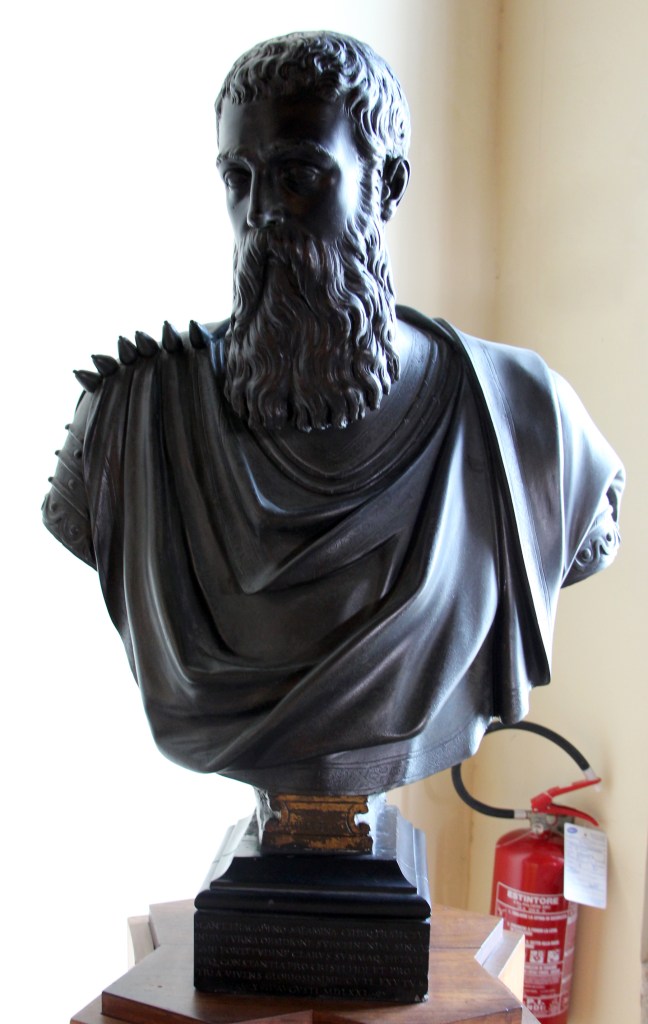
A bust depicting General Bragadin.
His torture did not stop there, however. After he collapsed, General Bragadin was tied to the mast of a ship in the Islamic fleet, and then raised and lowered repeatedly in and out of the water. Lastly, the general was brought to the town square, stripped naked, and tied up with his hands bound above his head. Then, he was slowly skinned alive from head to toe by the executioner. His flesh was stuffed like a doll and hoisted once again on the highest mast of the Muslim fleet and paraded around as a trophy. Word spread of the evil which laid waste to Cyprus, reaching all corners of the world of Christendom, and beckoning righteous souls to stand against the army of darkness marching upon their shores.
Light Shines Into the Dark
Word of the dark march of the Islamic empire was known long before the invasion of Cyprus. Pope Pius V had established the Holy League some months before in May. However, there was still much division among the world of Christendom. Despite the existential threat they faced, it was difficult to get people to work together in a coordinated effort. That changed for many when news of the horrors inflicted on the island nation of Cyprus spread.
Pope Pius V was instrumental in forming the Holy League which rose up to save the future of the free world at the Battle of Lepanto
One of the first to learn the fate of General Bragadin and Famagusta’s survivors was Don Juan of Austria, also known as “John” of Austria. At 22 years of age, he was given command of the entire joint fleet of the Holy League that was ordered to defend Italy and the Mediterranean Sea from the dark forces of the Ottomans. They were shocked to learn they would be arriving too late. Many under his command were also uncertain and hesitant about the effort entrusted to them. Christendom stood divided in their hearts from the Reformations, despite them all being together in that moment. However, once they learned of the evils which had transpired on Cyprus at the behest of the Muslim invaders, their shed their hesitations like a dead skin and stood renewed in their certainty of what they must do. It was up to them to stop the world from plunging into darkness, and them alone. If they failed, the world would fall, and evil, tyranny, slavery, and repression would spread to consume all the lands as the light was snuffed out from every corner of the Earth.
The Holy League was a joint force consisting of brave souls from Spain, Venice, Genoa, the Papal States, Savoy, Urbino, Tuscany, as well as from the Order of Saint Stephen, and the Knights of Malta. They all held different beliefs and generally did not work together following the massive division caused by the Reformation. It was rare to see them together, and certainly rare to see them on the same side of a coming battle. However, they all knew what was at stake for them and their children should they fail to come together on this day and find victory for their people. Hundreds of thousands of Christians had been abducted and forced into slavery at the hands of the Muslim forces. If the dark army was not stopped, it would spell doom for the whole world.
And so, the combined forces of the Holy League followed their young leader Don Juan straight into the belly of the beast with courage and bravery, against a foe which threatened to swallow the Earth. The whole joint fleet joined in prayer to God on their approach. They prayed for protection from the foe they were about to face and for the strength to overcome any threats to life, liberty, and the seeds of the free world.
The warriors of the Holy League prayed for divine before the Battle of Lepanto.
Shadow Recedes and Darkness Pushed Back
The joint Christian fleet arrived to find themselves outnumbered. About 200 ships of the Holy League carrying 60,000 souls faced down almost 300 Turkish vessels with over 84,000 Muslim swords. Naval combat at the time relied largely on attaching ships and engaging in melee combat, as ranged weapons were not yet so advanced. The Holy League approached the invaders in two lines, and the Turkish fleet prepared to fight for their claim in their signature crescent formation. Many of the ships of the Holy League sailed into battle emblazoned with a crucifix on their hull. The wooden cross on the flagship of the joint fleet, the La Real, remains on display in Barcelona to this day.
Don Juan took point with his ships at the front of the formation, alongside the large, heavily-armored ships with the new cannons which the Turkish forces likely had never seen before. The Knights of Malta were behind Don Juan’s attachment in reserve, with the Venetian ships on the left flank close to the shoreline and the Genoese fleet on the right. The sailed into the waters of the Mediterranean ready to liberate Cyprus and expel the darkness from their lands.
Ali Pasha was at the helm of the Muslim flagship, the Sultana. The windy conditions forced the Turkish fleet to sail forward in a straight line, disrupting their usual crescent formation. The Ottoman forces relied on felling clouds of arrows on their targets as they approached before closing the distance and initiating boarding action.
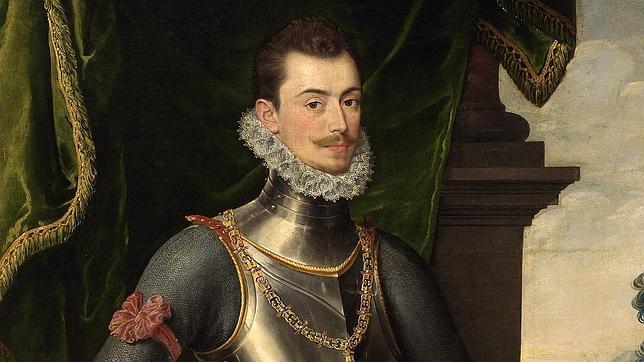
Don Juan of Austria was exceptionally young at the time of the battle at the age of 22, but he was as capable a commander as any.
The battle lasted for five hours as the outnumbered Holy League fought fiercely to break the lines of the dark empire. The long range cannons of the Christian forces wrought havoc on the Turkish fleet before they were close enough to engage with arrows, but eventually the gap was closed. Once in close, the early firearms of the Holy League and their broadside cannons continued to pepper and sink many of the enemy ships. Still, the Ottoman forces managed to unleash many clouds of arrows on the Christian fleet, leaving many of the brave vessels floating dead in the water. However, many warriors of the Holy League were equipped with the latest body armor designed to deflect bullets, which often repelled the wooden arrows of the Muslim forces.
Cannon fire broke the chains keeping many of the Christian slaves in place and rowing the Muslim ships while sitting in their own feces, urine, and blood. As a result, many of the slave rowers were freed and uprisings occurred on the Muslim ships. Meanwhile, the Christian ships were rowed by volunteers who knew what was at stake and gave the battle all their heart. The superior technology of the free market Christian forces gave them access to early firearms which wreaked havoc on the Muslim forces, which had not attracted as many entrepreneurs with their heavy emphasis on slavery and thus still relied entirely on bows and arrows. The freedom fighters of the Holy League may have been outnumbered, but they were by no means outgunned.
The battle raged on and the warriors of Christianity wore down the Turkish slavers with their superior technology and hearts burning with the fire of courage. They suffered heavy losses due to the overwhelming numbers of the Muslim invaders, but eventually the slave-driven fleet of the Ottoman Empire faltered to the forces of light who would later give birth to the free world. The battle reportedly ended after the third attempt to board the Sultana was successful, Ali Pasha was beheaded, and his head mounted on a pike atop the Muslim flagship. The darkness faded and the shadow was forced to retreat as the spirt of the invaders was broken. With the lines of evil shattered, the seas were saved and light returned to the lands. It would seem the prayers of the Holy League were answered, and good triumphed over evil once again.
A Lasting Legacy
The Battle of Lepanto stands tall in human history as one of the great clashes between good versus evil, freedom versus slavery, and liberty versus tyranny. The Turkish slavers of the Ottoman Empire were sent reeling back into the abyss from whence they came by the freedom fighters of the Holy League. The light had prevailed once more over the forces of darkness, and the world was spared from an age of oppression which would have stifled the growth of liberty for centuries more. With the defeat of the darkness at the Battle of Lepanto, the oppressive Muslim expansion was halted and never again took shape in the form of a major military offensive. The division among Islam led to more focus on infighting rather than expansion, and the free world was allowed to be born and to flourish.
The crucifix of the Holy League flagship stands in Barcelona to this day.
To me, the Battle of Lepanto embodies the importance of putting aside our differences and standing together against existential threats to freedom, liberty, and the prosperity of good over evil. During those times, many in the world of Christendom preferred to have peace with the Ottoman Empire in spite of the raids and slavery because it was profitable. Peace is a noble goal, but its pursuit can reach a point where refusing to fight becomes detrimental. When that point is reached, it is critical to put aside our profits and our differences to pick up a sword and slay the forces of evil amassing at our door. That is what the Holy League understood, and it is a timeless lesson to be retaught across the ages.
What do you think of the Battle of Lepanto? Have you ever heard of it before? This is hardly a comprehensive retelling of those events. I would encourage everyone to read more of the world during that time. There are many parallels to the challenges faced today.
Recently, I have been reading more about historical knights and their great deeds. This month of October, I also found there to be several important historical events involving knights and other prominent warriors of Christendom. This month marks the 450th anniversary of the Battle of Lepanto on October 7, 1571. Yesterday was also the 1289th anniversary of the Battle of Tours on October 10, 732. This month, I will write a series of blog posts focusing on the history of prominent knights, other Christian warriors, and historical battles important to them. I would like to begin with Hugues de Payens, the founder of the Order of the Knights Templar.
The Birth of a Legend
Hugues de Payens, also known as “Hugh de Payens,” was a French nobleman who became a knight and formed the Order of the Knights Templar, eventually taking the title of the first Grand Master of the Knights Templar as the Order expanded. He was born around the year 1070. Exactly when and where he was born is unknown, but he is believed to have been born in either Champagne or Burgundy, France.
An artist rendition of Hugues de Payens.
Hugues is said to have fought in the First Crusade to capture Jerusalem after it had been lost long ago. It is uncertain if this was before or after he married a woman named Catherine Saint Clair and fathered three sons with her. However, sometime after the death of his wife, Hugues gave up all that he owed and swore himself to a life in service of God. He had seen many Christian pilgrims being attacked on their way to worship at sites across the Holy Land from his time serving in Jerusalem during the occupation. Disheartened by these attacks on innocent civilians, he decided to devote himself to protecting the pilgrims who would not or could not defend themselves.
However, this was not a task he could accomplish on his own. As skilled of a warrior as he may have been – and by all accounts, he was a renowned fighter in his day – Hugues knew he was just on man, and one man could quickly be overwhelmed by a group of trained attackers. As such, he would need a team of men he could rely upon to accomplish this task. Fortunately, he knew of others who were willing to take up the cause. The original nine members of the Knights Templar were Hugues de Payens himself, Godefroy de Saint-Omer, André de Montbard, Hugues I, Geoffroi Bisol, Archambaud de St. Amand, Payen de Montdidier, Rossal, and Gondemar. We will explore the origins and what is known on each of these knights at a later date.
Hugues de Payens went to the patriarch of Jeruselum – the head of the church at the time – and swore himself to a life of poverty, obedience, and chastity. He would own nothing, seek nothing, and live only to serve God and protect His innocent followers from harm. He asked only for support in the form of the means to carry out this mission. Moved by Hugues de Payens and his plea, the nine were granted the authority to escort pilgrims arriving from the port of Jaffa to the city of Jeruselum where they would visit different sites around the Holy Land including the Holy Sepulchre, Bethlehem, and the Jordan River. The countryside was dangerous and full of Islamic marauders hunting Christian pilgrims, but Hugues de Payens and his men were effective at chasing them off and saving many lives.
Humble Beginnings
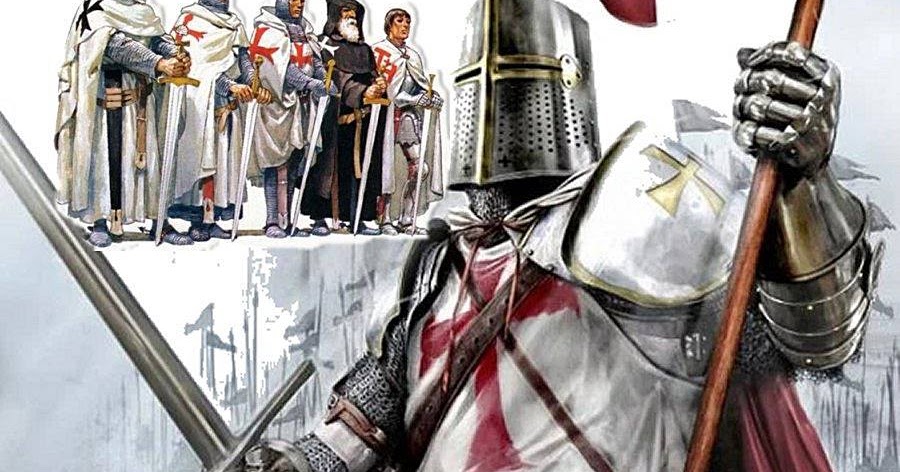
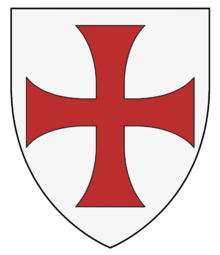
Originally, the Knights Templar were a truly impoverished order. With their original nine members, it is said they could only afford one horse for Hugues de Payens and Godefroy de Saint-Omer to share. In fact, they had an official seal which showed two knights riding one horse because of this. However, the Order eventually grew in prominence due to word of their success traveling far, spread by the lips of many grateful pilgrims who had been spared death by the courage of the knights. They were granted a house, funding, and support to grow the Order. The red cross on a white shirt became a recognizable symbol across space and time from the heroic deeds of the Knights Templar.
The simple coat of arms of the Knights Templar includes a red cross on a white background.
Hugues de Payens himself became an accomplished knight whose legacy ripples across the ages. He studied the Quran and learned about Muslim languages, customs, and values. At first, he did so to better understand the enemy he faced, but in time, these studies helped him to become a wise diplomat capable of negotiating peace with the Islamic forces and avoiding bloodshed in some situations. The true embodiment of a knight, he was skilled both in making war and forging peace. Many lives were spared due to the efforts of Hugues de Payens.
The Knights Templar eventually gained in prominence to the point where they were officially recognized by the Pope, Honorius II. Hugues de Payens and several other Knights Templar traveled from Jerusalem to Rome for this honor. They were put into official records as an order of warrior monks in the service of God and all of Christendom. They were also granted the Temple of Solomon as their official station. Hugues de Payens traveled across Europe looking for support and establishing other stations in many countries.
A Life Well Lived
Hugues died in 1136 at the age of 66. By that time, the Order of the Knights Templar was well-established as an official fighting force of fearsome protectors who went on to carry the legacy Hugues de Payens had dedicated his life to building. Eventually, the Order strayed into a role of international banking, perhaps after becoming so large and wealthy that they lost sight of their founding vision of a life of poverty, chastity, and obedience to God. Fortunately, Hugues de Payens did not live to see this change and the ultimate demise of the Knights Templar in the 14th Century.
Despite the ultimate fate of the Order, Hugues de Payens created an enduring legacy through the timeless legends of the heroic deeds performed by the Knights Templad in its early days. Through his determination, skill, and life of service, Hugues de Payens serves as a timeless beacon of inspiration echoing throughout human history. What he built and what he accomplished are a testament to what humans can achieve when they dedicate themselves fully to so noble a cause.
A statue of Hugues de Payens in Dijon, France.
What do you think of Hugues de Payens and his story? What about the other original nine members of the Order of the Knights Templar? Are there any other knights you would like to see mentioned here? Feel free to share you thoughts, and please, share this post with others who may enjoy it.
This weekend was the anniversary of the Texas Revolution in 1835. This armed conflict is also known as the “Texas War of Independence.” It was a brief dispute in which the Republic of Texas rebelled against the government of Mexico. The notorious “Gonzales Flag” was born out of this conflict and inspired many reimagined versions across time and space, as we have discussed before on this blog. The war concluded in April of 1836 with Texan independence.
While the rebellion is stated to have occurred between 1835-1836, conflict occurred between the people of Texas and the government of Mexico stretching back as early as 1826. The tensions which led to the conflict can also be said to have begun in between the years of 1815-1821 as Spanish rule of the area was ending and American settlers were moving onto the land. In fact, the Battle of Velasco on June 26, 1832 is considered to have been a major Texan victory during the Texas War of Independence. In an attempt to stop further American immigration, the Mexican government sent troops and officials to enforce tariffs meant to stop more migration. This culminated in a pitched battle where the Mexican Army was forced to retreat from many of its garrisons in Texas, marking a major victory for the Texan rebels in the war.
Even though earlier battles occurred, many sources report the war officially began with the Battle of Gonzalez in 1835. This is perhaps due to the iconic nature of that particular confrontation. After Santa Anna was declared leader of Mexico, he eventually decided on a policy of confiscating weapons to try and minimize the risk of rebellion, so perhaps it is the great irony of that policy which motivates 1835 as the start date. No matter the reason, the Battle of Gonzalez is famous for the dramatic manner in which the rebels refused to relinquish the cannon they had been requisitioned by the Mexican government. The ensuing events are historic in their own right.
The Gonzales Flag of 1835 is perhaps the most iconic artifact of the Texas Revolution
When the Mexican government sent forces to retrieve the weapon, which they did in fact lend out to the city of Gonzales, a long, drawn out debate occurred in which the rebels sought to buy time to prepare for the inevitable attempt to confiscate the cannon by force. After all, the Texans had no intention of giving it up, as it was necessary for the town’s defense; and the rebels were fairly certain the Mexican government was not trying to retrieve a single cannon out of logistical need. They knew the Mexican government was attempting gun confiscation, and they prepared accordingly. The bombastic and epic manner in which they did so, however; with the timeless flag and the reported declaration: “come and take it,” the October 2, 1835 official start date of the Texas Revolution is inspiring to peoples across the world to this day of the importance of noncompliance with gun confiscation. The Battle of Gonzales will also no doubt live on across time with the many flags it has inspired across years.
Have you ever visited the state of Texas or seen a Gonzales Flag before? Also, do you think the official start date of the Texas Revolution should be pushed back to account for earlier battles? Why do you think the Battle of Gonzales is recognized as the official start of the rebellion?
As many of you may know, the Star Spangled Banner was written on September 14, 1814 by Francis Scott Key. September has an eventful month in human history with many prominent occasions to note. It can difficult to decide for which to account on a weekly basis. Yet, I still wished to write something about the War of 1812 or Francis Scott Key before September’s end. This haiku series was one I produced while pondering the motivations for the War of 1812 and the course it took.
Tensions flaring high Bitter resentment abound Conflict is brewing
Honor under threat Petty disputes festering Life disrespected
Souls taken adrift Stolen by the enemy Madness rules the sea
The War of 1812 was sparked by trade and territorial disputes between the United States and the British Empire; the impressment of American seamen who were captured and forced to work on British ships; and British influence on the Native Americans to fight against the American colonists.
Battle lines are drawn One shot will set them ablaze Peace is to be lost
The world in peril An empire on the march All to be undone
Once more into fire Freedom threatened once again Liberty at risk
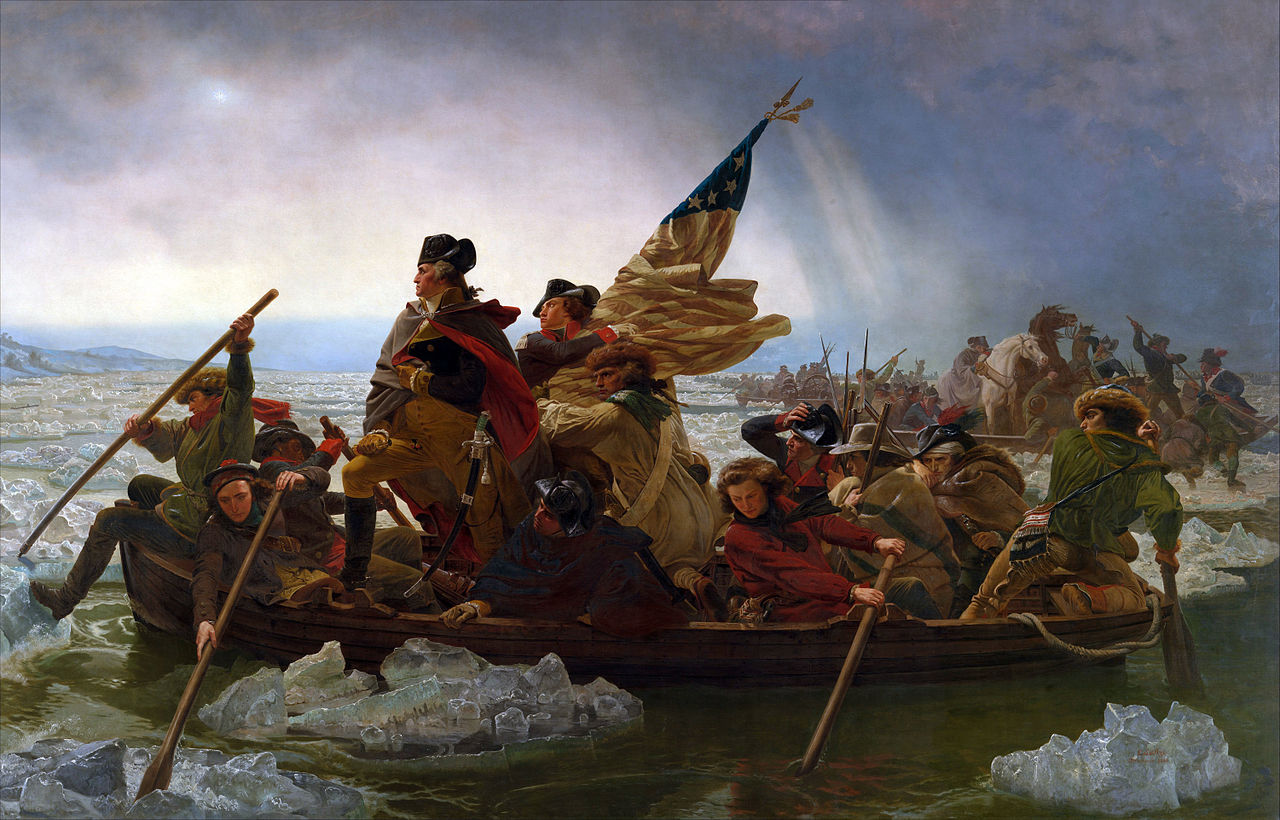
The Americans suffered many devastating defeats at the hands of the British in the War of 1812, as the British were able to conclude their hostilities with the French and focus their attention fully on the United States.
Losses unmeasured A fate brought upon ourselves Darkness we conjured
Yet hope always looms Victory is never far A path forged in strength
The goals unattained Dust settles where it first flew Nothing changed for good
After the war, none of the goals set forth were achieved. British impressment and Native American hostilities continued. Territorial lines were not changed. However, the war did prove to many for the first time, including the Americans themselves, that United States was ready to fight and defend its people, territory, and honor on the global stage against hard-hitting giants.
Peace returns once more The fury of war subsides A new era comes
On September 17, 1787, the Founding Fathers of the United States signed the U.S. Constitution. The holiday was originally “I Am an American Day” and was observed on the third Sunday in May, first established as a federal holiday in 1940. Twelve years later in 1952, it was changed to September 17 and renamed “Constitution Day” to coincide with the day the U.S. Constitution was originally signed. More recently, the holiday was again renamed in 2004 to “Constitution Day and Citizenship Day.”
We remember this day by reading and studying the U.S. Constitution and pondering its meaning. In reading its words, we learn the profoundness of the timeless wisdom contained within. This revolutionary document was produced by those who had studied the errors of governmental design throughout human history and sought to establish a new form of government which rectified many of the past issues. The separation of powers between three branches of government was ingenious, combining the strengths of different systems and balancing out the weaknesses. The Founding Fathers devised a system of constitutional republicanism which sought to have representative government without falling into the same traps presented by the tyranny of the majority which are the downfall of democracies.
The full text of the U.S. Constitution can be read here. It first describes the system of government, various responsibilities, and how to carry them out. The necessary requirements of adding amendments to the document are also detailed. Then, the various amendments which have been added are listed. These describe the restrictions placed upon a just government which has the support of the people. Failing to abide by these amendments by making laws or taking actions which contradict them is akin to forfeiting the right to govern, and necessitate that government officials guilty of enacting such laws or engaging in such actions be removed.
Of particular importance in the U.S. Constitution are the First Amendment and the Second Amendment. The First Amendment states: “Congress shall make no law respecting an establishment of religion, or prohibiting the free exercise thereof; or abridging the freedom of speech, or of the press; or the right of the people peaceably to assemble, and to petition the Government for a redress of grievances.” The Second Amendment states: “A well regulated Militia, being necessary to the security of a free State, the right of the people to keep and bear Arms, shall not be infringed.” These two amendments being first and second is significant, as the Founding Fathers understood that conventional weapons are the enforcement mechanism of civil liberties, and freedom of speech would be pointless to those unprepared to defend it. As the saying goes, “the Second protects the First.”
Looking back throughout history, I find I certainly cannot deny the truth of this wisdom. That is why I am proud to have trained with and carried a weapon from a young age, starting with learning how to use a knife and my bare hands when I was a child, to learning how to use and carry a gun responsibly now. I love learning about weapons and how to use them, both practical applications for the modern era; and historical weapons no longer in common use. Being armed and responsible is one way we can all make society a safer place and honor the wisdom granted to us by those who came before.
I hope everyone has a great weekend, and happy Constitution Day! If you have the time, I would recommend taking a minute to read through the U.S. Constitution, whether you are an American or not. What do the words mean to you? What lessons can be learned? What are the most important parts? Feel free to share your thoughts.
As I saw so many posts remembering the loss and the sacrifice that characterize our collective memories of the September 11 terrorist attacks, I was prompted to ponder the national response and massive relief effort which took place in the wake of the attacks.
For those unfamiliar with the context, on September 11, 2001, a group of militants from the Islamic extremist group known as al Qaeda launched a series of suicide attacks against targets in the United States by hijacking airplanes and flying them into buildings. The targets were the World Trade Center, the Pentagon, and the White House. The plane intended to target the White House was retaken by the passengers and crashed in Shanksville, Pennsylvania. The other hijacked planes were successful in hitting their targets. Approximately 3,000 casualties were suffered from the attacks.
Many eyes were fixed on the Twin Towers of the WTC after the attack began.
A recovery effort ensued immediately following the attacks which persisted for many months around the area where the World Trade Center used to be, an area referred to as “Ground Zero” or “The Pile.” Many local first responders were killed when the buildings collapsed on them as they attempted to facilitate an evacuation. The following day, a small army of volunteers from around the nation converged on Ground Zero to begin clearing debris and searching for survivors. Emergency responders and construction companies brought in equipment to move the heavy debris and “bucket brigades” of humans moved small pieces rock-by-rock, stone-by-stone to clear the rubble. Churches and other humanitarian organizations assisted by bringing food and medical supplies for the emergency workers and survivors pulled from the site.
By early October, the mission at Ground Zero shifted from rescue and recovery to just recovery. In mid December, the fires which had been ongoing for months were finally declared extinguished. Cleanup and recovery continued for many more months as the operation was downsized with progress being made. Many areas and services gradually reopened and the safely-accessible areas at Ground Zero expanded. Recovery operations formally concluded on May 30 the following year.
The affected area became referred to as “Ground Zero” after the attack.
The collective effort of the United States and the American people to rapidly rise up and recover from the attack while rescuing survivors reminds me of the value of a nation and why I am grateful to be part of one. As I understand, a nation is a collection of people who share a common history, value system, and moral framework who, together, are more than they are alone. While any one of those people involved in the rescue and recovery effort would not have been able to make much of a difference by themselves, working together as a team – as a nation – they were able to pool their knowledge, resources, and willpower to orchestrate a massive relief effort which saw life in the area largely return to normal in less than a year. The unity displayed by those who responded to the terror attacks serves as an inspiration to all of us across time and space about the importance of standing together in time of need. United by a common vision, the nation extols the value of teamwork and cooperation.
While spoken in a very different context, I find myself reminded of Benjamin Franklin’s comments on July 2, 1776 when the Continental Congress agreed upon the Declaration of Independence. He said: “We must hang together or surely we shall hang separately.” When blessed with a nation, the people are able to coordinate a massive amount of effort and resources toward achieving strategic goals too grand for a few souls to muster, let alone for one on their own. No matter how brave or how strong we are, we can surely achieve more as a team than we do operating alone. Hence the common saying, “there is no ‘I’ in ‘team.'”
Many emergency responders and volunteers who were local to the area and from around the nation were brought together to help recover from the attacks.
That is not to say some tasks are not better suited for a lone operator. Surely there are. Also, a team is only as strong as its weakest link. A nation which champions individual liberties is strongest of all by building a team of robust members. A nation which neglects the rights of the individual is no nation at all, but a horde of mindless husks which think not for themselves, completely at the whims of the hive. This is why the greatest nation which can ever be achieved is the one which is built up by a group of people who protect first and foremost the virtue of individualism, while still retaining the ability to work as a team.
I am inspired by the legacy created by the Founding Fathers of the United States and the wealth of literature they have left behind to guide us. It is amazing to see how far we have come and what we can accomplish when we unify behind a common goal. I know we face many challenges ahead, both from Nature and from our fellow Man. Threats to freedom and liberty shall assail us until the end of time, both from without and within. Yet by staying true to the principles which shaped the nation during its founding, I believe we can overcome any trial and best any foe.
The “Tribute in Light” to the Twin Towers displayed on September 11 from dusk till dawn.
Just as those who rushed into the fires of uncertainty on September 11 stood together as one in their endeavor to preserve life and heal the nation, I do believe that we today can and must exemplify the same excellence in moral character wherever we are by holding true to the ties that bind us together as one people and one nation. There is no darkness too great and no evil too strong. Where there is a will, there is a way. Some tests may break us down, but we have the power within ourselves to stand back up after a thousand falls and rise again stronger than ever.
For my part, I am honored to take this day to remember those who perished on September 11, 2001 and those who spent months toiling away to save others, repair the damage, and restore life to the nation. Most honorable are those who charged into the storm and gave their lives so that others may live. Most cherished are their souls among the halls of the dead. While they fell, their memory lives on forever and inspires us all to live our lives in such a manner worthy of their sacrifice. May the fallen be at peace, and the survivors find theirs.
This weekend was the 244th anniversary of the first time the American Flag was flown in battle. On September 3, 1777 the red, white, and blue banner with thirteen stars and thirteen stripes was first flown during the Battle of Cooch’s Bride in Delaware. Under the command of General William Maxwell, Continental forces raised the flag for the first time in history as the rallying point of where to meet British and Hessian troops in battle. They were defeated, however, and forced to retreat to Pennsylvania. It has flown on many occasions and in many battles since then, by both Americans and many other peoples around the world.
Betsy Ross presenting the first red, white, and blue American Flag to George Washington.
Flying in the wind Rallying us to our goal By our flag we stand
A strength that binds us Stars and stripes. Red, white and blue Together as one
U.S. Marines with the American Flag in Iwo Jima during WWII.
Against cold and rain Against trials evermore Nothing in our way
Guiding light and force To never lead us astray As long as we know
Charles Conrad Jr. next to the American Flag on the moon during Apollo 12.
Know what we must know To follow on the right path And find our way home
To find liberty To do not just as we please To do as we ought
Pro-democracy protestors in Hong Kong waving American Flags during the communist takeover.
On the quest for peace Darkness rising around us We prepare to fight
It is inspiring to see the journey the American Flag has taken throughout its long history, and will no doubt be just as interesting to see where it goes from here. What is your favorite image of the American Flag? I think the most interesting instances of its flight are when people who are not American citizens choose to fly the flag as a symbol to try and inspire others.
The Monomyth is a 17-step guide for creating a story, separated into three acts. It was first defined as such by Joseph Campbell, and later refined into the 12-step Hero’s Journey by Christopher Vogler. However, this formula was not something created by Joseph Campbell or any other individual. Rather, it would be more accurate to say that Campbell discovered stories from across human history tended to follow the structure of what he defined as the “Monomyth.” Most epic tales which engender awe and wonder in humans across time and space have followed closely this timeless structure. From the stories of Osiris to Prometheus; to Jesus and Buddha, the Monomyth is an integral part of Humanity and the tales we tell to inspire one another.
The Monomyth described by an infographic.
The Monomyth or the simplified Hero’s Journey can be a useful tool for aspiring and accomplished writers alike. Whether you are wondering where to start, or are stuck on where to go next, the formula has guided writers for millennia. We will go over each of the steps to the Monomyth and explain what they all entail briefly. While we do, something important to remember is that the Monomyth is not a hard requirement for making a good story. In fact, sticking to such a method so strictly can make our stories homogenous and less interesting as a result. Instead, the Monomyth should be taken as a guide to thinking about good stories, something which motivates and inspires us to come up with unique plotlines and characters of our own.
The 17 Steps of the Monomyth
The Departure
The Call to Adventure
Refusal of the Call
Supernatural Aid
The Crossing of the First Threshold
Belly of the Whale
The Initiation
The Road of Trials
The Meeting with the Goddess
Woman as the Temptress
Atonement with the Father
Apotheosis
The Ultimate Boon
The Return
Refusal of the Return
The Magic Flight
Rescue from Without
The Crossing of the Return Threshold
Master of the Two Worlds
Freedom to Live
The Call to Adventure: the hero starts the story off in a normal and mundane place where something beckons them to start their journey.
Refusal of the Call: for one reason or another – be it fear, duty, or uncertainty – the hero initially refuses to heed the call to adventure.
Supernatural Aid: the hero receives some kind of aid which is outside the boundaries of what they would consider to be “normal,” whether it be a person to guide them; a weapon to use; or some kind of knowledge/power.
The Crossing of the First Threshold: the hero sets out on their adventure in earnest, leaving the mundane world of their beginning for a new and dangerous setting.
Belly of the Whale: the hero is separated forever from the world of their beginning, either because it has been destroyed or forever changed; they have undergone some metamorphosis or permanent change themselves; or because duty demands they keep pressing forward.
TheRoad of Trials: the hero undergoes a series of tests, some of which they fail; and which change them from the normal, mundane individual they were in their humble beginnings into the hero they are meant to be.
The Meeting with the Goddess: the hero experiences some kind of all-encompassing, unconditional power which is akin to that of a mother’s love.
Woman as the Temptress: the hero is tempted to abandon the journey for some material gain.
Atonement with the Father: the hero must confront the object of power which holds influence over their life, which is often represented by an estranged father who must be reconciled with.
Apotheosis: the hero conquers their fears and is reborn. This may be represented by a spiritual rebirth, or the hero may physically die and be reborn in a new form.
The Ultimate Boon: the hero accomplishes their goal or receives that which they embarked upon their journey to receive. This conveys great power, wisdom, or ability upon them which they can use to further shape the world.
Refusal of the Return: after having found enlightenment, the hero may hesitate to return the world where they came from in order to impart new wisdom onto others, desiring to isolate themselves or stay in the new world.
The Magic Flight: the hero must escape with the ultimate boon, pursued by danger and threats which seek to stop them from bringing enlightenment to the world from whence they came.
Rescue from Without: the hero receives assistance in returning to the everyday world to bring the boon to others.
The Crossing of the Return Threshold: the hero returns to the world of their everyday life with their boon and shares their new wisdom, knowledge, and enlightenment with others of their world.
Master of the Two Worlds: the hero achieves balance between the spiritual and material world.
Freedom to Live: the hero is free from regret and worry. They have learned how to “live in the moment,” without concerning themselves of the past or future.
Applying the Monomyth
As mentioned, one should caution against sticking too stringently to the Monomyth when crafting a narrative. Indeed, if you analyze any great epic which follows the Monomyth and possesses all of its elements, you will notice that much else happens in the story which exists outside the 17 prescribed steps. This is because all great epics are said to possess these elements, but they are not directly molded by them. For example, the original Star Wars trilogy and the story of Luke Skywalker becoming a Jedi is often reviewed as an example of the Monomyth or Hero’s Journey. However, much happens in the story which is not part of the 17 steps, even though all of the 17 steps are included. The story shows what is happening with other characters and events when Luke Skywalker is not on screen, and there are many instances which flesh out Luke’s story which do not neatly fit into any of the specific steps of the Monomyth. This is because his story is its own, unique story.
The original story of Luke Skywalker is often cited as a contemporary example of the Monomyth or “Hero’s Journey.”
And your story needs to be unique too. All our stories do, because all our stories are unique in real life. If every story followed a standardized formula, using the 17-step Monomyth as a “fill-in-the-blank” format for a 17-point plotline, every story would be exactly the same. There would be no variety in storytelling. No unique and compelling narratives which reinvent ideas and make us think of old concepts in new ways we never considered before. Part of what makes great stories so great is their uniqueness from stories which came before. As such, I would recommend keeping the Monomyth in mind when outlining a story, but not sticking to it strictly. Instead, one can review their story outline after it has a beginning, middle, and end. You can compare the finished outline to the Monomyth to ensure all the elements are present without limiting yourself by copying the Monomyth into an outline directly.
Have you ever heard of the Monomyth? What are your thoughts on the elements described in it? Also, how would you propose using the Monomyth as a tool to write great stories without falling into the trap of using it as a standardized method which could stifle creativity and uniqueness?
Here is my first attempt at a new form of poetry I have never written before: a dramatic monologue/soliloquy. I wrote it while contemplating the common phrase “the night is always darkest before the dawn.” Please enjoy!
The night is darkest before the dawn, as I am so often told. Walking through the halls of doom, a specter of dread looming over my shoulder at every turn. The dawn a light at the end of a sinister path, with no way back, and but one leading forward. A look behind or left to right brings only terror and emptiness. Peering into the shadow, it pierces the soul and slows the step.
Sometimes the end of a dark path seems ever out of reach.
Only striving toward the luminous glow brings hope, yet even that seems fleeting. The tendrils of the void closing in and gripping my mind. A twisted force spreading as light seems to recede. To reach dawn’s embrace as it recedes from the encroaching shadow, one must run to catch it. As the light recedes, all we can do to escape the darkness is to forever resist.
Walls closing in around me. An overwhelming force bearing down on my will, threatening to force me to my knees. All my strength conjured in every step. I battle with demons, pace-by-pace just to keep myself from stopping. The light calls to me, but the dark touches my core and drags me back. The beacon ahead a distant reminder of what is at stake and what lies ahead, yet the shadow an ever-present companion which trips me and turns me astray at every opportunity.
In the darkest of hours, stress can seem to take shape like a dark hand holding us back.
But darkness holds not forever to those who press ever onward. Yearning, striving toward the light with unwavering commitment and persistence. The night is darkest before the dawn, and the dawn shall come to those who do not falter. Its warm rays pressing on my face to comfort me as cold lashes tear into my back. I taste the blood and sweat pooling in my mouth as the light heals my frozen numbness, if only for a moment.
My body aches with burning cold scars, the pain I was apathetic to now returning as life and warmth refill my mind, body, and soul. I stumble forth into the sanctuary of the light. All the terrors of the dark recede and peace falls back upon the world. A stillness comes to preside over my mind and with it the clarity of calm. Looking back, I understand the path which led me here and push on further still.
A flicker of hope on the darkest night can light the path to victory.
Strength returns as darkness falls. The light pierces into shadow with the might of a thousand suns and vanquishes the last vestige of agony plaguing my weary soul. The night is darkest before the dawn, they say. Indeed, and the dawn breaks upon the darkness at the end of every night, picking us up to reach new heights. I feel stronger than the day before, for the cold lashes of the night pushed me toward the light I would have never otherwise reached.
Basking in the warm caress after having escaped the cold embrace of the darkness, my body reinvigorates and grows to new strengths not before imagined. I turn and face the encroaching shadow, now with the light at my back. Other souls inch forward, pulled back by the cold lashes whipping and grasping at their backs. With the warm push of the light guiding me forward with the fire and fury of a burning star, I rush forth into the darkness once more. The light steadies me now to reach out to others and bring them forth into the dawn as darkness fades and the shadow recoils back to the abyss.
One of the best things about overcoming our own demons is helping others do the same.