The First World War was a major conflict for control of the European continent between the Central Powers of Germany and Austria-Hungary and the Allied Powers of France, Britain, and Russia. Many other countries came into the fold on one side or the other until most of the world was involved, and nearly the entire global economy became mobilized for the war effort. Beginning in July of 1914, many thought the war would be over before Christmas, although as the fighting dragged on it quickly became apparent this would not be the case. The opposing forces had fought each other to a standstill by that time with no end in sight. Trenches had formed along the Western Front of the conflict which turned to mud and frost with incessant rain giving way to frost with the cold of winter closing in.
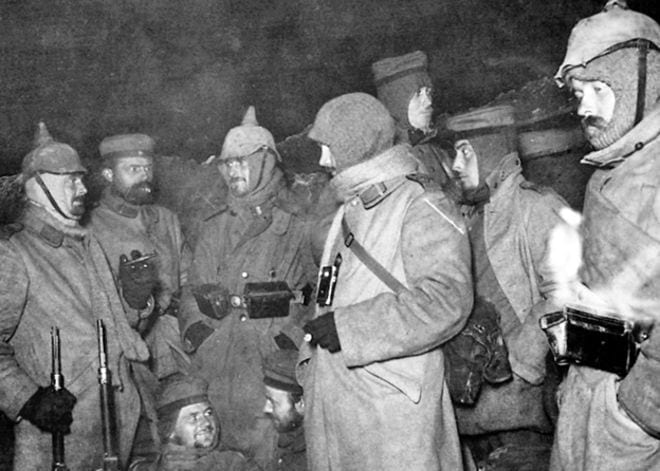
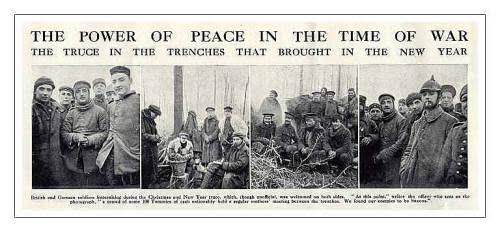
The Christmas Truce of 1914 was not sanctioned by the leadership of either side, but was brokered by low-ranking officers in the trenches.
Nevertheless, the spirit of Christmas prevailed when December rolled around after months of constant fighting had made the troops eager for respite. Leading up to the great Christmas Truce, Pope Benedict XI called for a ceasefire on Christmas, requesting “that the guns may fall silent at least upon the night the angels sang.” While the British and German leadership had no interest in peace at this time, word spread of the call nonetheless. Perhaps it was this, or perhaps the spirit of Christmas weighed heavily on the fires of war and kept them still for a time. The German emperor, William II sent Christmas trees to the Western Front to try and bolster German morale, and the German soldiers set the trees up along the trenches. Christmas carols were also being sung on Christmas Eve by the soldiers, and warriors from both sides soon began to sing along together to classic hymns including Silent Night, known as “Stille Nacht” in German. Friendly exchanges occurred throughout the night with the two sides exchanging good tidings and wishes of “Merry Christmas.”
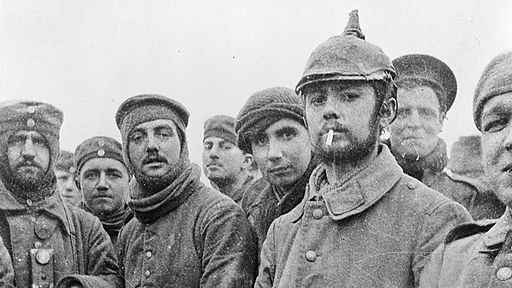
The British and German soldiers who participated in the Christmas Truce exchanged cigarettes and other small items as Christmas gifts.
Dawn Breaks On Christmas Morn
That night, orders began circulating among the British troops to “live and let live,” meaning to not fire unless fired upon. The orders from the top on both sides were to continue fighting, and most did. However, as the sun rose on Christmas Day, it is said German soldiers along portions of the Western Front stepped out onto No Man’s Land with hands raised repeating the words “Merry Christmas” in the English language. The British at first thought it a rouse and readied weapons, but did not fire, waiting for the Germans to fire the first shot. Some shootings did occur, but the Germans did not return fire. They continued on with their hands raised as they were shot down. Eventually, the British troops realized it was not a ploy, and soldiers from both sides emerged from the trenches to meet the other side on Christmas morn.
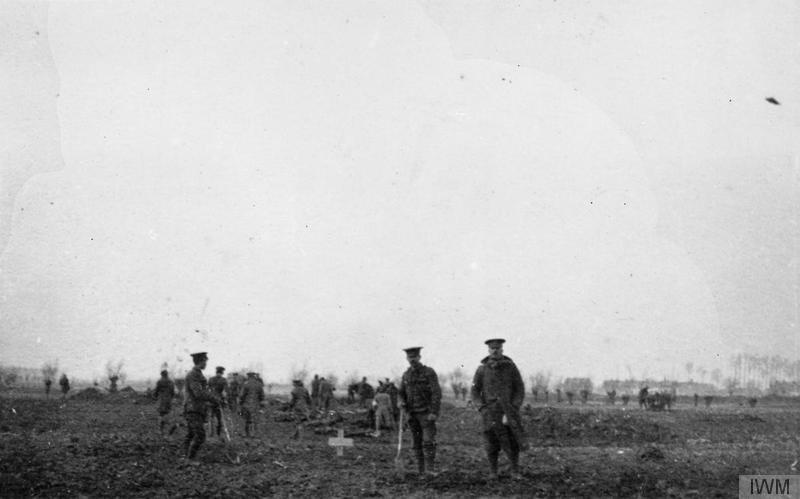
The German and British warriors set up Christmas trees and crosses across No Man’s Land, symbols of hope, love, and peace used to celebrate Christmas, the day used to celebrate the birth of Jesus Christ.
The British and German troops who observed the ceasefire exchanged gifts and sang songs together. Some took the cessation of hostilities to gather the dead from No Man’s Land and fortify their positions. A still moment of peace descended over the field of death that many described as eerie and strange, yet wonderful and marvelous at the same time. The Christmas trees were brought up and lit with candles, and the two forces even played a friendly game of football (soccer). Reportedly, the French did not participate in the ceasefire due to much animosity from earlier offensives into French territory, and the Russians along the Eastern Front saw no such truce as they were using a different calendar with Christmas happening at a later time. The truce persisted in some areas until the new year, at which point all hostilities resumed.
Many did not initially believe the Christmas Truce of 1914 occurred, as it was heavily censored and considered unfavorable by the German and British leadership, yet photos were taken and began to circulate.
Word Spreads of Startling Peace
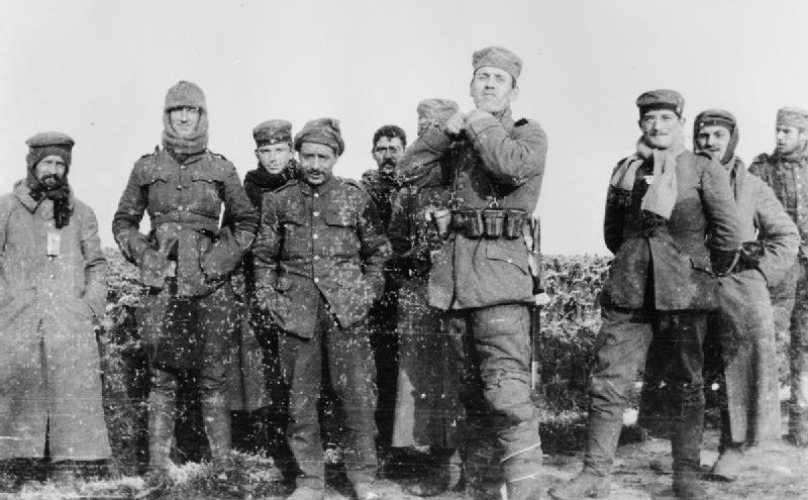
The Christmas Truce of 1914 is said to be the last recorded instance of chivalry on the battlefield between warriors. British and German soldiers wrote about the truce in letters to home before censorship of communications was implemented. Word began to spread and was met with much disbelief. On both sides, the media portrayed the other as bloodthirsty demons who one would scarcely believe might stop fighting for the sake of Christmas. Yet word of the miraculous ceasefire continued to spread, much to the dismay of military leaders who feared it might affect the will of their soldiers to continue to fight. For some time, the Christmas Truce of 1914 was treated as a myth or legend rather than a historical event, and its occurrence was disputed. After the war, it became a more widely accepted fact the ceasefire did occur, no doubt due to the circulation of photographic evidence from that day.
Images of the Christmas Truce began to spread, in spite of widespread disbelief and censorship efforts.
With technological advances in firearms, ballistics, and explosives, chivalry eventually faded away from the battlefield as distance was created between warriors and battles protracted from brief bouts of intense melee to endless scourges of attrition. With larger economies and bigger guns brought into play, war became more and more vicious, prolonged, and desperate than ever. The First World War was one of the last major conflicts where chivalry could have been possible, and even then, it was not widely observed. The great Christmas Truce of 1914 was only possible due to the close proximity of fighting forces and the initiative of low-ranking officers to broker their own unofficial ceasefire in defiance of orders from their superiors. It was also a shocking moment which defied all expectations. The Christmas Truce was never repeated, and remains an anomaly to this day.
A Lesson for the Ages
The Christmas Truce of 1914 is a dark, yet heartwarming tale. In the midst of the fire and ice of a wintery battlefield, two groups of warriors which had been driven to hate one another down to their cores by the media they each received demonizing the other side managed to find some peace and solace, not just on their own, but together on that holy day we know as Christmas. It is a surprising and touching moment in human history that sheds a ray of hope into even the bleakest of ponderings. To me, it serves as a reminder of how important it is to set aside any trifles one might have with another when Christmas time comes around. For whatever conflicts we may find ourselves broiled in, Christmas is not a time for war or strife. As much as our nature may push us to dig in our heals, Christmas is a time for us to lay down the sword and share a moment of peace with the people around us.
The month of December is host to many great tales. Some of heroism and bravery, others of self-sacrifice and generosity, and some tell of unsuspecting peace and tranquility. This is a special time for many when magic is in the air and the impossible is made possible. The Battle of Trenton in December of 1776 is one such tale to be told where a daring group of rebels trekked across frozen wastes into a storm of ice and fire, yet still took the day despite all the wailings of the world seemingly against them.
Sailing the Frozen River
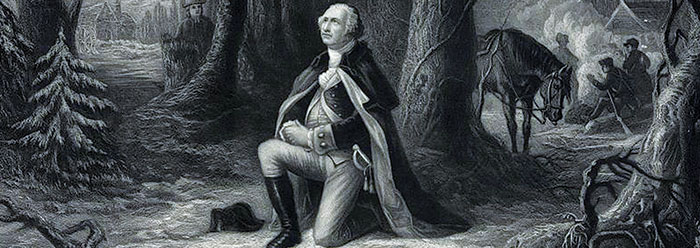
The Continental Army under George Washington was often plagued with low morale. Few scarcely believed they could defeat the British Empire, and yet they fought nonetheless for they knew in their heart of hearts it was a stand worth taking. Washington had brought together both boys and men from different state militias with enlisted Continental troops. They were to set out across the icy river of the Delaware under cover of storm and march almost 10 miles through the snow to attack the Hessian mercenaries at Trenton. It was a plan so perilous it seemed doomed to fail. As such, the enemy was ill prepared when the Americans arrived.
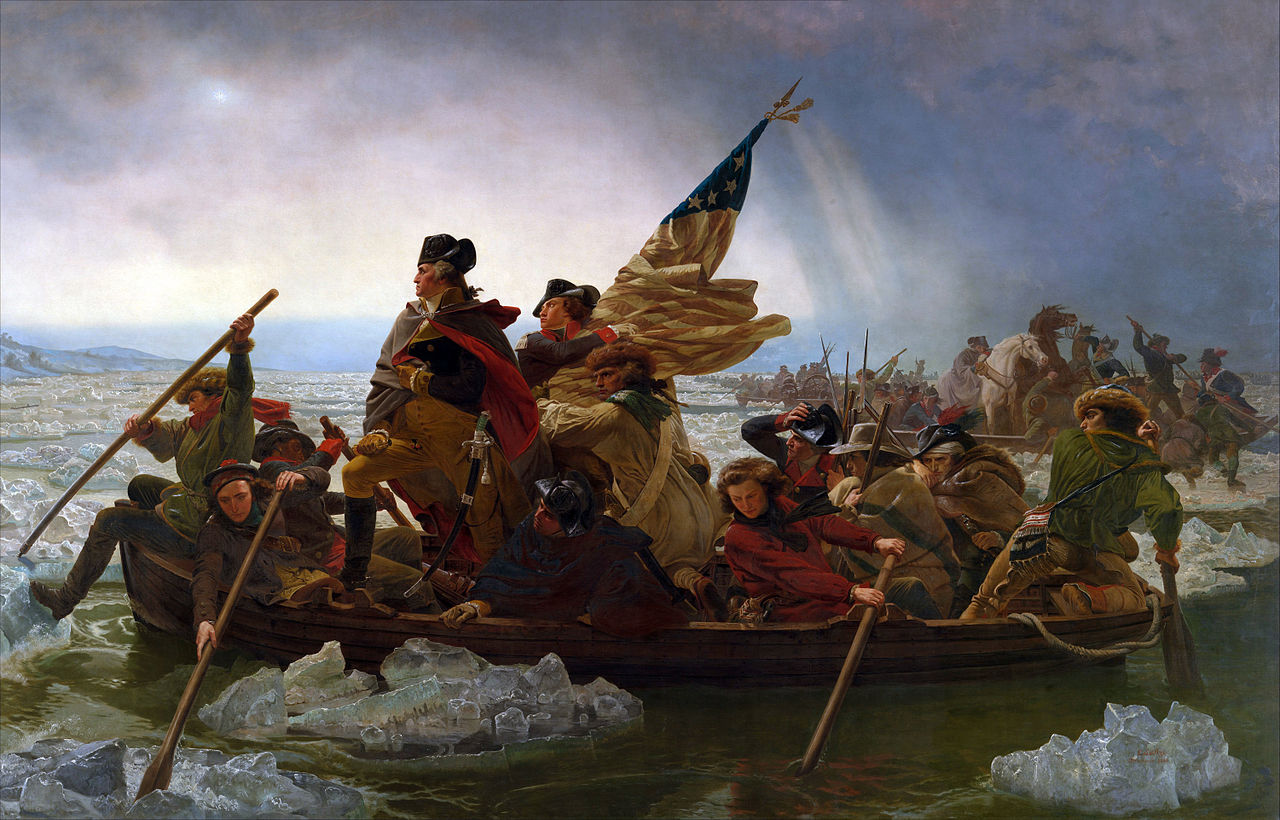
Across rivers of ice and against winds full of rage, the Americans begin their treacherous journey though the wintery hell.
On Christmas Day, George Washington, with Nathanael Greene and John Sullivan by his side, set out on boats across the frozen river with their troops in tow. The journey over the water was long and arduous, and as such, 3,000 men were not able to make it across and found themselves forced to turn back. The air was deathly cold and the waters nearly frozen solid. Only those nearest to Washington’s formation managed to carry on to the other side, pushed onward with an unseen hand at their backs. They knew the Hessians would be drunk and hungover from celebrating Christmas and tonight was their best chance to strike. So, they pressed on.
The March of Ice and Blood
After a treacherous journey across the icy Delaware, and having already lost more men than they had left, the Americans marched through the snow and wind to the city of Trenton. They trekked nearly 10 miles from the river’s edge to the Hessian encampment. Many of the troops were without boots, and so they wrapped their feet in rags to ward off the cold and save their toes. A trail of blood is said to have stained the snow a deep red as many bled at the feet after their soles froze stiff and cracked wide open. Yet still, they marched, for they knew the cost of failing to defeat their enemy was far greater than any temporary hardship or individual death.
After the test of the river, many were turned back. Less than half of those who began the journey now trekked across frozen fields on bloody feet.
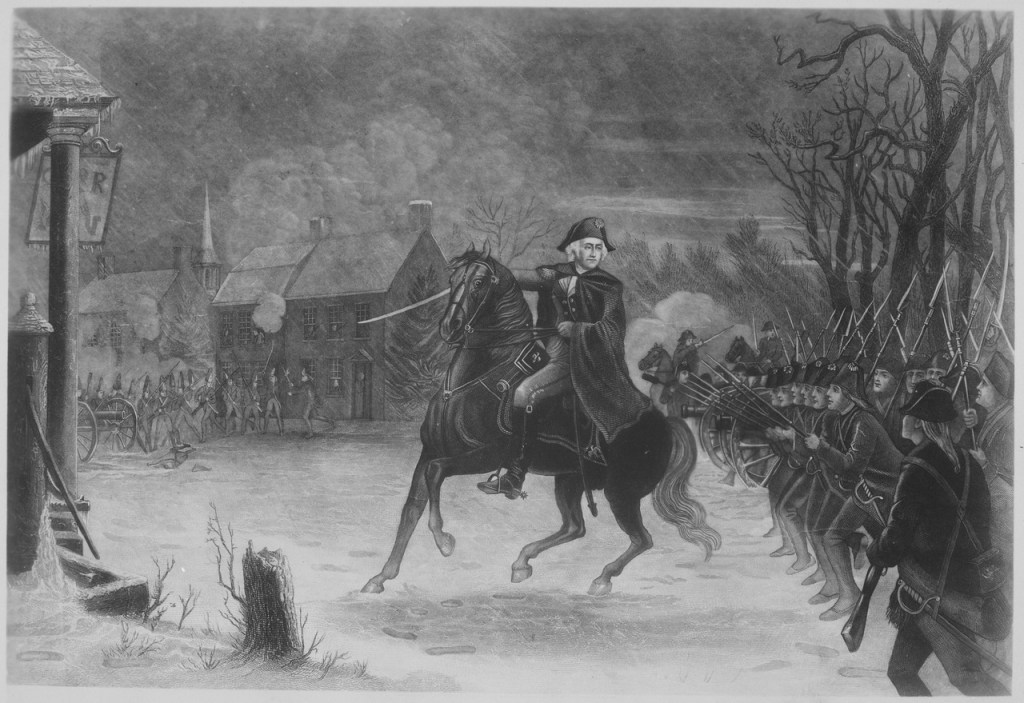
Many colonists saw the rebels marching through the snow leaving their trail of blood, and volunteers came out to offer aid. They gave food, clothes, and directions to the brave young warriors on their march to fight for freedom. General Washington acquired a horse and used it to ride along the column of men, encouraging them to continue on. With this generous aid, the Continental forces managed to trek all the way to Trenton and only lost two souls to exposure on what should have been a death march fraught with hundreds of casualties. Selfless Americans came out of their homes and gave what little they had to offer the troops to keep them warm, fed, and dry as they marched on through the winter winds and mountains of snow into the unknown.
On the Eve of Battle
As they approached the city of Trenton, General Washington was informed by a courier from Major General John Sullivan that the storm had wet the gunpowder they carried with them, and it would be unreliable at best. Undeterred, Washington famously said to the courier to “Tell General Sullivan to use the bayonet. I am resolved to take Trenton.” With that, the Americans prepared themselves to attack the Hessians. Whether their guns fired or not, they would charge nonetheless, determined and as ready as ever.
Starving and cold, yet brave and bold, the American forces charged at their enemy with souls on fire.
American spies had fed disinformation to the Hessians, and the weather forced regular patrols to stay back. The German commander, Johann Rall also ignored earlier requests to fortify the positions of his troops with redoubts, feeling the Americans were no threat after previous victories against them. In response to the threat of an attack on his forces, Rall said, “Let them come … We will go at them with the bayonet.” As such, the Americans approached undetected and faced no outer defenses to slow down their advance. The Hessian mercenaries were overwhelmed as a result.
A Strike Decisive and Swift
At approximately 8:00am on December 26, 1776, the Americans emerged from the woods outside Trenton and were fired upon by Hessian outposts stationed there. They returned fire and began to encircle the small groups. The Germans saw the massive force was no small raiding party to which they were accustomed. They quickly began an organized retreat, firing on the Americans as they fell back from their positions outside the town. Continental forces surrounded the city and blocked the roads before moving in.
The Hessians tried to warn their allies in the city that the outposts were lost and Trenton was now under siege. The Americans had set up cannons outside the city and were firing into the Hessian lines to break their control over the streets. The efforts of the defenders to bring their own cannons to bear were stopped by the overwhelming amount of suppressing fire. As the fighting became apparent to the American colonists living in Trenton, they too gathered their weapons and took aim at the Hessians from their windows and rooftops. The Americans overwhelmed the German mercenaries with gunfire from every angle and broke their lines as swiftly as the battle began.
The battle was brief as Americans rose up from their homes and rained down fire on the foreign occupiers from every direction.
Hall and his troops were routed, and the survivors were forced to abandon the city. As Washington lost most of his force crossing the Delaware, the enemy escape could not be completely locked down. Many Hessians fled, but most surrendered, including Hall. Wounded and dying from the fighting, the German leader asked only that Washington treat his men with humanity. Washington, an honorable man, obliged, and made sure to extract the prisoners from the combat zone rather than press further into enemy territory.
The battle was a decisive victory for the American rebels. Approximately 2,400 Continental Army troops and state militia members managed to inflict 905 casualties on the force of 1,500 Hessian mercenaries, killing and/or capturing 105 hostiles. With this feat, only 5 Americans were wounded in the battle, with none killed or captured. The outcome instilled confidence in George Washington among the Continental Congress, and among the young American rebels in themselves. It also proved something much more.
The Gift of Giving
One often hears the “gift of giving” in reference to the spirit of Christmas. This is the feeling we gain through giving unto others with no expectation of receiving in return. In so doing, we receive the greatest gift of all. With such an act of altruism and charity, we see the effect of giving on the recipient. We witness the smile on their face and the glow within their heart. While the actions of the troops under Washington’s command are quite impressive, the spirit of Christmas displayed by the American colonists who helped them along the way is also worth admiring.
As the Continental Army marched into the icy fields of certain death, selfless Americans who witnessed them on their journey came out to give aid, offering them food, shelter, directions, clothing, and any supplies they could spare. These gifts were surely never to be returned, yet the people opened their homes and their hearts to the courageous rebels on the perilous odyssey. It is through these acts of charity that Washington and his company made safe passage through the storm.
Yet the American spirit of Christmas did not cease there. When the rebels rushed into the fires of battle to oust the mercenaries occupying the city of Trenton, brave American townsfolk rose up with their guns to rain down fire from above. With the fear of death in their faces, the people of Trenton showed in the earliest days of the country what it meant to be an American, and they offered their lives in the fight for freedom in the spur of the moment. With this selfless act of courage and bravery, the enemy was overcome and driven out. The true spirit of Christmas rang out that day across the lands from every corner it was called and forever earned December 25, 1776 a spot in history as one of the great Christmas miracles of our world.
I had a wonderful Thanksgiving holiday this year, and it has given me the opportunity to ruminate further on the spirit of Thanksgiving. This is a holiday rich with tradition and history, even though it may often be overlooked by many as a mere family gathering every November. This prompted me to produce another ABAB poem in honor of the story of the first Thanksgiving and the meaning carried with this very special occasion. I hope you enjoy!
From Famine to Feast, and Back Again
Setting forth into lands unknown
Promise and warning abound
The frontier beckons weary bones
Fortune and famine to be found
Eager to prove our worth and thrive
We take on the world and meet our match
The lands push back on our will to survive
Testing our mettle with each dispatch
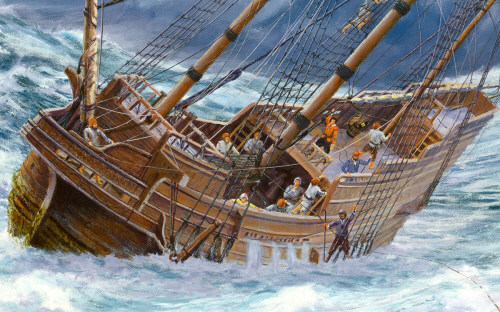
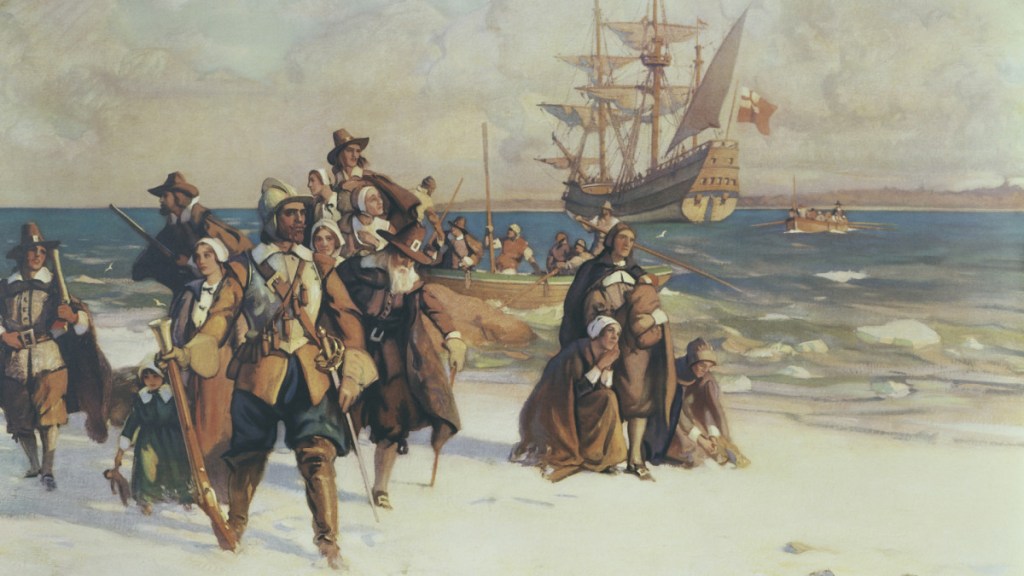
The voyage of the Mayflower across the Atlantic was as fraught as the struggles of the pilgrims to survive after making landfall.
Hunger scrapes at the mind
And frost bites at the soul
Nature can be most unkind
Beauty and cruelty as one whole
Hostiles be both man and beast
All eager for the taste of flesh
To make our own their bloody feast
Our spirits they set to gnaw and thresh
Through cold, hunger, and all manners of danger, the pilgrims at Plymouth were tested and pushed to the brink of oblivion.
Yet hope is never lost
Nor is it ever far
Amid the pain and ceaseless frost
We must keep sense of who we are
Amid the swirl of chaos and strife
We look to our friends both new and old
We stand together and breathe new life
To rise up as one into an age of gold
In times of great strife, people can often choose to either come together or tear apart. The spirit of Thanksgiving embodies the choice to come together.
Together we learn and do we grow
Facing the threats of the frontier
Sharing knowledge and wisdom both untold
Bringing about new love and cheer
A Thanksgiving Day to celebrate each year
A harvest long coming to sink winter's chill
And a feast of friendship rather than fear
Brings people together for good and not ill
The spirit of Thanksgiving would be carried on for centuries and remembered by great Americans like George Washington and Abraham Lincoln, reminding us to give thanks for the blessings we have during times of both feast and famine.
Yet as we return to uncertain days
Time and time again as struggle reigns
We give thanks for the blessings on our way
We give thanks even for the growing pains
I hope you all had a momentous Thanksgiving day last week, wherever you were and whomever you were with.
The story of Thanksgiving holds many common themes found in numerous holidays from across the ages. A people sent adrift in a strange land, unprepared for the perils and hardship. They find themselves set upon by famine and hunger, threatened with oblivion. Then, a kind people take notice of their plight and offer a trade in the form of mutual aid. The exchange is made, and the two peoples prosper as new friendships are formed. This is the spirit of Thanksgiving we hope to embody each year with this timeless tradition of bonding, caring, and giving.
The First Thanksgiving
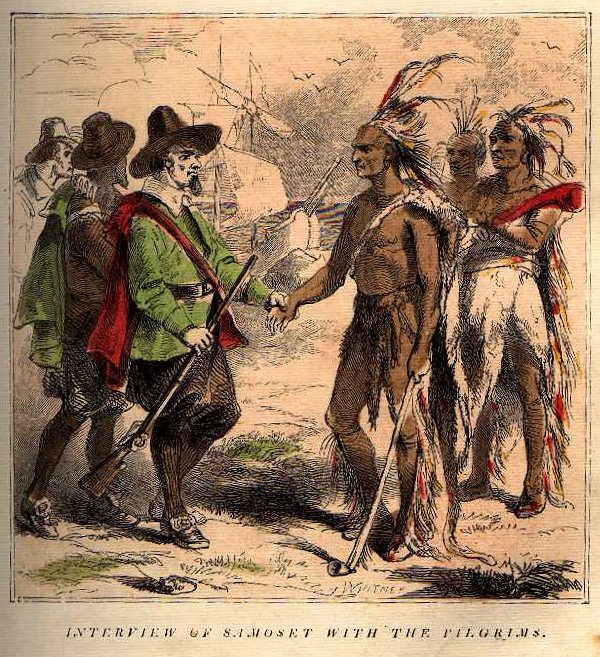
In September of 1620, about 100 brave souls departed on the Mayflowerfrom England to escape religious persecution, touching down in Cape Cod and founding the colony of Plymouth. Many died on the perilous journey across the Atlantic, and many more died after coming ashore. The English settlers struggled to survive in the New World, as they were unfamiliar with the land and not adept at farming. They were visited by Squanto of the Wampanoag, who was familiar with the English language and the word of God. Squanto taught the people of Plymouth how to grow corn and fertilize the fields, among many other priceless pieces of wisdom. With this knowledge, the struggling colony was able to survive. In return, the English settlers offered may goods to the Wampanoag people, including firearms. Many of the Native American tribes were violent against one another, raiding one another for slaves, food, and other supplies. Some of the Native American tribes were even cannibalistic, taking prisoners to use as food. The firearms of the English settlers offered a unique force multiplier against hostile tribes.
The settlers aboard the Mayflower found little solace on land after their perilous journey across the sea.
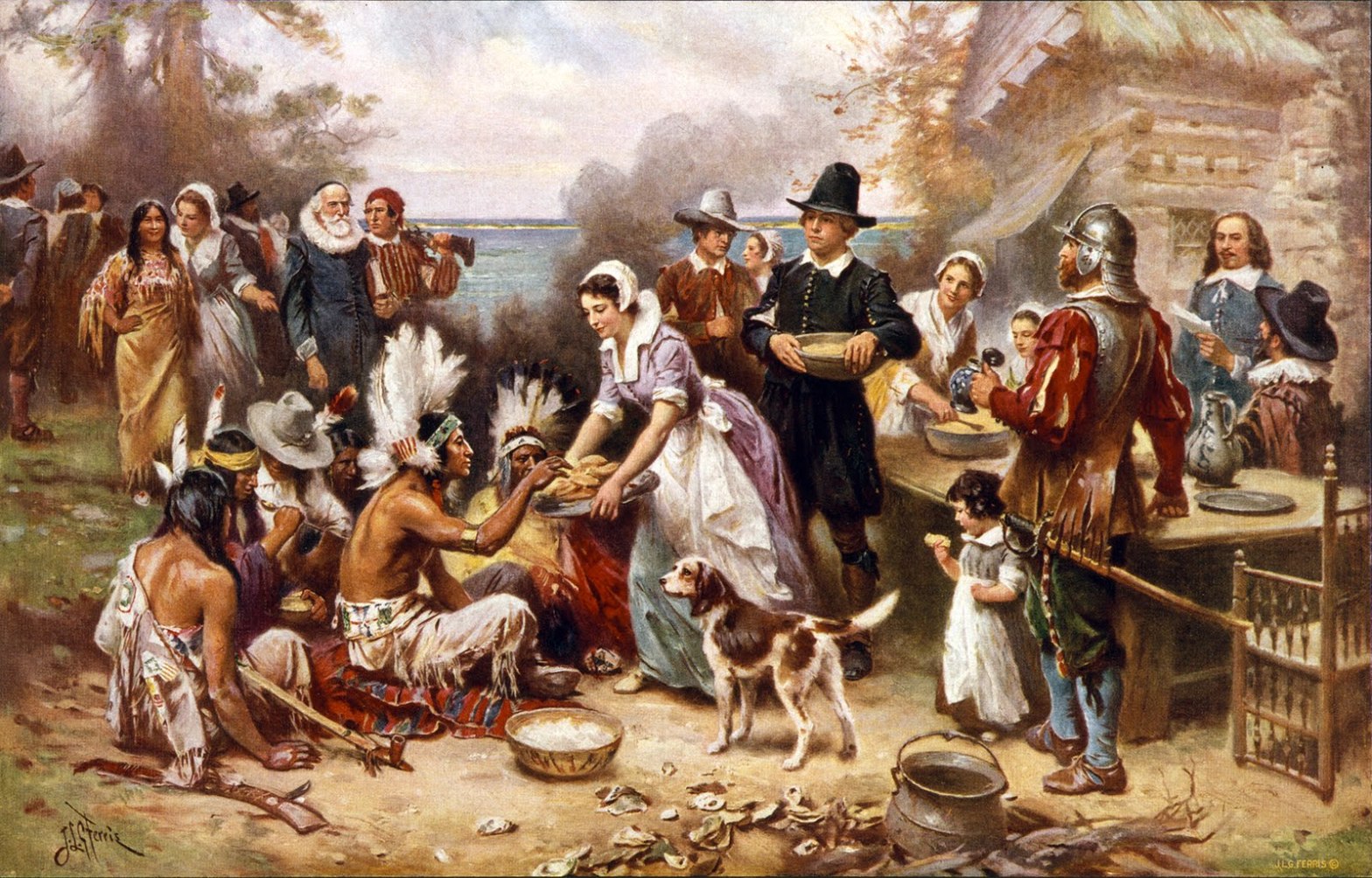
The first Thanksgiving would have taken place sometime in October, shortly after the harvest. It was later made an official holiday on the fourth Thursday of every November. The peoples of Plymouth and the Wampanoag came together for a feast and several nights of celebration. They had a bountiful hunt and harvest after the two peoples learned from one another and shared their knowledge, wisdom, and tools of the trade. Before the first great feast, they all joined together and gave thanks to God for the fortuitous turn of events at the colony. The celebration lasted three days as the two peoples sang, danced, and held friendly competitions including foot races and shooting contests. It was a powerful moment in human history, filled with so much symbolism and meaning.
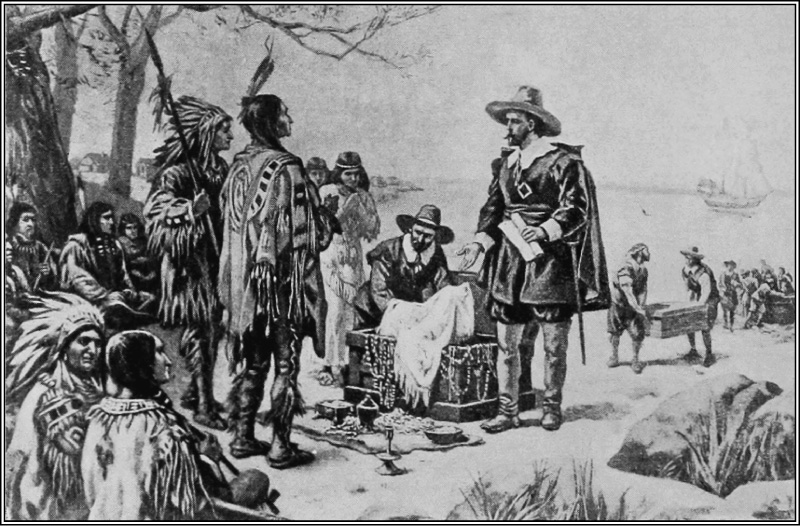
The English settlers traded tools, knowledge, and other goods that helped each other survive.
What Thanksgiving Means to Me
My family has always celebrated Thanksgiving for as long as I can remember. Each year, I find myself loving the holiday more and more. It is not every day I get to see many of my extended family members, each with their own lives which take them to other parts of the world. I also appreciate seeing events one can find where public feasts are held around town, bringing members of the community together who may have otherwise never met.
Even more precious can be a small get-together with friends new and old to share in the bounty and blessings we enjoy from the society our ancestors have built up over generations. As we stand upon the shoulders of giants, we give thanks for the efforts of those who came before and gave us the chance to achieve heights greater than past civilizations may have ever imagined possible. Together, we can face down the darkness set upon us, and know no fear as we strive forth into the light.
A family gives thanks to God for their meal in the modern era, just as the Plymouth colonists and Wampanoag natives did on the first Thanksgiving.
I look forward to celebrating Thanksgiving again this year with my family and friends, and to sharing my journey this holiday season in the form of song and poetry, bringing light into the world in my own little way.
Do you celebrate Thanksgiving? If so, how? Do you get together with family or friends? What sorts of things do you give thanks for? I hope everyone has a great week this week and a wonderful Thanksgiving holiday.
November 10th this year was the 246th anniversary of the birth of the United States Marine Corps. At the time of their initial inception, the US Marines were referred to as the Continental Marines. The Second Continental Congress ordered the formation of two battalions of marines on November 10, 1775 to serve as a landing force for the Continental Navy. They served with distinction under the leadership of the first Marine Commandant, Samuel Nicholas. The Marines raided ships and helped defend Continental vessels. The first amphibious raid of their history was launched against the British port of Nassau in the Bahamas on March 3, 1776.
The Continental Marines were officially disbanded after the signing of the Treaty of Paris 1783. However, they were later reformed on July 11, 1798 as the United States Marine Corps. Since that reformation, they have taken part in numerous operations throughout history. The U.S. Marines earned the name “Devil Dogs” during World War I. On June 1, 1918, at the Battle of Belleau Wood in France, two regiments of U.S. Marines reinforced two U.S. Army divisions alongside French and British soldiers. Despite being heavily outnumbered and outgunned by the advancing German forces, the Marines helped hold the enemy off and even went on the offensive, charging German machine guns and artillery positions with bayonets. The German survivors referred to the U.S. Marines as “Hollenhunde” and “Teufelshunde,” meaning “Hell hound” and “Devil dog,” respectively.
This haiku series – Day of the Devil Dogs – was inspired by the history and service of the United States Marine Corps:
The first amphibious raid of the U.S. Marine Corps was at the Battle of Nassau in 1776.
Forged in flame and blood
In an age of strife and war
A new breed was born
Over land and sea
Into storms of fire unknown
To shores far and wide
A small force of US Marines led by John G. Reynolds took part in the First Battle of Bull Run on July 21, 1861 during the American Civil War.
Brave and proud are they
The few they call the Marines
Respite they earned
Across the ages
Fighting battles at God's call
Giving not to fear
At the Battle of Belleau Wood during World War I, as U.S. Marines overran German machine gunners with their bayonets, Daniel Daly spoke the legendary words: “Come on you sons of bitches, do you want to live forever?”
From rebels anew
To keepers of torn heartlands
To guards of the Earth
From Hell they were called
To do the work of the Lord
And chase out the fog
On September 15, 1950, U.S. Marines launched an amphibious assault during the Battle of Inchon, landing behind enemy lines and charging head on into battle against the Communists.
Devil dogs in name
They are to live forever
In the halls of time
I hope you enjoyed this haiku series. I know the last few poetry posts have all been haiku, and it has been some time since I wrote an ABAB poem. With Thanksgiving approaching and Christmas next month, I will be writing more ABAB poems for the holiday season. Stay tuned to see those coming up!
On November 7, 1917, Vladimir Lenin led Bolshevik forces to seize power in Russia by capturing government offices in Saint Petersburg. The Bolshevik Revolution was complete and the Soviet Union came into being. Many have argued that for this reason, November 7th should be the internationally-recognized Victims of Communism Memorial Day.
Since that day, numerous communist regimes cropped up around the globe during the 20th Century which led to an estimated 80 to 100 million casualties from socialist policies. Even after the collapse of the Soviet Union, many communist regimes continue to hold power and exert influence around the world. The Chinese Communist Party continues to expand its reach after surpassing the Soviet Union with its death toll, leading to a new cold war as many countries scramble to correct decades of free trade agreements with a future great power adversary.
In order to help safeguard future lives which may be lost from the implementation of socialist policies in societies around the globe, there is the obvious need to educate and raise awareness about such historical and current threats. Therefore, many advocate for using November 7th as the Victims of Communism Memorial Day. However, there is also the perspective that May 1st should hold this day to counter communist celebrations which take place on that day. May 1st is often used as a day by communists to celebrate their ideology more broadly, without specific reference to the Soviet Union. As such, it would make sense to many to hold a counter holiday on the same day to help push back on the celebration of death with a memorial day commemorating lives lost.
The Victims of Communism Memorial Foundation chooses to recognize November 7th as the appropriate day of remembrance, and has made efforts to pass legislation throughout the United States to officially recognize this holiday. So far, they have achieved this goal in a number of states and have bills proposed in several others. Peoples all around the world can commemorate this day by reading history, learning about the ideology of communism, and taking a moment of silence to remember the untold lives lost at the hands of communist forces to this day.
Do you think the Victims of Communism Memorial Day makes more sense on November 7th or May 1st? The November date is already more widely used, so this may be a moot point. I do think there is merit in advocating for a May 1st date to directly oppose the death celebration with a remembrance of life. Nevertheless, the November date is the one which is gaining traction, and ultimately, either would be valid.
Halloween is the modern-day interpretation of All Hollow’s Eve, the Vigil of All Saint’s Day. Historically, this is a day for people to remember those who have passed on and are now in Heaven, and to pray for those in Hell or Purgatory. The imagery of ghosts, ghouls, and other deathly images was meant to remind people of their mortality and to do well with the time we are given on this Earth. In the past, people would give out homemade cakes on All Hollow’s Eve on October 31st, as All Saint’s Day on November 1st was meant to be a feast in remembrance of saints who had passed on and all the work they did while they were alive. There was concern that the spirits in Hell might feel forgotten and cause trouble if they were not remembered as well. Therefore, the practice of chanting and wearing costumes or masks came out of this practice as well.
Jack-o-lanterns were used historically to protect the candle within from the wind and have become an iconic symbol of Halloween.
Those are some of the more Catholic and Christian origins of Halloween, which have merged with commercialization to produce the practices known today of children parading around while dressed as their favorite characters and asking for free candy. Neopagans also celebrate the day and often try to claim Halloween is about worshipping devils, demons, or other unsavory characters. Despite these things, I still love Halloween and love it even more knowing the wholesome meaning behind it. I also have fond memories of the holiday as a child, as it brought me, my siblings and friends, and other members of the community together in ways many other holidays did not. For most holidays, we spent the time together with family, and did not always have contact with the broader community or with friends. Halloween brought everyone together though.
As a child, me, my siblings, and several close friends would get together at the biggest house to use as a staging area for our trick-or-treating expedition. We would come with costumes to dress up as our favorite characters and cover ourselves in layers to try and stay warm later into the evening. Then, after receiving instructions from our parents to stick to the path we walked with them when we were younger and they accompanied us; as well as to stick together and watch out for one another; we set out to try and get as much candy as we could before the sun went down.
Bats and other nocturnal “creatures of the night” are often synonymous with Halloween.
Me, my brother, and some of our of friends were all martial artists and boy scouts, and we were armed with knives that we had some minimal training with. While I doubt we could have handled any professional attackers, we certainly could have deterred any untrained thugs with four members of our party armed and minimally trained. Plus, we lived in a pretty safe neighborhood anyway and never ran into any trouble. As such, we felt confident we could work together to fend off an attacker should one threaten us or our other companions who were untrained and unarmed. It was also somewhat exciting to be going out on our own for the first time with no one but our fellow peers to rely upon should anything go wrong. Even if we were just walking around a few blocks, it felt like a big adventure as a kid.
When we got back home, we all dumped our candy out in a massive pile and sorted it out. We gave everyone as much of their favorite candy as we could, and we made sure to categorize our own stockpiles according to which candy would go bad first. We wanted to make sure our loot lasted us as long into the next year as possible, since our parents would always tell us, “you don’t need candy. You’ll get candy on Halloween.” We learned to be patient and to ration our resources when we had them. We strategized about where to go and what houses gave out the most candy from our experience. We also tried to move fast and hit as many houses as possible. We got familiar with the layout of the neighborhood and agreed upon a path we felt was most efficient. No one told us to do these things, but the motivation to acquire as much candy as possible prompted us to do it of our own accord. Halloween was like our own little mission as kids, and it brought me and my peers together to make us a team in a way no other holiday did. In fact, on most other holidays, I never saw my friends as they were off somewhere with their families.
“Trick or treating” is the common practice of little kids dressing up in costumes and going around their neighborhood soliciting neighbors for candy with the greeting, “trick or treat!”
Now, I love all the holidays that bring families together which would otherwise be apart. That time spent together is a blessing. However, Halloween has always had a special place in my heart for how it stood out amongst the other holidays and brought me and my peers together in ways no other holiday ever could. Now, I am fortunate to be able to sit back and hand out candy to young kids doing the same on Halloween, as adults did for me when I was growing up. It is great to see them getting that same experience I was blessed with as a child.
I also have a newfound appreciation for Halloween knowing it origins with All Hollow’s Eve. It makes it feel even more special knowing this is a day to remember those who have passed on, and to remind us of our own mortality. Since we only have a short time on this Earth, we should make it the best we can. Halloween reminds us of that with the scary and deathly costumes we see passing by. It is a solemn, but humbling thought which brings even more meaning to the day.
“Happy Halloween” and “trick-or-treat” are common forms of greeting appropriate for Halloween.
For more on the different origins of Halloween, check out some these articles:
October is host to the anniversary of the Battle of Tours, a less impactful, but no highly symbolic skirmish in human history. Also referred to as the Battle of Poitiers, was a skirmish fought between the Frankish Carolingians and the Umayyad Caliphate on October 10, 732. The exact location of the skirmish is unknown, taking place somewhere in France around the two towns of Tours and Poitiers. Islamic invaders under the command of Abdul Rahman Al Ghafiqi inserted into French territory from occupied Spain and began burning churches and attacking civilians. Charles Martel led a contingent of Frankish troops to halt the Muslim army and end their onslaught in the region.
Al Ghafiqi was killed during the fighting by Martel and his forces. The Frankish troops held their ground and reversed the enemy’s advance against superior numbers. The defenders were described by observers to the battle as like “a wall,” “immovable,” and a “mass of ice.” The Muslim invaders were said to greatly outnumber the defenders and ride atop horses, attempting the run down the defenders with ease. But the Frankish troops stood their ground and “manfully resisted” the charge of the invading horde. After the battle, Charles Martel became known as Martellus, meaning “The Hammer.”
This haiku series was written in memory of the sacrifice of those great warriors who halted in the onslaught and passed into legend.
The Hammer of Man
Invaders are here
A dark storm is on the march
Chaos spreads abound
A horde sweeps the land
Destroying all in their path
Who will stop their wrath?
The Hammer stands tall
Brave souls standing by his side
Ready to face death
Men immovable
They stand at the gates of Hell
Ice to block the fire
Hell comes with fury
Men stop demons in their path
No hellfire may pass
The Hammer pushed back
He manfully resisted
And stood to the end
The demons charged forth
All struck down by The Hammer
And the land was saved
Hundreds of years of Muslim conquests came to a head at the Battle of Lepanto on October 7 in the year 1571. Islamic forces had been spreading through force of arms, capturing or pillaging every Christian settlement across the Middle East, North Africa, and parts of Europe. The Ottoman Empire had formed out of Turkey off the backs of slave labor and a thirst for global domination. The world of Christendom lay divided and scattered, with cooperation a scant sight among followers of God in those days. Under the direction to conquer all of the world for Allah and enslave the entire population of the Earth, the Ottomans made for another push to break the spirit of the Christian world once and for all. The Battle of Lepanto was a pivotal moment in human history whereby many nations which stood apart came together at a critical time to stop the world from plunging into total darkness.
Prelude to the Battle
Many Christian capitals of the world had fallen to the Muslim conquest in the ages prior. Jerusalem, Antioch, Alexandria, Hippo, Tunis, Carthage had all fallen. This was largely due to the disorganization and division among the world of Christendom following the Protestant Reformation. The many different sects stood apart and refused to work together, even in the face of annihilation. On the other hand, the Ottoman Empire commanded unity through a vision of world subjugation and the crack of the whip against the backs of unwilling slaves. In fact, part of the reason the Ottomans raided shores and captured so many slaves was due to the high attrition rate of their labor force. Christian slaves were worked to death in about 5 years and needed to be replenished. In this manner, the Islamic forces were conquering Christian lands by aggressively eating their way through the population, enslaving the people and working them to death and replacing them.
A new caliph was expected to expand the territory of the Islamic empire to a greater extent than their predecessor. Thus, in the year 1571, Ali Pasha was given command of a massive fleet and ordered to move into the Mediterranean Sea with the goal of conquering all of Italy, making way for a broader invasion of Europe. Ali Pasha raided the forts and villages along the Adriatic shoreline, taking new Christian slaves to replenish the ship rowers that perished from the heavy labor of moving the Turkish ships with little food or rest. At the same time, he sent another contingent to capture, rape, and pillage Cyprus. The dark forces stormed the island nation and laid waste to Nicosia. They destroyed churches, burning them all to the ground. The Muslims also ordered older women beheaded and took the men and young women into thralldom.
The worst of the atrocities was yet to come, however. The Muslim army of darkness marched along the coastline of Cyprus and laid siege to the city of Famagusta under the command of Lala Mustafa Pasha. Here, the valiant defenders held out for several weeks under constant fire and enemy reinforcements. The city’s defense was led by General Marcantonio Bragadin, who was said to be an exceptional leader who inspired the warriors of Cyprus to hold the city against overwhelming odds and with little food or ammunition for such a long period of time that the attacking commander became furious from losing so many of his own men. Nevertheless, with constant enemy reinforcements arriving by sea and no help to come for the brave defenders, the city eventually fell, and General Bragadin surrendered himself in an attempt to negotiate safe passage of the city’s survivors to outside the combat zone.
Darkness Rises and Shadow Engulfs
It was at this time the tone of the conflict changed for all those involved. The defenders fought bravely and fought well, inflicting over 100,000 casualites on the attackers while suffering less than 9,000 casualties of their own. However, they could not hold out forever, and after the surrender of Famagusta on August 1, the Islamic forces beheaded the few hundred remaining defenders and piled them up around Mustafa’s tent. General Bragadin was then mutilated with his ears and nose chopped off, and he was forced to walk around the city on all fours with a dog collar for the world to see. The general was made to carry heavy bags of dirt on his back as he crawled and kissed the ground by Mustafa’s feet whenever he passed the evil man.
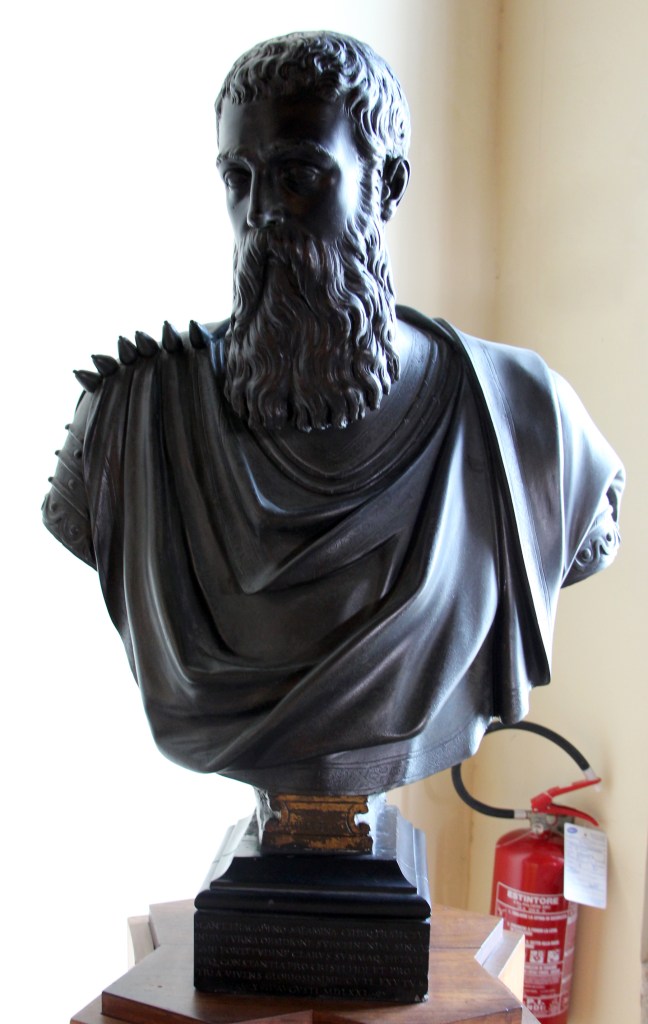
A bust depicting General Bragadin.
His torture did not stop there, however. After he collapsed, General Bragadin was tied to the mast of a ship in the Islamic fleet, and then raised and lowered repeatedly in and out of the water. Lastly, the general was brought to the town square, stripped naked, and tied up with his hands bound above his head. Then, he was slowly skinned alive from head to toe by the executioner. His flesh was stuffed like a doll and hoisted once again on the highest mast of the Muslim fleet and paraded around as a trophy. Word spread of the evil which laid waste to Cyprus, reaching all corners of the world of Christendom, and beckoning righteous souls to stand against the army of darkness marching upon their shores.
Light Shines Into the Dark
Word of the dark march of the Islamic empire was known long before the invasion of Cyprus. Pope Pius V had established the Holy League some months before in May. However, there was still much division among the world of Christendom. Despite the existential threat they faced, it was difficult to get people to work together in a coordinated effort. That changed for many when news of the horrors inflicted on the island nation of Cyprus spread.
Pope Pius V was instrumental in forming the Holy League which rose up to save the future of the free world at the Battle of Lepanto
One of the first to learn the fate of General Bragadin and Famagusta’s survivors was Don Juan of Austria, also known as “John” of Austria. At 22 years of age, he was given command of the entire joint fleet of the Holy League that was ordered to defend Italy and the Mediterranean Sea from the dark forces of the Ottomans. They were shocked to learn they would be arriving too late. Many under his command were also uncertain and hesitant about the effort entrusted to them. Christendom stood divided in their hearts from the Reformations, despite them all being together in that moment. However, once they learned of the evils which had transpired on Cyprus at the behest of the Muslim invaders, their shed their hesitations like a dead skin and stood renewed in their certainty of what they must do. It was up to them to stop the world from plunging into darkness, and them alone. If they failed, the world would fall, and evil, tyranny, slavery, and repression would spread to consume all the lands as the light was snuffed out from every corner of the Earth.
The Holy League was a joint force consisting of brave souls from Spain, Venice, Genoa, the Papal States, Savoy, Urbino, Tuscany, as well as from the Order of Saint Stephen, and the Knights of Malta. They all held different beliefs and generally did not work together following the massive division caused by the Reformation. It was rare to see them together, and certainly rare to see them on the same side of a coming battle. However, they all knew what was at stake for them and their children should they fail to come together on this day and find victory for their people. Hundreds of thousands of Christians had been abducted and forced into slavery at the hands of the Muslim forces. If the dark army was not stopped, it would spell doom for the whole world.
And so, the combined forces of the Holy League followed their young leader Don Juan straight into the belly of the beast with courage and bravery, against a foe which threatened to swallow the Earth. The whole joint fleet joined in prayer to God on their approach. They prayed for protection from the foe they were about to face and for the strength to overcome any threats to life, liberty, and the seeds of the free world.
The warriors of the Holy League prayed for divine before the Battle of Lepanto.
Shadow Recedes and Darkness Pushed Back
The joint Christian fleet arrived to find themselves outnumbered. About 200 ships of the Holy League carrying 60,000 souls faced down almost 300 Turkish vessels with over 84,000 Muslim swords. Naval combat at the time relied largely on attaching ships and engaging in melee combat, as ranged weapons were not yet so advanced. The Holy League approached the invaders in two lines, and the Turkish fleet prepared to fight for their claim in their signature crescent formation. Many of the ships of the Holy League sailed into battle emblazoned with a crucifix on their hull. The wooden cross on the flagship of the joint fleet, the La Real, remains on display in Barcelona to this day.
Don Juan took point with his ships at the front of the formation, alongside the large, heavily-armored ships with the new cannons which the Turkish forces likely had never seen before. The Knights of Malta were behind Don Juan’s attachment in reserve, with the Venetian ships on the left flank close to the shoreline and the Genoese fleet on the right. The sailed into the waters of the Mediterranean ready to liberate Cyprus and expel the darkness from their lands.
Ali Pasha was at the helm of the Muslim flagship, the Sultana. The windy conditions forced the Turkish fleet to sail forward in a straight line, disrupting their usual crescent formation. The Ottoman forces relied on felling clouds of arrows on their targets as they approached before closing the distance and initiating boarding action.
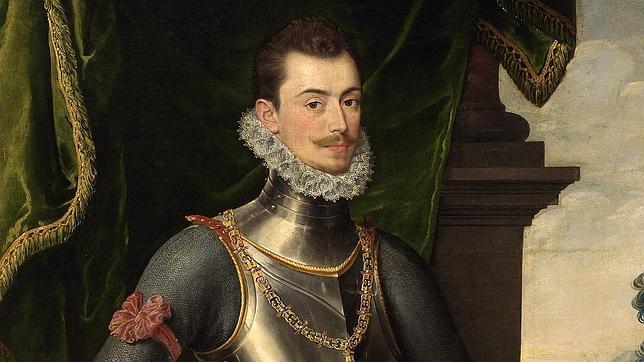
Don Juan of Austria was exceptionally young at the time of the battle at the age of 22, but he was as capable a commander as any.
The battle lasted for five hours as the outnumbered Holy League fought fiercely to break the lines of the dark empire. The long range cannons of the Christian forces wrought havoc on the Turkish fleet before they were close enough to engage with arrows, but eventually the gap was closed. Once in close, the early firearms of the Holy League and their broadside cannons continued to pepper and sink many of the enemy ships. Still, the Ottoman forces managed to unleash many clouds of arrows on the Christian fleet, leaving many of the brave vessels floating dead in the water. However, many warriors of the Holy League were equipped with the latest body armor designed to deflect bullets, which often repelled the wooden arrows of the Muslim forces.
Cannon fire broke the chains keeping many of the Christian slaves in place and rowing the Muslim ships while sitting in their own feces, urine, and blood. As a result, many of the slave rowers were freed and uprisings occurred on the Muslim ships. Meanwhile, the Christian ships were rowed by volunteers who knew what was at stake and gave the battle all their heart. The superior technology of the free market Christian forces gave them access to early firearms which wreaked havoc on the Muslim forces, which had not attracted as many entrepreneurs with their heavy emphasis on slavery and thus still relied entirely on bows and arrows. The freedom fighters of the Holy League may have been outnumbered, but they were by no means outgunned.
The battle raged on and the warriors of Christianity wore down the Turkish slavers with their superior technology and hearts burning with the fire of courage. They suffered heavy losses due to the overwhelming numbers of the Muslim invaders, but eventually the slave-driven fleet of the Ottoman Empire faltered to the forces of light who would later give birth to the free world. The battle reportedly ended after the third attempt to board the Sultana was successful, Ali Pasha was beheaded, and his head mounted on a pike atop the Muslim flagship. The darkness faded and the shadow was forced to retreat as the spirt of the invaders was broken. With the lines of evil shattered, the seas were saved and light returned to the lands. It would seem the prayers of the Holy League were answered, and good triumphed over evil once again.
A Lasting Legacy
The Battle of Lepanto stands tall in human history as one of the great clashes between good versus evil, freedom versus slavery, and liberty versus tyranny. The Turkish slavers of the Ottoman Empire were sent reeling back into the abyss from whence they came by the freedom fighters of the Holy League. The light had prevailed once more over the forces of darkness, and the world was spared from an age of oppression which would have stifled the growth of liberty for centuries more. With the defeat of the darkness at the Battle of Lepanto, the oppressive Muslim expansion was halted and never again took shape in the form of a major military offensive. The division among Islam led to more focus on infighting rather than expansion, and the free world was allowed to be born and to flourish.
The crucifix of the Holy League flagship stands in Barcelona to this day.
To me, the Battle of Lepanto embodies the importance of putting aside our differences and standing together against existential threats to freedom, liberty, and the prosperity of good over evil. During those times, many in the world of Christendom preferred to have peace with the Ottoman Empire in spite of the raids and slavery because it was profitable. Peace is a noble goal, but its pursuit can reach a point where refusing to fight becomes detrimental. When that point is reached, it is critical to put aside our profits and our differences to pick up a sword and slay the forces of evil amassing at our door. That is what the Holy League understood, and it is a timeless lesson to be retaught across the ages.
What do you think of the Battle of Lepanto? Have you ever heard of it before? This is hardly a comprehensive retelling of those events. I would encourage everyone to read more of the world during that time. There are many parallels to the challenges faced today.
Recently, I have been reading more about historical knights and their great deeds. This month of October, I also found there to be several important historical events involving knights and other prominent warriors of Christendom. This month marks the 450th anniversary of the Battle of Lepanto on October 7, 1571. Yesterday was also the 1289th anniversary of the Battle of Tours on October 10, 732. This month, I will write a series of blog posts focusing on the history of prominent knights, other Christian warriors, and historical battles important to them. I would like to begin with Hugues de Payens, the founder of the Order of the Knights Templar.
The Birth of a Legend
Hugues de Payens, also known as “Hugh de Payens,” was a French nobleman who became a knight and formed the Order of the Knights Templar, eventually taking the title of the first Grand Master of the Knights Templar as the Order expanded. He was born around the year 1070. Exactly when and where he was born is unknown, but he is believed to have been born in either Champagne or Burgundy, France.
An artist rendition of Hugues de Payens.
Hugues is said to have fought in the First Crusade to capture Jerusalem after it had been lost long ago. It is uncertain if this was before or after he married a woman named Catherine Saint Clair and fathered three sons with her. However, sometime after the death of his wife, Hugues gave up all that he owed and swore himself to a life in service of God. He had seen many Christian pilgrims being attacked on their way to worship at sites across the Holy Land from his time serving in Jerusalem during the occupation. Disheartened by these attacks on innocent civilians, he decided to devote himself to protecting the pilgrims who would not or could not defend themselves.
However, this was not a task he could accomplish on his own. As skilled of a warrior as he may have been – and by all accounts, he was a renowned fighter in his day – Hugues knew he was just on man, and one man could quickly be overwhelmed by a group of trained attackers. As such, he would need a team of men he could rely upon to accomplish this task. Fortunately, he knew of others who were willing to take up the cause. The original nine members of the Knights Templar were Hugues de Payens himself, Godefroy de Saint-Omer, André de Montbard, Hugues I, Geoffroi Bisol, Archambaud de St. Amand, Payen de Montdidier, Rossal, and Gondemar. We will explore the origins and what is known on each of these knights at a later date.
Hugues de Payens went to the patriarch of Jeruselum – the head of the church at the time – and swore himself to a life of poverty, obedience, and chastity. He would own nothing, seek nothing, and live only to serve God and protect His innocent followers from harm. He asked only for support in the form of the means to carry out this mission. Moved by Hugues de Payens and his plea, the nine were granted the authority to escort pilgrims arriving from the port of Jaffa to the city of Jeruselum where they would visit different sites around the Holy Land including the Holy Sepulchre, Bethlehem, and the Jordan River. The countryside was dangerous and full of Islamic marauders hunting Christian pilgrims, but Hugues de Payens and his men were effective at chasing them off and saving many lives.
Humble Beginnings
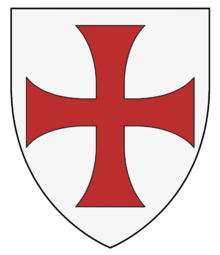
Originally, the Knights Templar were a truly impoverished order. With their original nine members, it is said they could only afford one horse for Hugues de Payens and Godefroy de Saint-Omer to share. In fact, they had an official seal which showed two knights riding one horse because of this. However, the Order eventually grew in prominence due to word of their success traveling far, spread by the lips of many grateful pilgrims who had been spared death by the courage of the knights. They were granted a house, funding, and support to grow the Order. The red cross on a white shirt became a recognizable symbol across space and time from the heroic deeds of the Knights Templar.
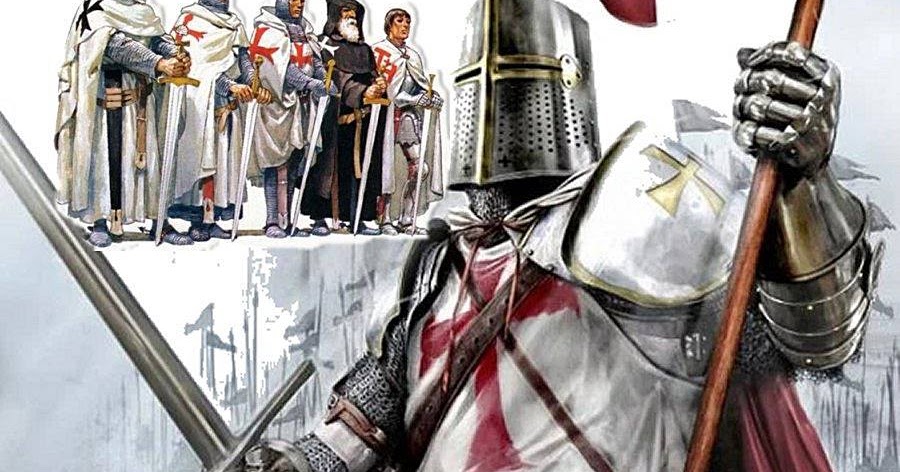
The simple coat of arms of the Knights Templar includes a red cross on a white background.
Hugues de Payens himself became an accomplished knight whose legacy ripples across the ages. He studied the Quran and learned about Muslim languages, customs, and values. At first, he did so to better understand the enemy he faced, but in time, these studies helped him to become a wise diplomat capable of negotiating peace with the Islamic forces and avoiding bloodshed in some situations. The true embodiment of a knight, he was skilled both in making war and forging peace. Many lives were spared due to the efforts of Hugues de Payens.
The Knights Templar eventually gained in prominence to the point where they were officially recognized by the Pope, Honorius II. Hugues de Payens and several other Knights Templar traveled from Jerusalem to Rome for this honor. They were put into official records as an order of warrior monks in the service of God and all of Christendom. They were also granted the Temple of Solomon as their official station. Hugues de Payens traveled across Europe looking for support and establishing other stations in many countries.
A Life Well Lived
Hugues died in 1136 at the age of 66. By that time, the Order of the Knights Templar was well-established as an official fighting force of fearsome protectors who went on to carry the legacy Hugues de Payens had dedicated his life to building. Eventually, the Order strayed into a role of international banking, perhaps after becoming so large and wealthy that they lost sight of their founding vision of a life of poverty, chastity, and obedience to God. Fortunately, Hugues de Payens did not live to see this change and the ultimate demise of the Knights Templar in the 14th Century.
Despite the ultimate fate of the Order, Hugues de Payens created an enduring legacy through the timeless legends of the heroic deeds performed by the Knights Templad in its early days. Through his determination, skill, and life of service, Hugues de Payens serves as a timeless beacon of inspiration echoing throughout human history. What he built and what he accomplished are a testament to what humans can achieve when they dedicate themselves fully to so noble a cause.
A statue of Hugues de Payens in Dijon, France.
What do you think of Hugues de Payens and his story? What about the other original nine members of the Order of the Knights Templar? Are there any other knights you would like to see mentioned here? Feel free to share you thoughts, and please, share this post with others who may enjoy it.


















 The Pensive Warrior