Historical Events: The First Great Awakening

The First Great Awakening was a spiritual revival which began as early as the 1720s in England and the Colonies, continuing on to as late as the 1760s. The movement is primarily recognized as having taken place in the 1730s and 1740s. Prominent figures in the First Great Awakening included George Whitefield, John Wesley, and Jonathan Edwards, among others. The First Great Awakening was critical to inoculating English communities from the devastating ideas of the proto-communist French Revolution which led to the Reign of Terror and ultimately, communism itself in the centuries to come. The First Great Awakening was also instrumental in preparing the Colonies to unite against the British crown under the word of God and birth the new nation of the United States.

Fall From Grace

The Enlightenment brought the world out of medieval times and into the Renaissance Era. Scientific discoveries and advancements in technology led to dramatic improvements in quality of life. Material conditions had never been better. This was the end Middle Ages and the beginning of the Age of Reason. It was a tremendous triumph for Humanity, but as with many things, it was taken too far. Excesses and complacency led humans astray once more, and people began to turn away from God as they put their faith in science as the be-all-end-all. This set the stage for the wars to come, but not all would be cast into the fire. There were a few brave souls who went against the excesses of the fleshy world and turned back to the Bible just before judgement swept across the globe, saving many others in their efforts.

Awakening in England

In England, John Wesley was born in 1703 to a large Christian family. His house was burned down by an anti-Christian mob when he was young, but he was saved from the fire and went on to continue studying scripture. He attended Oxford university and started the “Holy Club” with his brother. Wesley became a preacher and sailed to Georgia on a mission to convert the Native Americans to the word of God. Meeting little success at the time, he returned to England and attended a Moravian meeting in which a Lutheran commentary was being read. Wesley experienced a change in himself upon contemplating the words on how faith and complete trust in Christ is a force for personal renewal. After this, John Wesley traveled around the British Isles preaching the message he had received of salvation through Christ’s word alone. While he was shunned by many churches for preaching a personal relationship with God instead of an indirect relationship through the church leader, Wesley nevertheless drew large crowds speaking outside churches and in open fields.

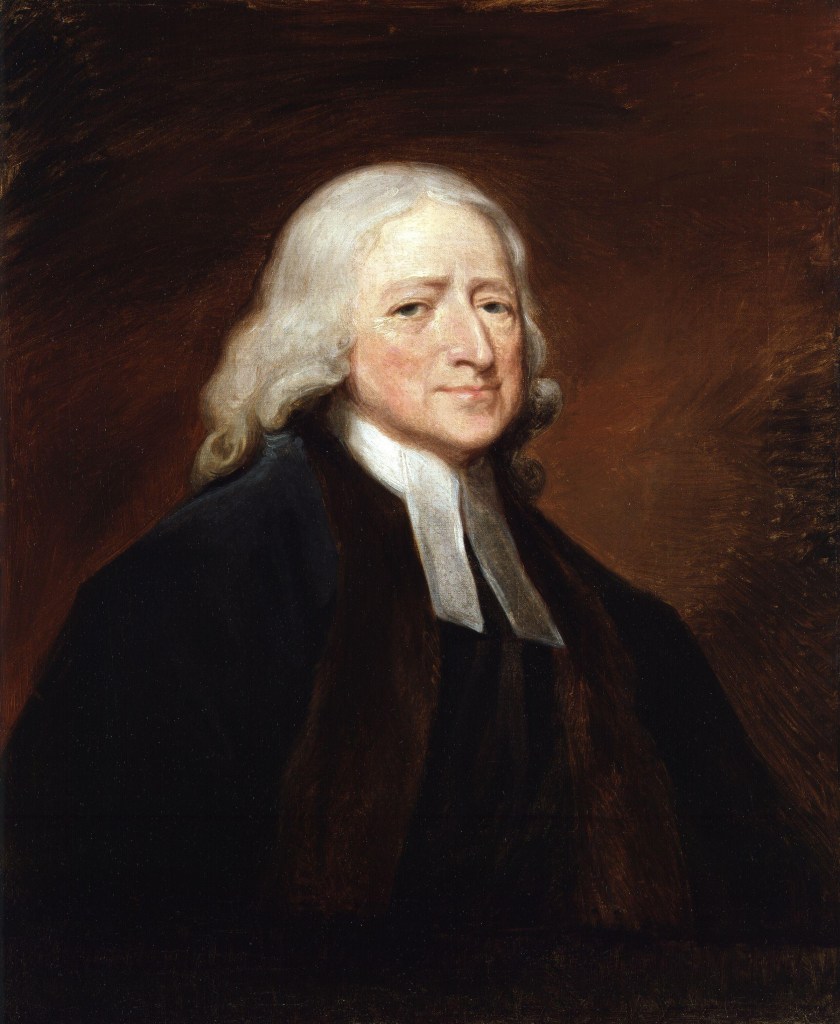
John Wesley
A painting of John Wesley by the painter, George Romney.

Meanwhile, George Whitefield was also coming up as a prominent figure of the First Great Awakening in England. Whitefield was born in 1714 and lived a non-believer’s life during his youth. Whitefield noted that when he was young, he was a vile and foul individual who reveled in worldly pleasures. However, Whitefield attended Oxford and became a member of Wesley’s Holy Club. With this, his own personal awakening began and he wrote that one night in 1735 he awoke and cried out for salvation from the burdens of sin he felt weighing so heavily upon him. From that moment forward, he was a changed man, becoming an Anglican priest the following year. He then traveled to Georgia and founded an orphanage before returning to England to preach there again. However, Whitefield also found many of the old guard of the church shunning him and closing their doors to him, forbidding him from preaching to their congregations. Nevertheless, Whitefield drew even larger crowds for his sermons outdoors and in massive fields.

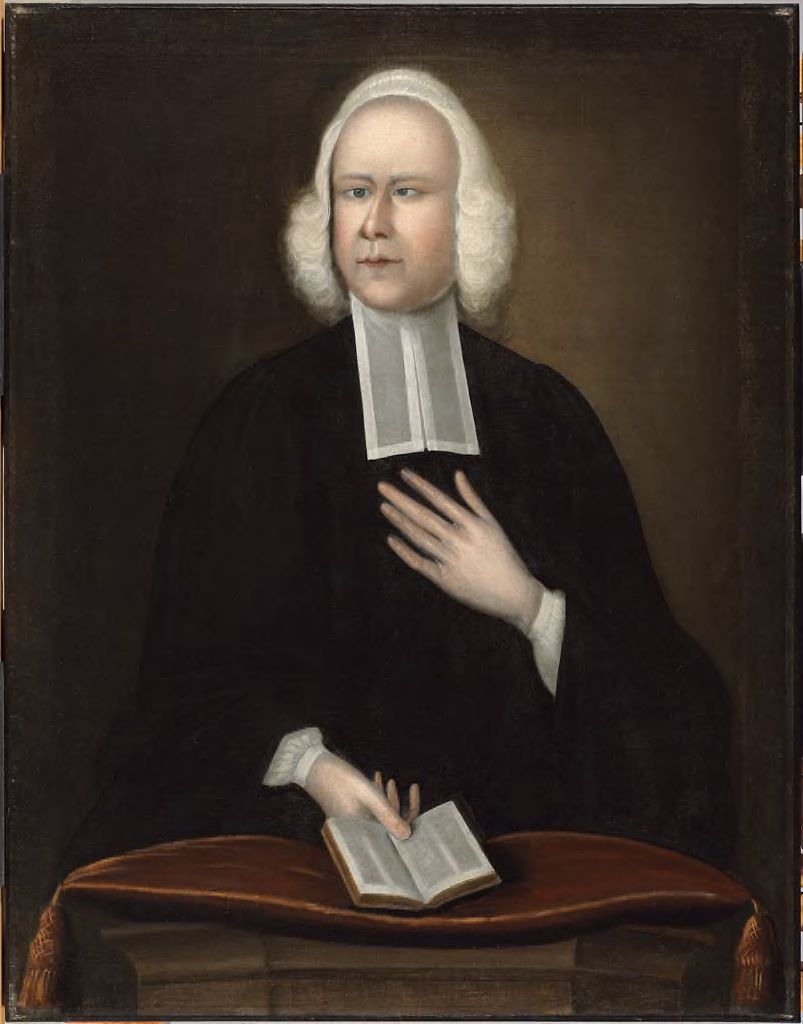
George Whitefield
A painting of George Whitefield by the painter, Joseph Badger which shows Whitefield’s cross-eyed vision.
Unification of the Colonies

The British Colonies were deeply divided among their different denominations. They squabbled over doctrinal differences in how they interpreted the Bible, and this prevented them from uniting as one Christian nation. However, Jonathan Edwards was born in 1704 and would become a uniting force for the budding American Colonies. Edwards attended Yale and became an assistant minister in the town of Northampton, Massachusetts under his grandfather. When his grandfather died, Edwards had to step up and take over as the only minister of the then second-largest church in the Colonies. He handled this position so well he was called upon to deliver a lecture at a commencement ceremony at Harvard in 1731. He preached his famous sermon, “God Glorified in the Work of Redemption” to a crowd far older and more experienced than he.

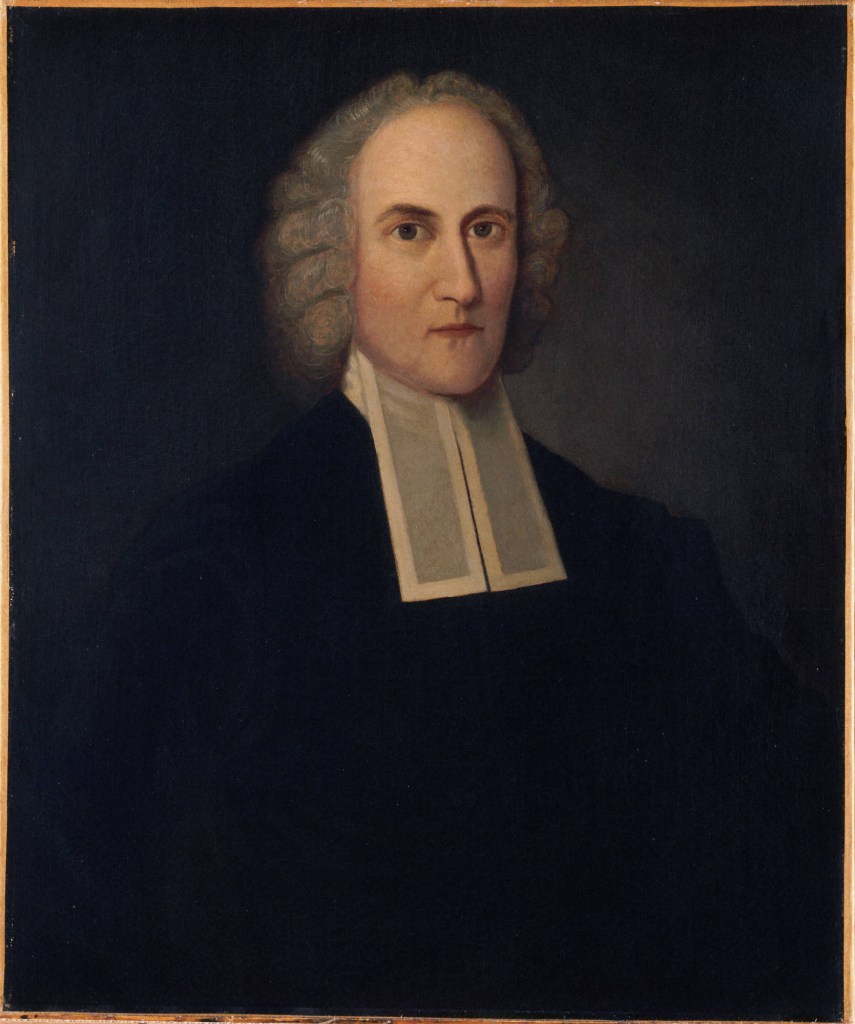
Jonathan Edwards
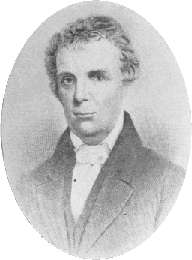
A portrait of Jonathan Edwards

Edwards continued to preach in Northampton, and there was a change which occurred in the surrounding towns. Edwards chronicled this mass of conversions in his book, A Faithful Narrative of the Surprising Work of God in the Conversion of Many Hundred Souls in Northampton and in the Neighboring Towns. Around this time, Wesley and Whitefield were doing their corresponding work in the mother country. They continued for some time, and Edwards gave one of his most famous sermons in 1741 after another preacher fell ill and he was called upon to fill the spot. That sermon was “Sinners in the Hands of an Angry God” in which the crowd notably became hysterical and cried out at numerous times throughout Edwards’ sermon. When the crowd became too loud, he patiently waited for them to calm back down before continuing.

New Lights and Old Lights

As mentioned, many of the old guard of the church who had become accustomed to the intermediary relationship they served between God and their followers were perturbed by the urging of men like Wesley, Whitefield, and Edwards for people to read the Bible themselves and form a personal relationship with God. Whitefield and Wesley were the target of numerous assassination attempts, none of which succeeded. Those who wished to stop the spiritual revival became known as the “Old Lights,” and those who wished to foster the awakening in the people were known as the “New Lights.” Many were inspired to abandon their different denominations and unify as Christians under one God after hearing the sermons of the New Lights. This was true even among the diverse and distinct Colonies.

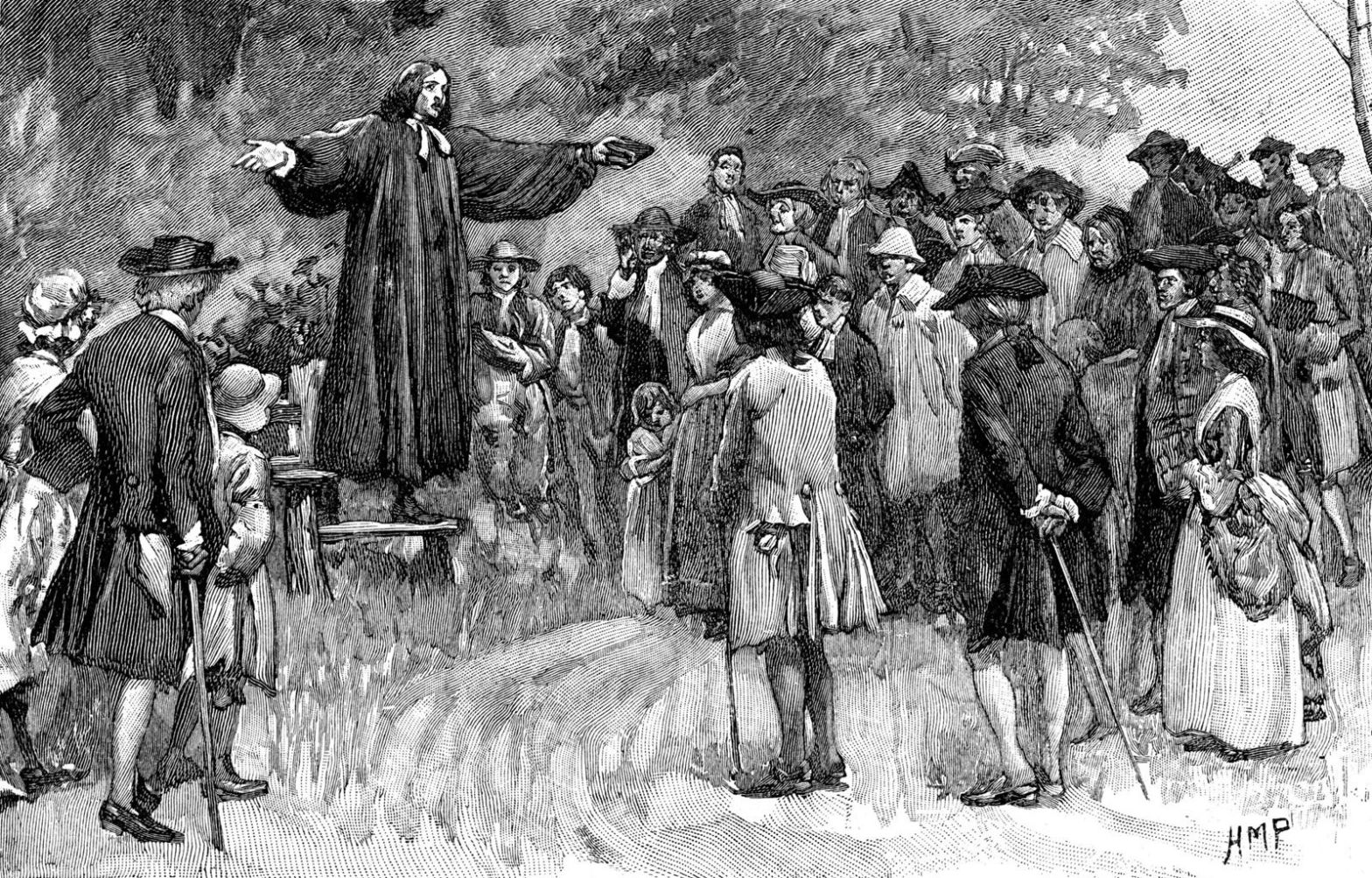
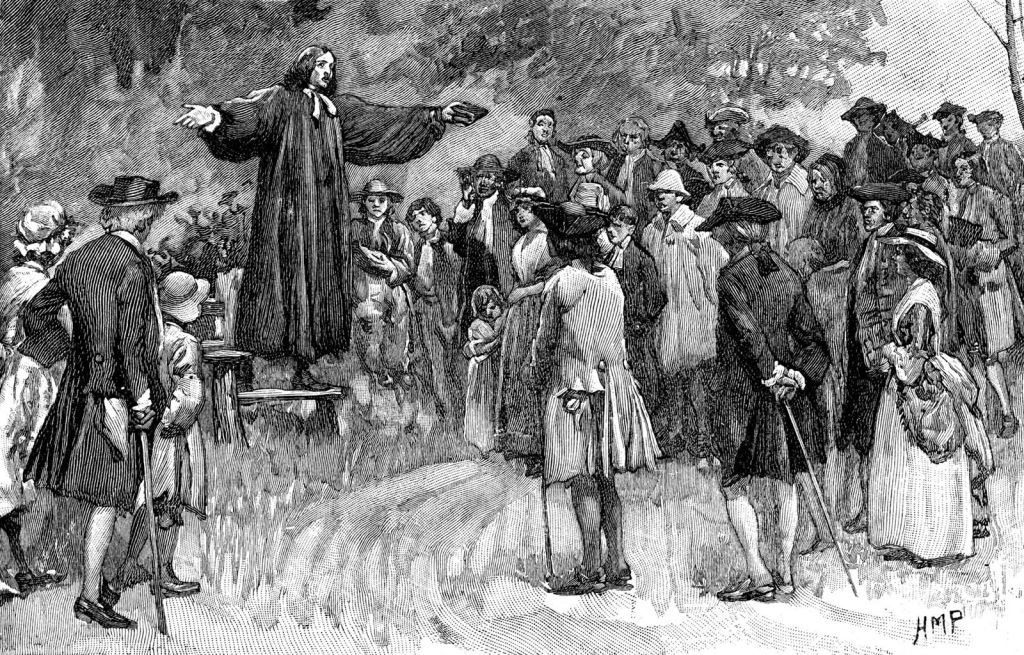
George Whiteman preaching
An undated engraving of George Whiteman preaching sourced from Encyclopedia Britannica

Even Benjamin Franklin, who was a notorious skeptic of the Christianity, was moved by one of Whitefield’s sermons in Philadelphia. Ben Franklin noted that following the preaching of the New Lights, it was as if life had returned to the towns which had fallen silent. People could be seen once again filled with joy and a renewed sense of purpose in places where it seemed hope was fading. The Colonies, which previously viewed themselves as distinct entities with little in common, began to unite under one banner, as one people. After that, they began to demand the freedom and liberty from the British crown which they felt was promised to them by God. One motto of the American Revolution rebuking King George III which swept across the new nation exclaimed, “No King but King Jesus.”

A Storm Sweeps the Earth

Many today may assume what is now known as “World War I” was the first world war ever seen on Earth. I would argue this is not so accurate. World War I – referred to as the “Great War” at the time – is referred to as such due to World War II being seen as a continuation of the Great War with a 10-year armistice. However, there have been several world wars beyond those of the 20th century. One such world war was the series of conflicts known as the Napoleonic Wars. This world war was incredibly complex, but was at least in part precipitated by Britain’s tensions with France, as well as the infamous French Revolution giving rise to a brutal, expansionist French state.

As mentioned, the First Great Awakening had the obvious influence of unifying the American Colonies under one banner and reigniting the passion for obedience to God among the newly formed American people. The Declaration of Independence asserted the God-given rights of the people which were being infringed upon by the British crown, and that the people would stand for it no longer. However, one protective factor of the First Great Awakening which is less mentioned is how it safeguarded the people of England against the kind of radical secularism which took root in France. This fervent rebellion against God led to the Reign of Terror among the French people, and the ideas spawned from this movement eventually gave birth to revolutionary communism, resulting in tremendous losses of life over the centuries which continue to this day.

Even though the British lost control of the American Colonies, they arose triumphant in the Napoleonic Wars and regained significant influence over the globe once more. This stopped the French proto-communists from taking over the globe, even though their ideas would spread and later give rise to the Soviet Union. The British population was also spared from the kind of ruthless self-depopulation which characterized the proto-communist French Revolution. Of course, the Napoleonic Wars are a story of their own worth telling, though that is a tale for another time. For the time being, the world was spared complete oblivion due in no small part to the First Great Awakening.


Creative Commons License

All posts by The Pen and Sword are licensed under a Creative Commons Attribution-NonCommercial-NoDerivatives 4.0 International License.

Heroes From History: Johnny Clem

John Lincoln Clem – commonly known as “Johnny Clem” – was a veteran of the American Civil War and one of the youngest participants of the conflict to engage in combat. He was originally born John Joseph Klem on August 13, 1851, but would later change his name and take on several nicknames. The American Civil War is often referred to as the “Boy’s War” due to the large number of underaged combatants involved in the conflict. As such, Johnny Clem was no exception, yet he was one of the most prominent boys who served in the war due to his prolific use in propaganda efforts by both the Union and Confederacy. Enlisting in the Union Army at the age of 9 years old, Johnny Clem became one of the youngest veterans in U.S. history, and certainly one of the most iconic.

Life Before Service

Given that he joined the Army while underage, Johnny Clem’s military service would certainly be considered part of his “early life.” Before that, however, he supported his family by selling produce from his parent’s farm on a cart he used to bring food into town. Johnny Clem was born and raised in Newark, Ohio. His mother died when he was 9, and Johnny reportedly did not get along with his new stepmother after his father remarried. This may have contributed to his desire to leave home and join the Union Army. However, Johnny was more inspired to join up by Abraham Lincoln’s speeches and seeing many of his other relatives enlisting in the fight.

Johnny started off his attempts to join the Union Army by skipping school to attend drills as a drummer boy with the 3rd Ohio Volunteer Infantry. He would make several attempts to join companies which moved through Newark without success. He was turned away by numerous commanders for his small size and age. Johnny then made attempts to ride a train further away from Newark and join a company where he was not so easily recognized, yet he was continually spotted by friends or family and sent back home. At one point he was rebuked by the commander of the 3rd Ohio Regiment who exclaimed the Army was not “enlisting infants.” Undeterred and determined to fight for the Union, Johnny continued his attempts to travel further away from home and find a unit which would enlist him.

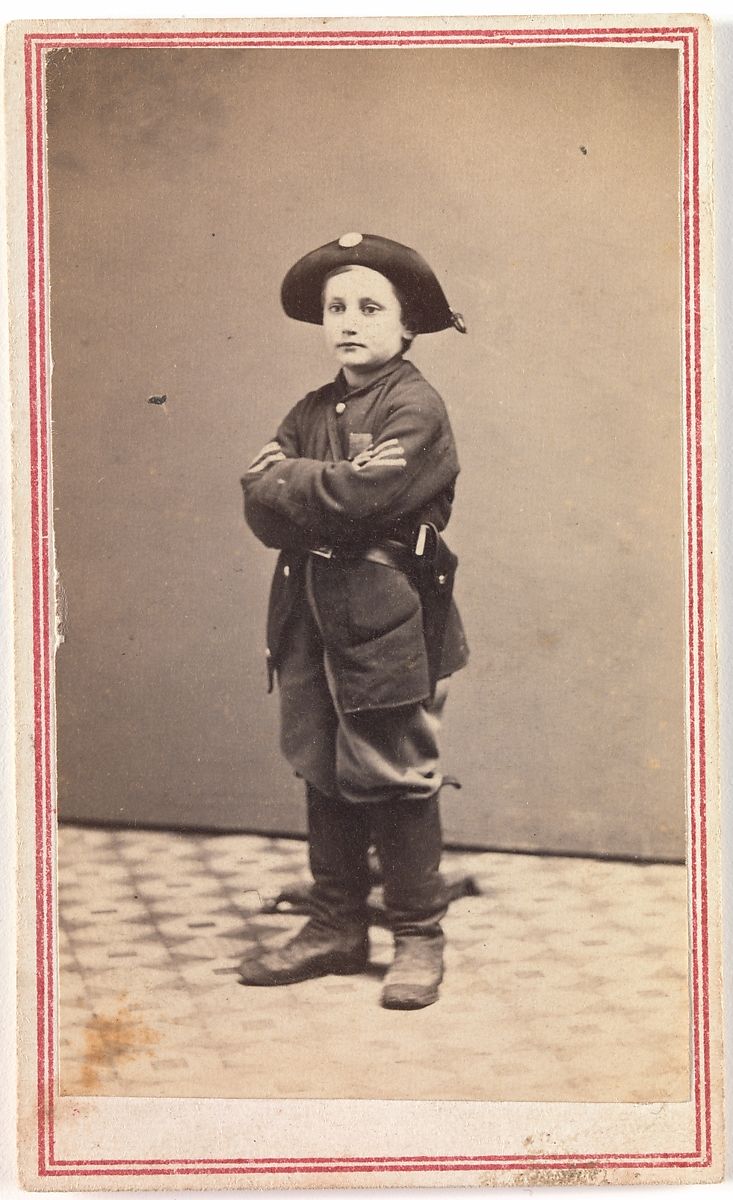
Johnny Clem
A poster of Johnny Clem during his service with the 22nd Michigan Regiment.
Joining the 22nd Michigan Regiment

Johnny was eventually able to travel far away enough from home that he found a unit which did not know him and could not send him back. That unit was the 22nd Michigan Regiment which took on Johnny Clem as an unofficial mascot and drummer boy. A group of officers pooled their money together to cover his $13 monthly salary under the table. He was provided with the smallest uniform available and a modified musket with a sawed-off barrel to match his small stature. In May of 1863, Johnny was officially enlisted with Company C of the 22nd and began receiving his own salary from the Union Army.

Jonny Clem’s involvement in the war was embellished somewhat as he became a popular subject for war photographers. Reports were made claiming he took part in battles which he could not have been involved in, such as the Battle of Shiloh. This earned him the new nickname of “Johnny Shiloh.” He also changed his middle name to Lincoln after his hero, President Lincoln. Johnny also earned the nickname the “Drummer Boy of Chickamauga” and the “Rock of Chickamauga” for his confirmed role in the Battle of Chickamauga.

Johnny Clem older
Johnny Clem continued to serve the U.S. Army after the end of the American Civil War.

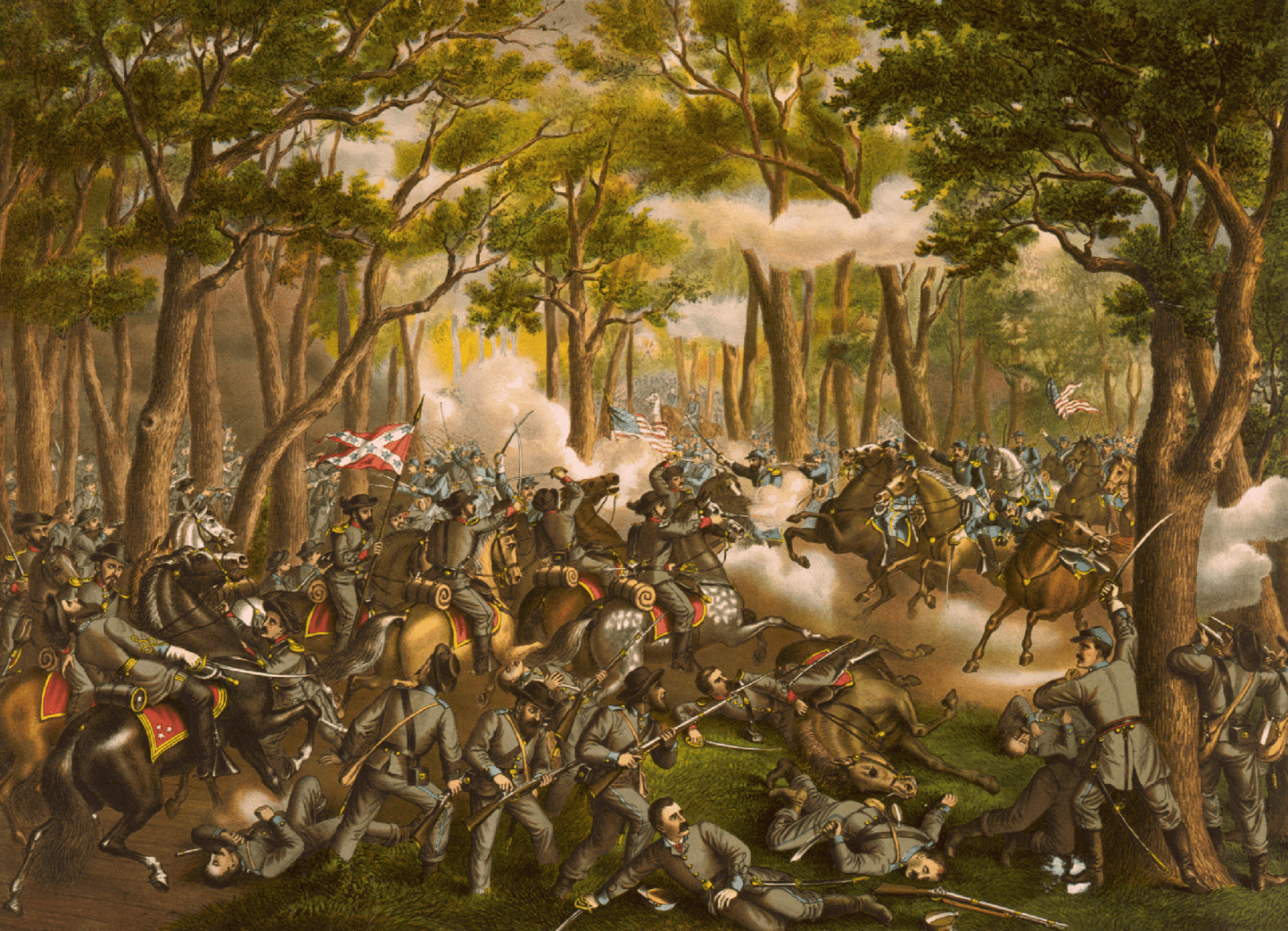
The 22nd Michigan Regiment was stationed at Horseshoe Ridge in Chickamauga when the Confederate Army came on September 20, 1863. The Confederates gained significant ground and began capturing members of the 22nd. When Johnny was first confronted and ordered to surrender, he was riding aboard an artillery piece with his shortened musket in hand. A Confederate colonel reportedly exclaimed that Johnny should put down his weapon and ordered him to “surrender, you damned little Yankee!” With no intent on being captured, Johnny shot the colonel and managed to escape. He was still captured later, but managed to escape again. After his valiant efforts in the Battle of Chickamauga, dispatching a Confederate officer and escaping imprisonment, he was promoted to the rank of sergeant. This made Johnny Clem the youngest noncommissioned officer ever to serve in the U.S. Army.

Life and Legacy

Johnny Clem would continue with his military career throughout the war, fighting in several other battles. He was wounded in the Battle of Atlanta twice, but managed to continue on and survive. He was discharged from the Army in 1864 at the age of 13 years old. Johnny would attempt to join the West Point military academy, but struggled to pass the entrance exams due to his lack of formal education. He was later recommissioned as a second lieutenant in the Army in 1871, serving the United States for the next 45 years, rising to the rank of major general. Johnny Clem passed away on May 13, 1937.

Johnny Clem retired
Johnny Clem served the Army his entire life before retiring at the rank of major general.

Johnny was far from an exception to the norm as an underaged soldier in the American Civil War. The conflict brought people from every walk of life into the fray as the country was torn apart from within. However, as one of the most prominent young boys who fought in the war, Johnny Clem shows us that we are never too small to make a big difference in the world. The drummer boy’s bravery and commitment to his country was legendary, far surpassing that of most boys his age throughout history. Some may call his service foolish, though to do so would be to engage in chronological snobbery and irreverence toward the conditions of life in that time. The American Civil War brought strife straight to the front door of many households, and everyone was needed to do their part. To that end, Johnny Clem played his part admirably, going steadfast into the unknown without allowing fear of giants to overcome him. For that, he deserves to be remembered.


Creative Commons License

All posts by The Pen and Sword are licensed under a Creative Commons Attribution-NonCommercial-NoDerivatives 4.0 International License.
Battle at the End of the World

After learning about the Battle of Guningtou, I felt inspired by the story of the “Bear of Kinmen” and the harrowing tale of this triumph over great evil in such a dark hour. Given I was very busy this weekend, I felt it would be a good chance to write a poem in honor of the Bear of Kinmen and all the other KMT forces who gave their lives fighting against communism back in 1949. Without their sacrifice, the world would no doubt have become a even darker place than it is today. Yet, due in no small part to the bravery and victory of the Nationalist Chinese forces on that fateful day, a faint light still shines on Taiwan today, defiant against the specter of communism.


A nation turned against the Lord
Embracing of the greatest foe
Old evils raise a new Red horde
Wherever it goes, death does follow
Desperate souls driven from their homes
Out to the ends of the Earth
A world on fire changes all they know
And tests each man to see his worth
Now gone away to lands offshore
To find some semblance of respite
Darting in flight from Red fiends galore
An island still clinging to the Light
The enemy lurks ever near
Lashing out from darkened lands
Meager souls train, unbeaten by fear
Preparing themselves for the final hand
Yet retreat offers no way in relief
The Adversary relentless in his pursuit
Solace stolen in the night by a thief
Any respite had till then, now moot
But fortune favored the brave that night
Even had they seen the truth not then
As tanks broke down in the place just right
And a warship mulled about to no right end
Then the heroes tripped upon their own mines
Lighting up the night with what seems dismay
Yet revealing the enemy landing with the tide
A blessing disguised in mysterious ways
Once more, battle raged and unfurled
As if men know not what else to do
Here, at the end of the old world
And the beginning of something new
The Red horde would not win this day
Their arms soaked wet by the sea
By the sword of cleansing, all captured or slain
Overrun by men who feared no such Adversary
Darkness rises with the Red dawn
And the Light must be ready for a meet
A constant struggle of right against wrong
The Red specter's return as assured as its defeat
The Bears of Kinmen did stand fast
And spared the new world of total disdain
The darkness then faltered at long last
Giving hope we may be redeemed once again

Creative Commons License

All posts by The Pen and Sword are licensed under a Creative Commons Attribution-NonCommercial-NoDerivatives 4.0 International License.
Historical Events: The Battle of Guningtou

The Battle of Guningtou on October 25, 1949 was a pivotal moment in history which restored the crippled morale of the Nationalist Kuomintang (KMT) forces of the Republic of China (ROC) in their fight against the dark tide of communism during the Chinese Civil War. The ROC, commonly referred to today as Taiwan, managed to repel an amphibious landing by Chinese Communist forces of the People’s Liberation Army (PLA) on the island of Kinmen. After the Communists swept across mainland China and established the People’s Republic of China (PRC) in Beijing, they were on the verge of total victory over the ROC. This crucial win was the first after a series of devastating losses, boosting morale for the KMT and stopping the spread of communism from being absolute. The “Great Victory at Guningtou” spared the last remnants of the Republic of China from the cultural destruction which would befall the mainland under communism and gave resistance to the red tyranny a chance to survive into the 21st Century.

The Specter Spreads

In the wake of World War II, Communist forces under the command of Mao Zedong swept across China, ushering in a new era of darkness which would continue into the modern era. By October 1, 1949, the Nationalist KMT forces under Chiang Kai-shek were in full retreat from the mainland. All of China’s major cities had fallen, with small pockets of resistance far off to the north and south soon to meet the same fate. The Nationalists fell back to Taiwan and maintained garrisons on several smaller islands near Taiwan, including Kinmen and Matsu. The Nationalists still had naval superiority at the time, and the Communists believed they needed to seize Kinmen and Matsu before invading the much larger island of Taiwan. Intent of wiping out the last vestiges of the Republic once and for all, the Chinese Communists launched an amphibious invasion of Kinmen that October.

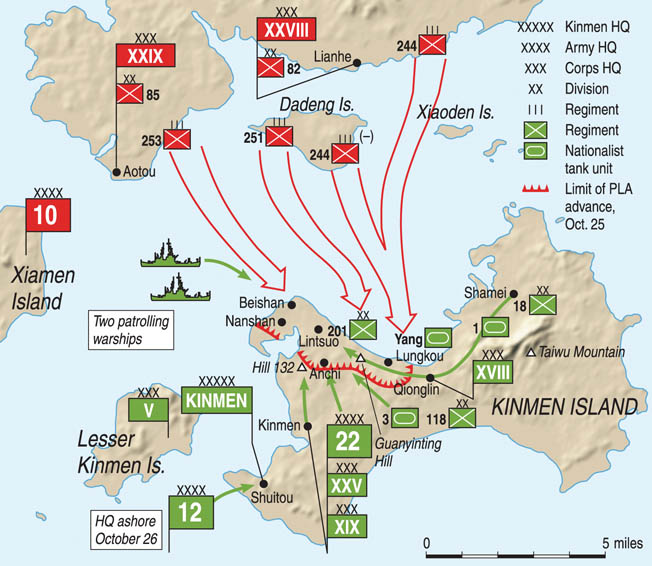
invasion plan
English-language recreation of the PLA invasion plan from warfarehistorynetwork.com.

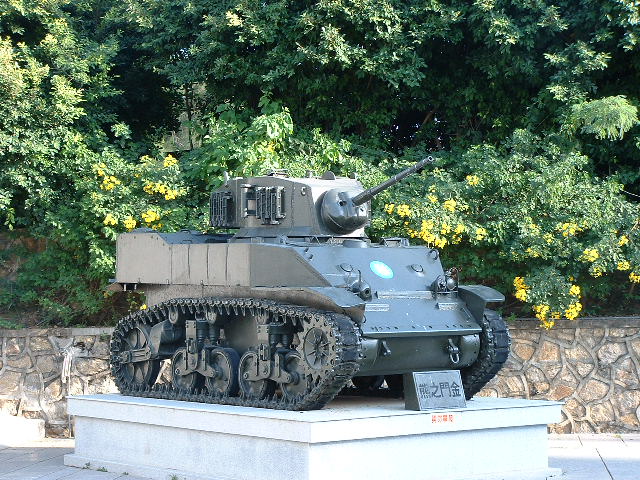
On October 17, the Communists captured the smaller island of Xiamen. Lacking a navy at the time, they commandeered local fishing boats to use as amphibious landing craft under the cover of night. After the fall of Xiamen, the Nationalists began fortifying their coastal defenses on Kinmen. Landmines and obstacles were set up along the beaches and troops began routine exercises to simulate repelling an amphibious invasion. The Nationalist forces on Kinmen consisted of roughly 40,000 men from the 12th, 18th, and 22nd KMT Army. They were supported by the LST 210, the Chung Lung of the ROC Navy as well as American-made B-26 and B-25 bombers of the ROC Air Force for close air support. The 1st Tank Battalion of the ROC also had American M5A1 “Stuart” tanks from their time serving with the Americans in India as the First Provisional Tank Group.

The Communists Strike

On the night of October 24, 1949, the Communists made their move. Their plan was to use the roughly 200 commandeered fishing boats to quietly ferry 19,000 troops onto the beaches of Kinmen over several trips before moving further inland to take positions at Guningtou, Lungkou, Huwei and dig in to repel a counterattack. If lucky, they would have amassed a large enough invasion force before being discovered and having to fight their way off the beach. However, only about 8,000 Communist troops managed to land on the first and second day before the PLA’s plan went amiss. In the early morning of October 25, fortune favored the Nationalists defenders when they set off one of their own landmines and put the whole island on alert. Flares were fired into the air, illuminating the Communists who had landed on the beach. With the invaders now revealed, the fighting began.

Battle of Guningtou
Artist’s depiction of the Battle of Guningtou at the Guningtou Battle Museum on Kinmen Island.

The Nationalist forces opened fire on the Communists who had already come ashore near Lungkou with machine guns, mortars, and artillery. The PLA tried to support their landing forces with artillery fire from the mainland, but had limited intelligence on the island of Kinmen and had to cease fire support in order for the Communist troops to attempt to move further inland without risking friendly fire. Also, a Stuart tank under the command of Lieutenant Yang Chan had broken down during exercises on the beach with a clear line of sight on the invaders. The Communists suffered heavy casualties landing at Lungkou and became pinned down on the beach from the many bunkers and three tanks wearing into them, resulting in their fishing boats being destroyed. Many of the Communist troops were unable to fight back at all due to their guns being waterlogged from the amphibious landing. When the Stuart tanks ran out of ammunition, they moved forward and used their hulking carriages to run over and crush the invaders stuck on the beach with nowhere to run.

The Communists coming in near Guningtou and Huwei managed to land safely, but their fishing boats became stuck on the obstacles along the beach due to the high tide and were eventually destroyed by shore bombardment from the Chung Lung. PLA reinforcements were cut off, and the Communists who made it onto the island were on their own for now, but those landing near Guningtou and Huwei had some initial success. They were able to push inland and hold defensive positions at Shuangru Hill, Guanyin Hill, and the Huwei Highlands for some time before the KMT forces could bring more tanks into the battle the next day and push them back. However, PLA forces were skilled at avoiding ROC tanks by this time, having fought against them extensively on the mainland. The Communists were able to avoid direct confrontation with the tanks in many instances, flanking infantry attempting to use the tanks as cover and avoiding encirclement before moving into the village of Guningtou for a final stand.

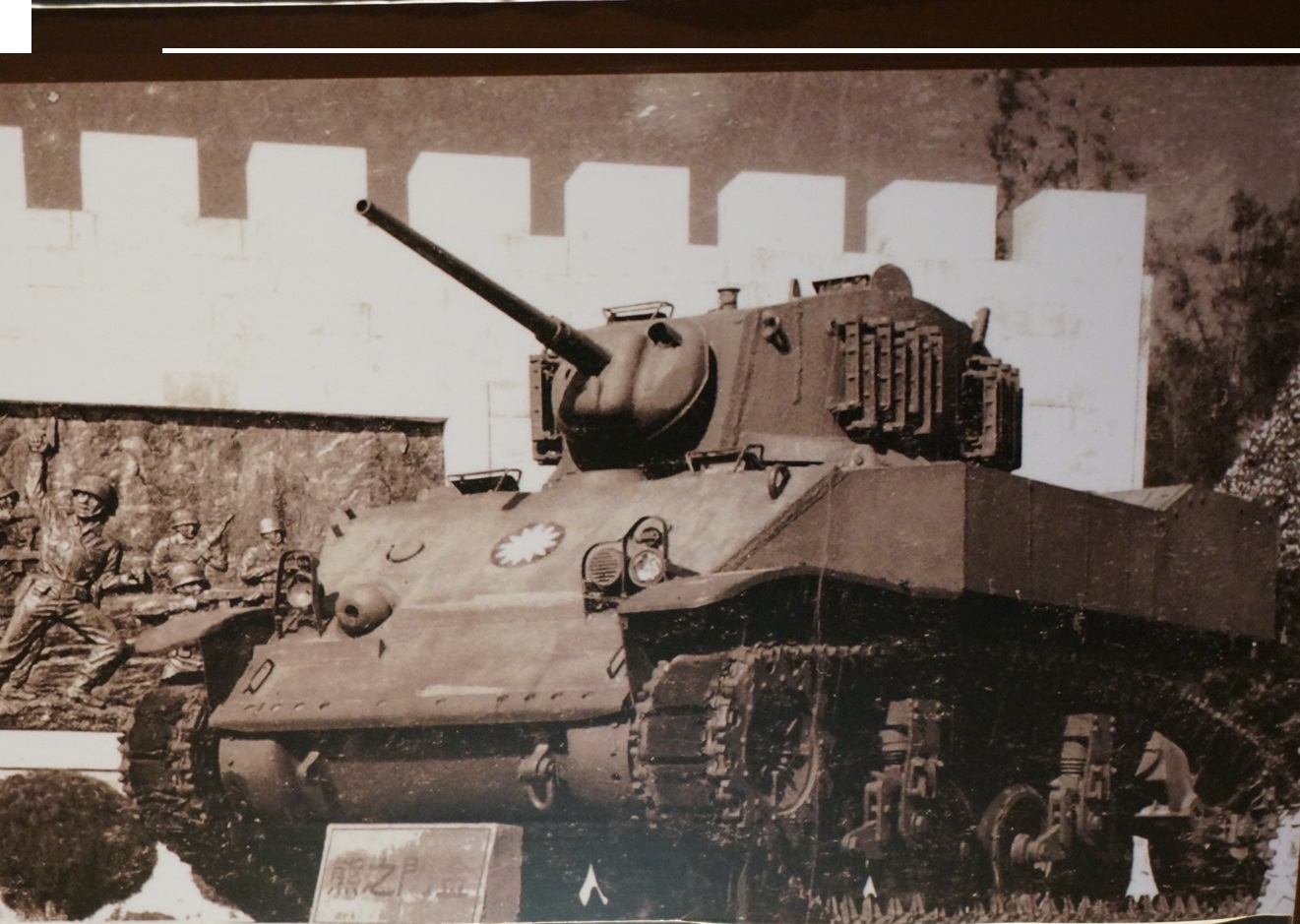
Bear of Kinmen
The “Bear of Kinmen” which was instrumental in repelling the PLA invasion.

On the third day of the invasion, about 1,000 additional PLA troops managed to land and reinforce Guningtou. Yet, this would not be enough. The Communists had found great success on the mainland due to spies and traitors among the ROC feeding them intelligence, and that advantage did not extend to Kinmen. Also, despite the reinforcements arriving, the Communists were still outnumbered and outgunned on Kinmen. Near the end of the last day, the Nationalist forces moved into Guningtou with tanks and limited air support. The fighting was bitter and bloody in the village, with significant close quarters and house-to-house combat. Eventually, the Nationalists wore down the Communists, pushing them out of Guningtou. Out of food, ammunition, and other supplies, the remaining Communists surrendered on the beaches of Guningtou with nowhere left to run.

Aftermath and Legacy

Following their defeat at the Battle of Guningtou, the Communists abandoned their ambitions of conquering Taiwan for the time being. The Nationalists were also dangerously low on morale at the time of the battle, having been driven from their homeland and losing control of the entire Chinese mainland. The major victory at the Battle of Guningtou was also considered to be one last desperate attempt to survive by the beaten and battered ROC. At the time, it was likely the first good news they had heard in a long time after a series of tragedies and defeats. By holding the line on Kinmen Island, the Nationalists also gave a future to the people of Taiwan and a home for traditional Chinese history and culture to survive unmolested by communism.

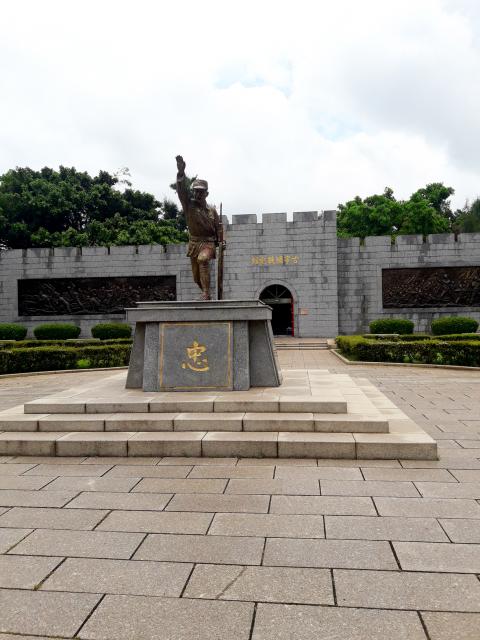
Guningtou Battle Museum
A statue of charging KMT soldier in front of the Guningtou Battle Museum.

It is also clear that someone was looking out for the Nationalist forces that fateful day. First, with the tripping of one of their own landmines revealing the enemy; to the waterlogged guns preventing the Communist soldiers from firing back; to the tank which just so happened to break down at just the right spot to repel the invasion force. While everything had gone wrong throughout the Chinese Civil War to lead the Nationalists to this point, everything seemed to go right at just the last moment before they were wiped out forever. As a result, they were spared complete annihilation at the hands of the Communists, and the people of Taiwan today have thus been spared from the horrors which ensued on the mainland under communist rule.

While information on the specific individuals involved in the battle is hard to find in English, the heroes involved in the defense of Kinmen Island in 1949 deserve to be recognized as a whole. Their efforts were instrumental in stopping the spread of communism in the 20th Century. For their sacrifice, all those alive today still have a chance to stand up against communism once and for all.


Creative Commons License

All posts by The Pen and Sword are licensed under a Creative Commons Attribution-NonCommercial-NoDerivatives 4.0 International License.
The Quiet Speech of Calm

I was busier than usual this weekend, and found myself pondering the value of rest in the moments I enjoyed it. This poem was born out of those ponderings. Next month, I will start to experiment with some different forms of poetry to see if I can find some new forms I enjoy.


Calmness speaks to us
Quiet peace, almost frozen
Abound with stillness
A lesson if we listen
In peace, we find strength
Resolve to fight our battles
Might needed at length
To leave God's foes in shambles
Take rest while it lasts
For peace is always fleeting
Ever out of grasp
Precious moments left reeling
We must be ready
Ready to answer the call
With our steady hand
To ensure God's foes will fall
So now, take your rest
While you may still find solace
Rest makes us our best
Ready to face the lawless

Creative Commons License

All posts by The Pen and Sword are licensed under a Creative Commons Attribution-NonCommercial-NoDerivatives 4.0 International License.
Heroes From History: William Eaton

William Eaton was a U.S. Army officer who led an expedition of U.S. Marines and hired mercenaries to Derna, Tripoli during the First Barbary War in 1805. He was the first American to lead forces into battle on foreign soil and raise the American Flag in victory over the enemies of the United States. William Eaton was an accomplished leader, warrior, and adventurer.

Terror on the Mediterranean

The Barbary States of Morocco, Algiers, Tunis, and Tripoli waged campaigns of piracy and slave raiding against merchant vessels and coastal villages in the Mediterranean Sea. The Muslim pirates depopulated entire regions taking hundreds of thousands of Christians as slaves, which the Ottoman Empire condoned as part of their war against all they declared infidels. Previously, the Knights of Malta had kept the Barbary pirates and slavers at bay. However, Napoleon Bonaparte attacked and plundered the Knights of Malta in 1798, stripping the world of the defense they had previously provided. Now, the scourge of the Barbary was set loose upon the seas in earnest.

The United States had disbanded its navy following the conclusion of the American Revolutionary War. Congress did not wish to pay the costs for maintaining a navy, despite warnings that doing so would invite future attacks against the country. This quickly came to pass for the young nation, as the Barbary were extorting American merchant vessels for safe passage through the Mediterranean, demanding the U.S. pay “tribute” or face attacks. Even when this tribute was paid, American vessels were still at risk of being raiding by the pirates and slavers. The attacks increased in severity when Tripoli declared war on the United States after Thomas Jefferson was elected president and refused to continue paying tribute to the Barbary.

American Forces Deploy

In 1801, Jefferson sent a naval squadron to the Mediterranean with the mission to patrol the sea lanes, protect American merchant vessels, and interdict enemy ships. They attempted a blockade of the Barbary in 1803 and launched sorties on the enemy ports to try and destroy ships at anchor when they were most vulnerable. This proved to be unsuccessful, however, as the Barbary ports were heavily defended by a combination fixed artillery on land in forts and mobile units both on land and in the harbor. The American forces made numerous attempts to destroy the enemy fleet at anchor. They tried frontal naval assaults; deploying in small boats to scale city walls and burn ships with torches; and even attempted sending a fire ship loaded with explosives to suicide bomb the fleet. However, all these efforts were repulsed by the well equipped and highly coordinated Tripolitan forces, and the USS Philadelphia was captured and converted into a stationary weapons platform. In 1804, the Americans scored some victories after allying with the Kingdom of the Two Sicilies which had just declared war on Tripoli, but they never managed to ameliorate the threat completely.

A Plan and a Journey

Dismayed with the inability of the naval task force to quell the enemy conventionally, William Eaton came up with plan to ameliorate the treat posed by the Barbary. Yusuf Pasha Karamanl was in charge of Tripoli at the time after deposing his brother, Hamlet. Eaton and Hamlet agreed that if the U.S. helped Hamlet take back power, he would end hostilities between Tripoli and the United States. Eaton was able to persuade Congress, the Secretary of State, and the President to fund the regime change plan as a quicker and more effective alternative to the as of yet unsuccessful efforts at a purely naval campaign. Eaton received $40,000 worth of weapons and supplies for the mission.

Eaton then made his way to the city of Alexandria in Egypt where he met up with Hamlet Karamanl and a group of 8 U.S. Marines under the command of Lieutenant Presley O’Bannon. They hired a mercenary band of between 300-500 Greeks, Arabs, and Berbers to bolster their numbers. This was a great risk, as their loyalty was to their pocketbooks rather than the mission at hand. However, it was a risk which would eventually pay off. With his small army in tow, Eaton began his march across the deserts of North Africa. This would prove to be a challenge all by itself, and tested the limits of Eaton’s hired men.

William Eaton and his forces marched 500 miles, or about 800 kilometers through the desert from Alexandria, Egypt to reach their target of Derna where they were to assault the city by land while the naval squadron attacked by sea. Food rationing began from the start and all the men had to make due on half day’s rations for the journey. They reportedly only marched 5 miles a day toward the target city, as they spent much of their time arguing and searching for water. Religious differences between the diverse group of warriors also became a problem. Threats of mutiny and demands for more pay became common, even from Hamlet himself. Yet somehow, Eaton managed to lead the men out of the desert and all the way to the city of Derna after 52 days of marching.

Out of the Frying Pan and Into the Fire

After arriving at Derna and surveying the defenses, Eaton was dismayed. The city was heavily defended by forts with up to 8 heavy artillery guns and barricades with murder holes along the city walls. Eaton wrote a letter to the governor of the city, Moustapha, asking for safe passage. After such an arduous journey through the desert and seeing the city up close, Eaton was not inclined to fight. However, Governor Moustapha denied his request, writing back, “My head or yours.” As such, Eaton readied his men to attack the city.

Attack on Derna
“Attack on Derna” by Charles Waterhouse

On April 27th, 1805, the USS Nautilus opened fire on the shoreline of Derna with its artillery. The USS Hornet and the USS Argus arrived the next day and joined in the shelling. The day after that, Eaton and O’Bannon moved in on the city from the east and south. The marines and mercenaries approached under heavy fire from muskets, but the heavy guns had their attention drawn to the attacking ships. William Eaton was shot in the left wrist during the battle, but he kept on despite the injury, overcoming his then limited ability to aim his weapon. In the first 45 minutes of the battle, the enemy artillery was eliminated, and the city’s defender’s were left to fight with muskets and blades. With the attention of the city’s defenders split, the Americans surrounded and closed in on the city, wiping out the Barbary warriors and raising the American Flag on foreign soil for the first time in under 3 hours.

During the battle, the U.S. Marine, John Wilton was killed in action. Two other Marines, David Thomas and Bernard O’Brian, were both injured. Nevertheless, the managed to capture the city of Derna and completed the first phase of their plan. Now, they had to hold the city against enemy counterattack, and eventually march across the desert once more to attack Tripoli itself. Eaton and his men dug in for the inevitable enemy response, fortifying the town as best they could.

The counterattack from Tripoli eventually came, and being heavily outnumbered, Eaton and his men were unable to hold the city walls. Their defensive lines were broken and pushed back to the governor’s palace. However, Eaton turned the tide before the city fell back into enemy hands by turning the artillery guns inward on the city and targeting the Tripolitan forces. Eaton and the U.S. Marines held the city for six weeks before Tripoli finally surrendered. Without needing to remove Yusuf Pasha Karamanl from power, he agreed to a ceasefire and the release of captured Americans he had in his possession. The First Barbary War was over, but hostilities between the U.S. and the Barbary would not be resolved so soon.

William Eaton’s Legacy

As a reward for his valiant and courageous service to the United States, William Eaton was awarded by the Virginia Legislature with a ceremonial Mameluke-style sword which serves as the pattern for officer swords in the U.S. Marine Corps to this day. It is said that Prince Harmet Karamanli was so impressed with Eaton as well that after he was reinstated, he awarded Eaton with a similar sword. The Marines’ Hymn also recounts this epic tale with the first line of the song: “From the halls of Montezuma to the shores of Tripoli, we fight our country’s battles in the air, on land, and sea.”

William Eaton’s story is a massive inspiration to me. It is incredible how he was able to march such a large and diverse group of warriors hundreds of miles across the desert without losing any of them to death or mutiny. His leadership and communication skills must have been legendary. Then to still be able to lead them in battle and take the city of Derna, and then going even further and holding the city against a numerically superior force when the counterattack came. Such a feat was incredible on its own and speaks to the daring and skilled nature of Willaim Eaton.

He also showed the value of ingenuity by achieving such a tremendous success with relatively little advantage after so many attempts to quell the enemy by sea had failed. Eaton knew the Barbary was strongest out on the water and in their harbors. Thus, an assault by land from behind their artillery guns was needed to overtake them. The journey he undertook to achieve this is a legend in and of itself, which is why William Eaton certainly deserves to be remembered as one of the great and accomplished heroes of history. If we all could emulate a small fraction of his perseverance, bravery, and cleverness, we too can achieve great things in our lives.


Creative Commons License

All posts by The Pen and Sword are licensed under a Creative Commons Attribution-NonCommercial-NoDerivatives 4.0 International License.
When Honor Fades to Pride: A Haiku Series

I feel it has been some time since I wrote a haiku series, and I was starting to miss the simplicity of it. I was also reading about the Battle of the Wilderness during the American Civil War in early May of 1864. The Union forces threw themselves at Confederate positions to no avail, and survivors recounted the piles of corpses left in the wake of the carnage. Learning more about the experiences and perspectives of the combatants on both sides throughout the conflict provided the motivation for this haiku series. The American Civil War showed the brutality and the cost of a conflict where brother was turned against brother and neighbors became enemies.


A nation at war
Brother fights against brother
Father against son
Wanting ever more
Friends turn on one another
Eager to shed blood
Men of honor fade
Civility dies with them
Only pride remains
Now is time to fight
For our God and country too
Lest we lose it all
Brothers rip and tear
Incapable of reason
Their love has long gone
One blinded by pride
The other led by God's word
Destined to cross blades
Eyes meet no longer
Both sides see themselves as right
Only one may be
Locked in endless grief
Warrior blood flows through both
Neither can back down
The dead fill the land
And questions start to plague us
Where did we go wrong
May God forgive us
For we have strayed far from Him
We shed our own blood
But peace is not ours
Until we have earned its grace
And made ourselves whole
We have earned this war
With our hubris and our pride
And our own sense gone
But we carry on
For such is our lot in life
To set our path straight
In time, all will heal
Old wounds mend to bitter scars
To find Him once more

Creative Commons License

All posts by The Pen and Sword are licensed under a Creative Commons Attribution-NonCommercial-NoDerivatives 4.0 International License.
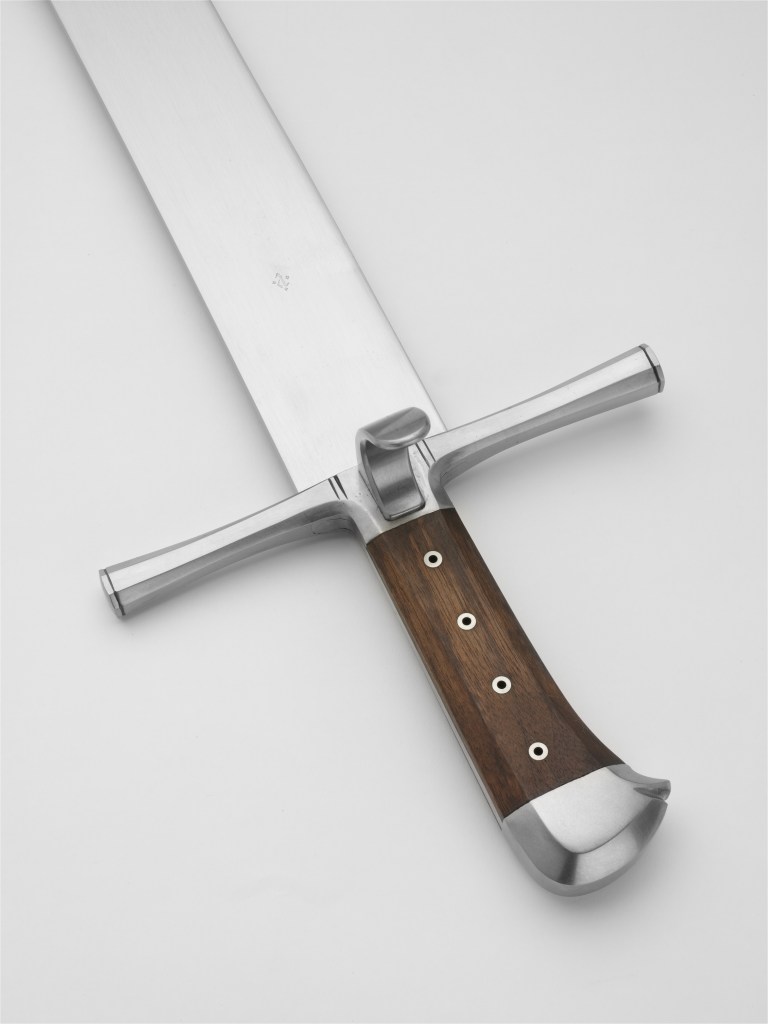
Iconic Weapons: The Messer

The “messer,” meaning “long knife” in German, is a weapon which was prominent in Germanic territories during the Renaissance era. It was called this for its hilt, which was constructed with a full tang and lacked a pommel, making it akin to a very large knife. The weapon was used throughout the 15th and 16th centuries as well as onward. As such, it experienced many different variations and changes in blade length and shape, hilt length, and guard design. The weapon experienced such evolution because it was terrifically effective and incredibly versatile, leading it to be used by commoners and nobility alike, as the utility and effectiveness of its design could not be denied.

Different Variations

The “kleine messer” was a small, dagger-sized version of the messer with a single-edged blade only about 12 inches long and a fine point for thrusting. It was a fighting knife and would not have been long enough to be considered a sword. It made an effective dagger, useful for thrusting between armor when up close or grappling with an opponent.

The “langes messer” is arguably the most iconic design, being the short sword with a knife hilt that was carried by commoners and nobles alike. It had a blade length of around 25 inches with a single cutting edge. These could have one-handed or hand-and-a-half hilts. Later versions added more hand protection in the form of a “nagel” in addition to a crossguard, which is a third stub protruding over the hand out from the flat of the blade instead of the edges.

The “grosse messer” was a longer, two-handed version of this iconic sword design. Meaning “great knife” or “war knife,” this version would not become as popular as the langes messer due to its size making it more of a dedicated battlefield or bodyguard weapon. With a typical blade length of 30 inches or more, this version was a bit too large for the average person to consider carrying daily for self-defense. Nevertheless, mercenaries and others making common use of swords found the grosse messer to be a great weapon of choice for their professional duties.

Langes Messer
The distinction between the earlier falchion and the later messer was in the knife-like hilt, as the blade profile was virtually the same.
Prominence of the Langes Messer

The langes messer became very popular and saw widespread usage as both a commoner’s and noble’s weapon of choice due to its exceptional design. The blade has good balance with a full tang, eliminating the need for a pommel to counterbalance the weight of the blade. It has a hefty blade profile for great cutting power, and many had a cut edge to help facilitate thrusting. Its single-edged blade made it cheaper than double-edged swords, and it was a rather short sword, contributing to its lower cost as well. Some sources say that its knife-like hilt also skirting restrictions on civilians carrying swords in some Germanic regions, since it was technically not a sword. It was a “long knife.”

The langes messer had essentially the same blade as a falchion from the medieval period, but with a knife’s hilt rather than the typical cruciform hilt with a pommel of earlier Germanic swords. The edge of the blade could be on the outside or inside of the curve. An outside edge was far more common in the past and today with reproductions, and an outside edge would make for better slicing cuts. However, an inside edge is useful as well, turning the weapon into more of a chopping tool, like an axe. Both types of edges would likely cut just as well, broadly speaking. Although, an inside edge might make the messer more useful as a general tool for chopping wood and meat, in addition to being a great self-defense weapon.

An Exceptional Tool

Like the falchion of the medieval period, the messer could be used as a sidearm, for self-defense, or as a utility tool. It was small and light enough to be carried daily without encumbrance, but big enough to be useful as a versatile weapon rather than a simple cutting tool or just a backup weapon. I do not know if any messers were historically made with a false edge, but one could be added to it to give it even greater versatility in combat at a slightly higher cost. The knife-like hilt design is also unique for a sword and gives the weapon a distinct, aesthetic appeal. These factors no doubt all came together to make the weapon as prominent as it was, since not all weapons throughout history find themselves being employed by the almost the entire society from the richest to the poorest members alike.


Creative Commons License

All posts by The Pen and Sword are licensed under a Creative Commons Attribution-NonCommercial-NoDerivatives 4.0 International License.
Iconic Weapons: Falchion

The falchion is a one-handed, single-edged sword of European design which saw widespread use in the 13th and 14th centuries. It was noted to have seen service as late as the 16th century, but then began to fall out of use. The blade of the falchion is similar in design to the Persian scimitar and the Chinese dadao, but with a cruciform hilt which was iconic of medieval European arming swords. With a hefty blade, it is said to combine the strengths of an sword and axe into one tool, making the falchion both versatile and strong. Some versions may have had a false edge, which is a partially sharpened back edge to help facilitate thrusting. However, the weapon was primarily a cutting tool.

Very few falchions have survived into the modern day. Only about a dozen have been found and preserved. However, they are depicted in artwork and included in some manuscripts. This, combined with the few which have been discovered by archeologists, show the falchion did indeed exist. Falchions are said to have weighed less than two pounds with blades between 37-40 inches in length. This is about half the length of a classic longsword, making the falchion rather short by comparison. It was a common sword used during the Crusades by both knights and commoners alike. However, it is speculated there may have been some stigma surrounding the falchion as a “poor man’s weapon.”

Falchion
An Italian falchion from the 15th century. The falchion saw use as late as the 16th century.

As a one-handed, single-edged sword, the falchion was cheaper to produce than two-handed, double-edged swords such as the classic European longsword. Also, longswords may often have been ornate with decorated hilts and engravings in the blade, whereas the falchion is said to have been mass-produced and crude in its construction. Still, knights were known to carry the weapon, likely due to the appeal of its versatile design. Not only was the falchion an effective weapon which could severe limbs and heads with a single strike, but it was also useful for non-combat applications. Some sources claim certain falchions were great tools for chopping wood do to their large and hefty blade. Carrying a single tool which could be used effectively both in and out of combat for a variety of tasks would have convinced some knights to carry the weapon in favor of other, more expensive swords.

There are said to have been two different types of falchions: “cleaver” falchions and “cusped” falchions. The cleaver falchions were broader and more like a machete, while the cusped falchions were thinner and more akin to a saber. Of the surviving falchions, they do vary greatly in thickness and in how ornate they are. As with most swords, many variations were created by different sword makers separated by time and space, all trying to design the best sword for the challenges faced in that era.

Falchion
A 21st century sword constructed in the historical design of a falchion.

What I find most inspiring about the falchion is the versatility and simplicity of its design. While the single-edged blade arguably makes it less versatile in sword-on-sword combat compared to a double-edged blade, it did make the weapon much cheaper because it required less time and effort to grind out the edge. This, combined with the shorter length of the blade, allowed many more to be produced, putting them into the hands of more warriors than the more expensive longswords. While generally speaking, more range in better, the falchion could also be paired with a shield to mitigate the weakness of the shorter length of the blade. Additionally, it should be said that while a longer weapon is generally better, a shorter weapon does become more effective as the distance is closed, eventually eclipsing longer weapons which cannot be used effectively at very close ranges.

The cleaver-type falchions are also said to have had applications outside combat. They could be used in place of an axe, allowing someone to carry a falchion as a multipurpose tool instead of bringing multiple tools. On long campaigns, this could be tremendously valuable to a soldier or traveler. This is also where the smaller size would be a boon as well. If one is going to be spending a lot of time marching long distances and making camp away from towns or cities, a smaller weapon will be easier to carry. As long as it is not too small so as to be ineffective in combat, a more compact sword like the falchion may be preferable to many seeking to lighten the load they are carrying.

Falchion
The falchion is a type of backsword, a single-edged sword with a one-handed hilt.

The falchion is an interesting sword design combining the classic cruciform hilt of other medieval European swords with the simpler, single-edged blade. Simplicity, practicality, and versatility are always appealing to me. While the shorter length and single edge are arguably less versatile, the heft of the sword and its subsequent utility outside of combat do give the falchion other perks which make it appealing. I also love the aesthetic of the falchion as a sort of mean-looking saber. Many backswords are thin and seem frail by visual comparison to the falchion, which is a chunky little sword. I am glad at least some survived to be on display in museums today.


Creative Commons License

All posts by The Pen and Sword are licensed under a Creative Commons Attribution-NonCommercial-NoDerivatives 4.0 International License.
He Has Not Yet Begun to Fight

John Paul Jones is often considered one of the Fathers of the United States Navy. He was a privateer who joined the Continental Navy during the American Revolutionary War. However, since he worked with mercenaries, pirates, and other soldiers of fortune under his command, he found himself betrayed by his own crew on more than one occasion.

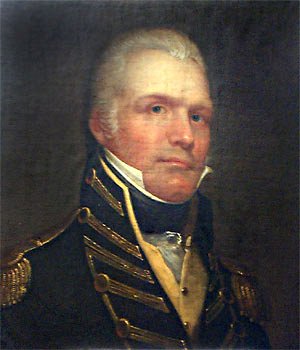
The life of John Paul Jones is an inspiring tale of the importance of perseverance. Surrounded on all sides by people he could not trust, he still pulled victory from the jaws of defeat time and time again. A driven individual, he was the one true believer in the cause he fought for among soldiers of fortune who only cared for coin and glory. For that reason, he is remembered fondly and honored today as a man who always gave life his all when it seemed no one else would.

This was the case during the Battle of Flamborough Head when the Alliance, one of the ships in Jones’s squadron when he was in command of the USS Bonhomme Richard, opened fire on him in an attempt to steal all the glory of sinking the British ships. Nevertheless, Jones continued to find success, defeat his enemies, and live to tell the tale in spite of such treachery, time and time again.

One can only wonder how impactful Jones would have been if he had a loyal crew at his side. This poem recounts the tale of his pyrrhic victory at Flamborough Head when despite the odds against him, the daring captain managed not only to take the day after his ship was critically damaged, but also capture and commandeer the enemy’s vessel.

John Paul Jones and the Battle of Flamborough Head
An artist’s depiction of John Paul Jones and the Battle of Flamborough Head.

Outnumbered at sea
Off the coast of hostile land
Far from home, they be
One young mercenary band
John Paul Jones, his name
A rascal with luck's good grace
To him, war, a game
In battle, he found his place
Hear the drums of war
Ships stare one another down
Here at Flamborough
Where young men have come to drown
All that's right goes wrong
Cannons ring across the sea
Gunfire sings a song
A song full of suffering
A battle now yet rages
Pain and fury fill men's hearts
A battle for all the ages
A final test of one's art
Traitors hunt for glory
Firing on both friend and foe
To tell their own story
They risk everyone they know
His ship now broken through
Fire and water closing in
One thing there is yet left to do
If free men are still to win
Their ships now bound up tight
Jones gives the order to board
Charging now, close in to fight
The gunfire, brave men ignored
Surrender, they say?
He's not yet begun to fight
They would all rue this day
Those who challenged Jones's might
Gun and blade are fiercely drawn
Free men face death with courage
Friends and brothers soon are gone
Those who survive are savage
Pushing past all to the brink
Every effort made to destroy
None can bear to hear or think
Yet fate would favor these brave boy
A stroke of luck then came
A stray grenade that met its mark
Soon to light up a great flame
And end the fight with a fierce spark
That day, did Jones find victory
And they said that he brought freedom
To all the Atlantic's highborn seas
And sorely did they need him
A pirate some say
The Terror of the English
He did win this day
His foes surely to anguish
Hero or villain
Surely not a man of ill
Though he was wanton
Always seeking too much thrill
A hero we know
Untethered as he had been
He found his way home
As a true American
And this was the tale
Of he known as John Paul Jones
Always to prevail
He had a will made of stone

To learn more about John Paul Jones, click here to read the story of his infamous White Raven Raid.

Creative Commons License

All posts by The Pensive Warrior are licensed under a Creative Commons Attribution-NonCommercial-NoDerivatives 4.0 International License.