
The American Long Rifle, known by a few other names, was a commonplace weapon on the American frontier before and during the Founding Era. Used more by hunters than soldiers for its greater accuracy over a musket, but longer reload times, the weapon did still see use in combat by marksmen.
It was also ubiquitous with the people who used it in its day, being a household staple in many families. The innovation in its design – the rifled barrel – would eventually become the standard for firearms over the predominant smoothbore muskets of its day.
Design & Usage
American Long Rifles ranged from .40 to .60 caliber. This was due to them being designed and modified in different places and by different people. It was not necessarily a standard-pattern weapon. More of a “general idea,” one might say. These rifles could be between 5-6 feet long, made mostly of maple wood. The barrel would be shaped from soft iron, with a length of approximately 42-46 inches. Some accounts claim the rifle could be accurate up to 200 yards, whereas a British colonel, George Hanger, said he once measured out a shot made up to 400 yards.
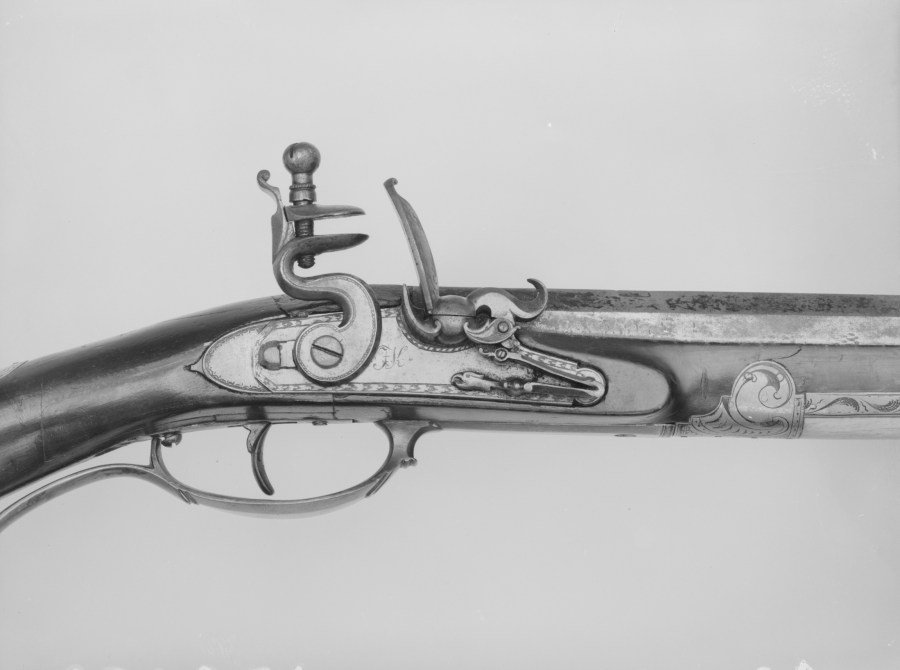
The rifled barrel gave it much longer reload times compared to smoothbore muskets like the Brown Bess. Hence why muskets were often favored in combat until later innovations in firearms technology. However, the rifled barrel was also the source of this weapon’s precision. Therefore, the American Long Rifle was used by marksmen to hit a single target at a great distance. This made it mostly useful for hunting, although it still saw its share of engagements in the French & Indian War and American Revolutionary War. Due to its incompatibility with a bayonet, the firearm would be carried with a folding pike or other melee weapon.
History & Significance
The American Long Rifle was designed by German immigrants in Pennsylvania. As such, it has been referred to as the Pennsylvania Long Rifle. However, the first time it was given a name may have been when it was called the “Kentucky Rifle” in the song, “The Hunters of Kentucky.” Naming conventions were certainly not so standard in that time and space.
This reminds me of the modern names we have concocted for all different manner of swords , whereas they were all typically just called “swords” in the language of the people using them at the time. I would not be surprised if the weapon, familiar as it had become on the American frontier, was simply called a “rifle” most of the time.
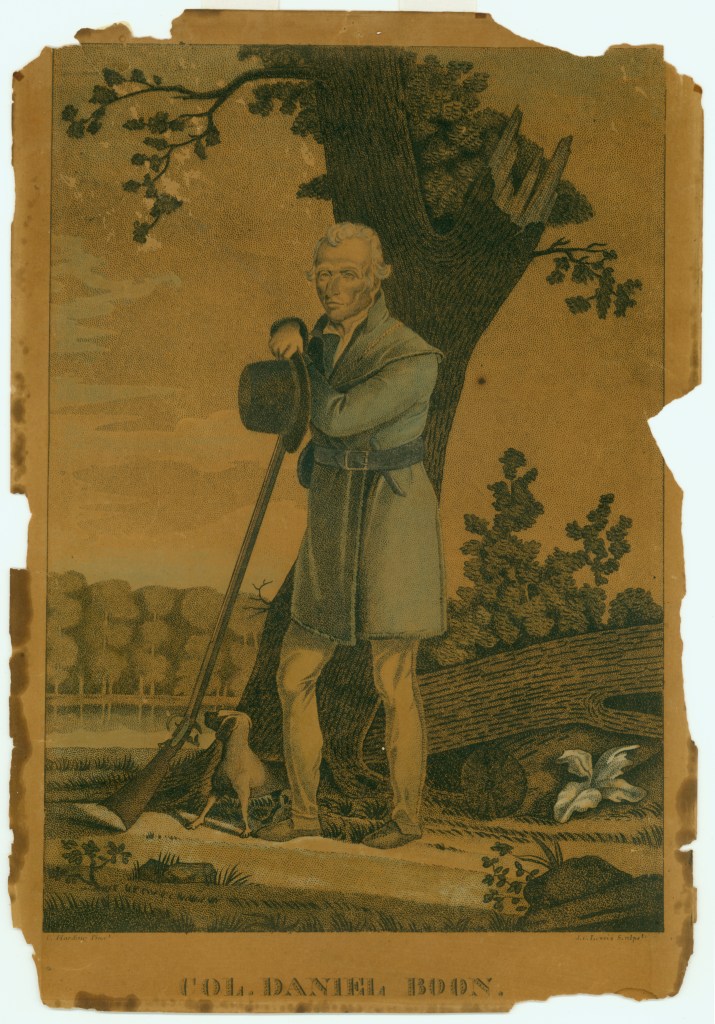
Due to its immense popularity, the early Americans developed a culture of use around the weapon. Boys learned to wield it when they were old enough to carry one, and shooting contests were popular. This carried on the old English traditions of martial culture stemming from the longbow in the Medieval Period, now beginning its passing to the American people of the Early Modern Age.
When social prestige is garnered through effective and innovative use of weapons, a culture thrives in its ability to survive and prosper. Then, just like the English Longbowmen, the stories of their combat effectiveness may serve as well as a deterrent against enemy aggression as any actual weapon. This reminds us of the numerous times where peace was had in Ancient Israel only following great success in battle (Judges 3:30, 1 Samuel 7:13-15, etc.).
Legacy Today
The American Long Rifle, whatever name it is known by, is now the official state rifle of Indiana, Kentucky, and Pennsylvania. In the Hoosier State, the “Grouseland Rifle,” a specific production of this weapon made by John Small, is actually the official state rifle. It is housed at the William Henry Harrison’s Grouseland museum in Vincennes, Indiana, right along the Wabash River.
The American Long Rifle, with its greater accuracy over the traditional musket, eventually saw it make the smoothbore weapon obsolete as breechloading decreased the time between shots. Nowadays, virtually every conventional firearm has a rifled barrel, excepting some shotguns still in use. The stabilization of the flight path by the twisting of the rifling provides unmatched precision. It was said to be baffling to those who witnessed it for the first time when muskets were still common. Now, I think it would be hard for many to imagine guns without it.

The novelty and ingenuity of rifling during the time of its inception reminds us to keep an open mind regarding innovations. Most new things may turn out to be silly notions or niche applications. However, it may be that someone’s strange idea is a revolutionary one that will soon take over the way the whole world does something. The difference between the two is found in testing each new thing by its own merits, seeing how well it does what it was meant to do, and how it compares to those things meant to perform the same task. With honest, objective assessment, we may just find the next “rifle” to our “muskets.”
All Pensive Warrior blog posts are licensed under a Creative Commons Attribution-NonCommercial-NoDerivatives 4.0 International License.


.%22_(Daniel_Boone).jpg)
.jpg)