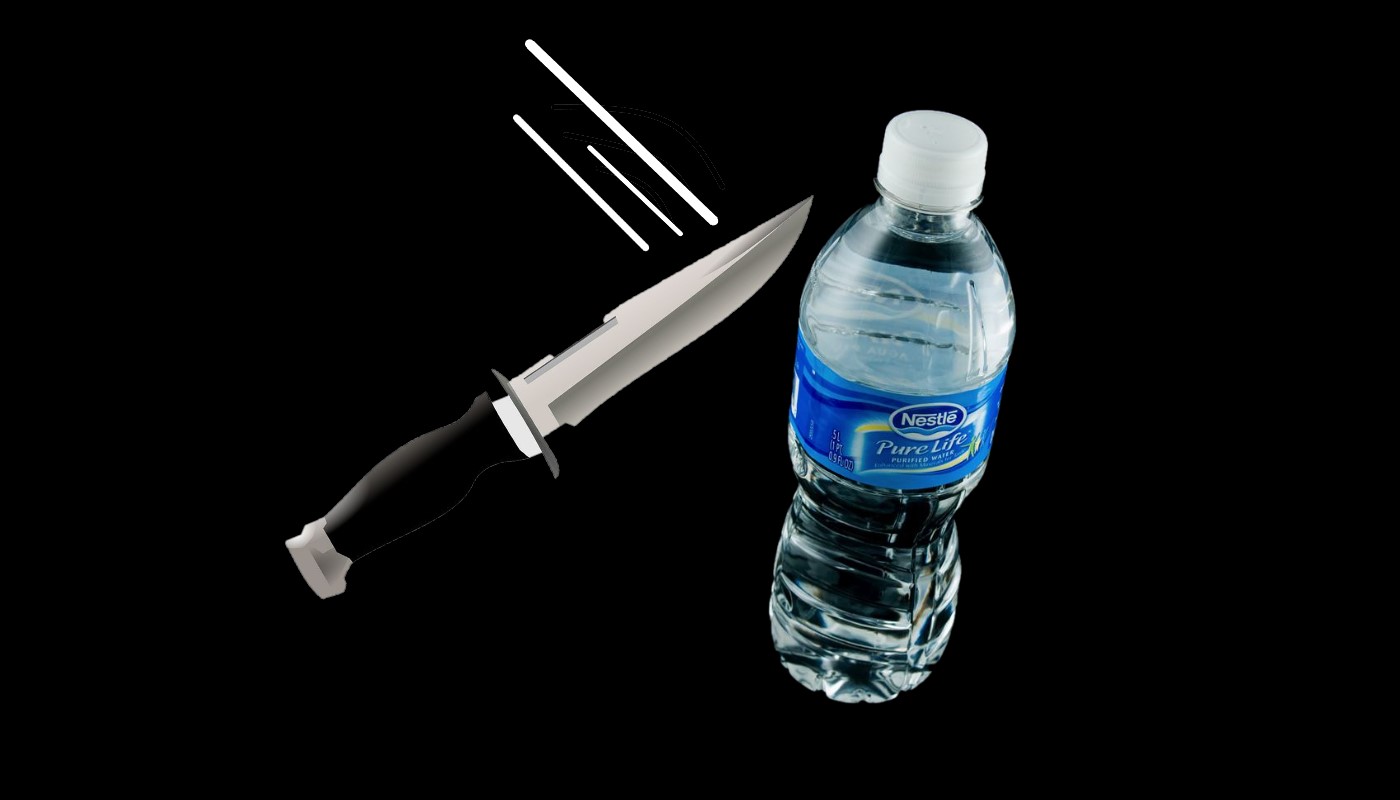
Recently, the uncomfortable weather of summer has subsided and the soothing touch of autumn has blown in over the land where I find myself. This brought me outside with comfort for the first time in many months. I took the opportunity to practice “edge alignment.” That is, my ability to keep the sharp edge of a blade in line with a target while cutting through it.

As you may know, an effective way to test and refine this is to cut into water bottles. If your edge alignment is poor, the bottle will explode spectacularly, spewing water everywhere. It will be knocked to the ground from whence you staged it, or swing to the side if it is suspended by cord. Lastly, the cuts will be jagged, and uneven across its surface.
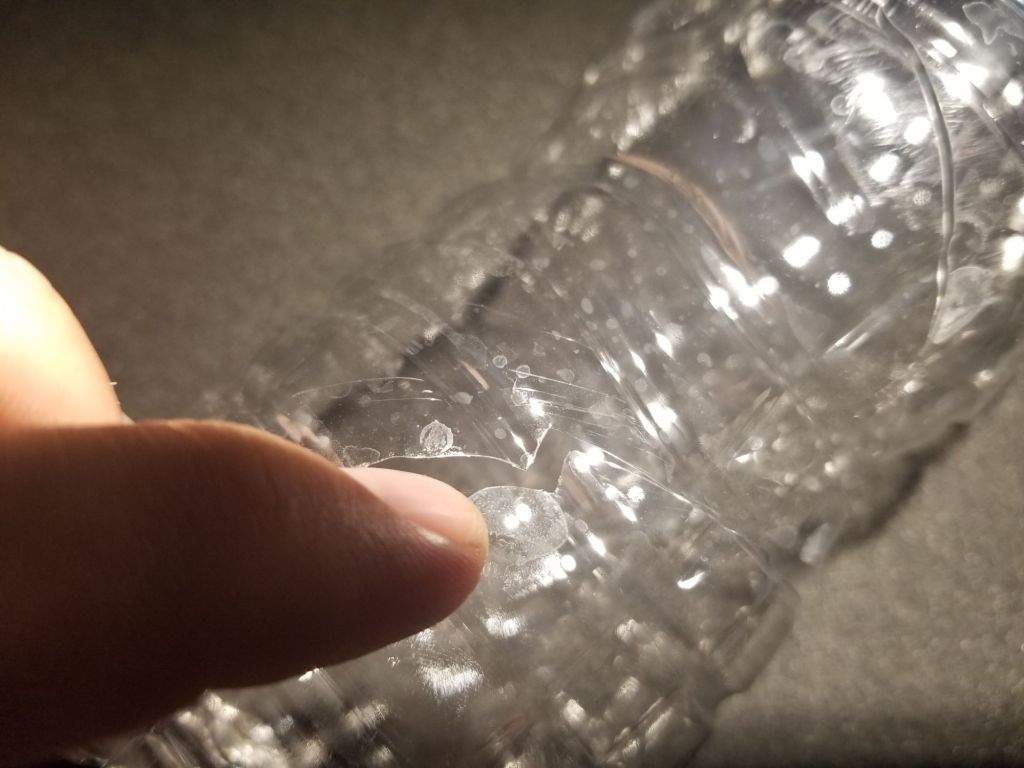
However, if you have good edge alignment, your blade passes through the bottle without disturbing it from its place, leaving a graceful cut from which water passes neatly through. A masterful cut moves through the water bottle almost as if nothing touched it at all, and the opening seems to appear like a magical seam has miraculously spawned. With such stark, visceral differences in the bottle’s reaction between good and bad edge alignment, it is a useful test of one’s ability in this regard.
Another bonus aspect is when you do make a poor cut, and the bottle explodes in your face, this presents a great opportunity to condition yourself not to flinch when fluids squirt out at you in the midst of battle. After the first poor cut that sent liquid straight at me, I flinched quite a bit. Less so with each instance, until I was not flinching at all by the end. This is important to train oneself to do, so that our attention is not taken off the enemy during combat – a fatal error which can cost innocent lives if allowed for even a moment.
The Test
Using a Mora Companion, I did 6 cuts. Of those, 2 were great, 1 was good, and 3 were bad. After that, I analyzed what I did differently on the good and bad cuts. I noticed that on all the bad cuts, I put a lot more power and strength behind the strikes. With the great cuts, I trusted in the sharpness of the blade to do the work, focusing on accuracy and speed.

This is common sense in retrospect. Everyone knows you don’t need to put a lot of power behind strikes with a sharp blade, and if you do, you risk compromising accuracy. In fact, I know that! Or at least, I do in my head.
However, as any with martial art, putting it into practice reduces us down to our level of training, forgoing much of what we know for what little we have actually trained. And, in my case, most of my hand-to-hand combat training up to that point was unarmed, where you actually do need to put a bit more power behind strikes. At least, more so than with a blade.
Having this in mind, I decided to try again. This time, I focused on speed and precision, trusting in the sharpness of the blade to compensate for the lack of power I put in. I did 3 more cuts, and this time, all of them were great.
Reflection
There are some important things I learned from this test. Firstly, filling the water bottles as much as possible helps to create pressure inside the bottle, simulating the closed circuit of fluids in the human body. Also, it helps to weigh the bottle down, keeping it in place if it is set atop something without being tied down. Secondly, the initial cut on the bottle seems to provide the most valuable feedback. Once the pressure is lost from the bottle being opened from the first cut, follow up strikes are arguably just for fun.
Lastly, and most importantly, you don’t need much power behind your strikes with a sharp blade. Precision and speed are much more important. Trust in the sharp edge. It will do the work. Any extra power you put behind your swings beyond what is necessary will hinder you, making you far less accurate and ruining your edge alignment. Logically, I knew that before this test. However, actually doing it and experiencing the result firsthand made a world of difference.
Do you have experience training edge alignment with a water bottle cut? If so, what insights do you have to share? Is there anything I missed that should be mentioned? Feel free to let me know.
All Pensive Warrior blog posts are licensed under a Creative Commons Attribution-NonCommercial-NoDerivatives 4.0 International License.
 The Pensive Warrior
Thank you for this incredible article on General Frank Howley’s key role in the Berlin Airlift I knew nothing about him. I want to cite your article in a book I am writing. Could you give me your name so that I can cite you properly.
LikeLike
Hi there. Thank you. I do remember that article and the story of Howley’s life. His efforts were most inspiring.
As for my name, it is “Louis Martinez.” You may certainly cite any articles on pensivewarrior.com.
LikeLike