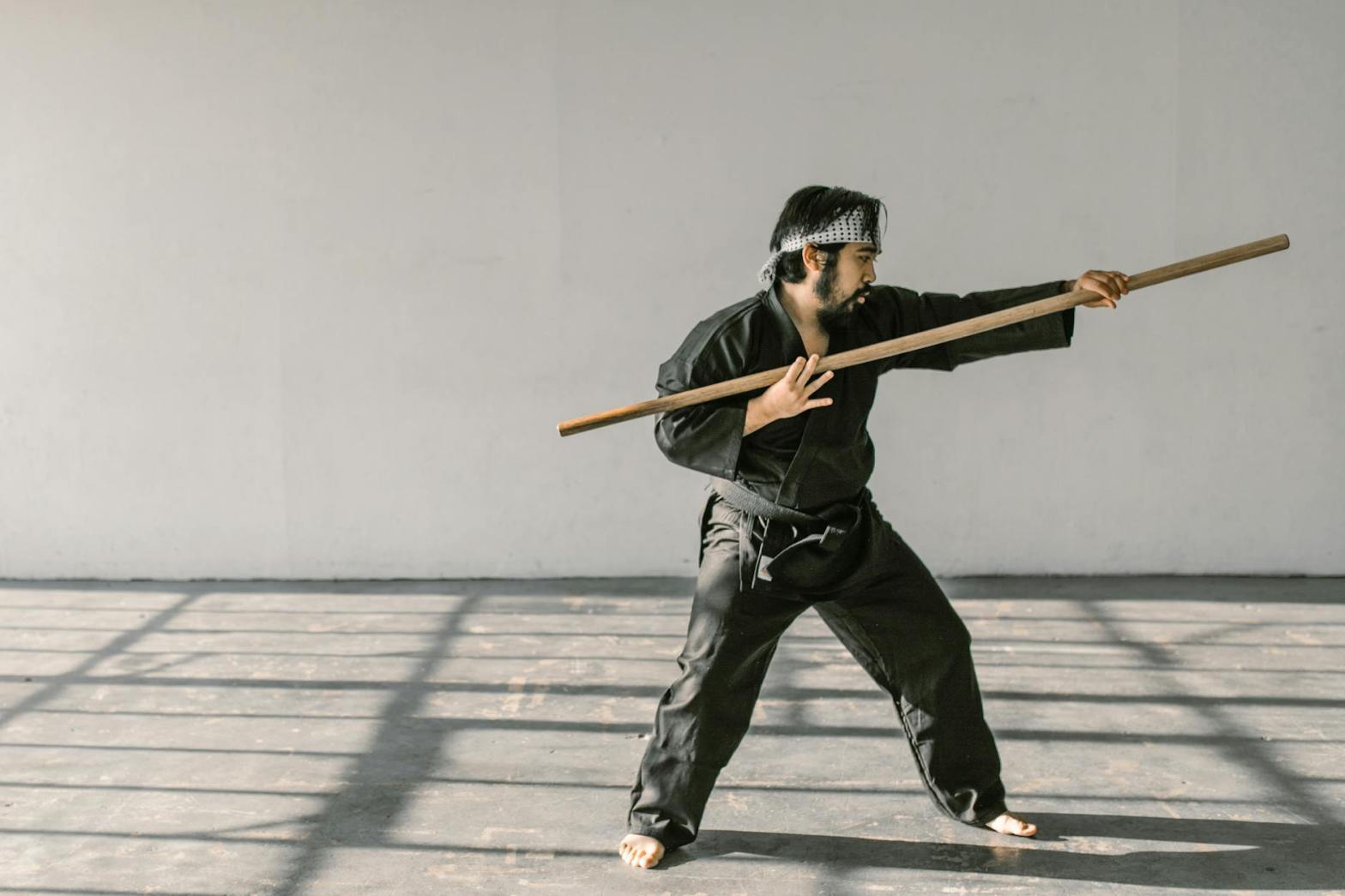
Oh, what could be a more memorable and foundational weapon than the staff? The sword, perhaps? Certainly none other.
Whether it be known as a rod, stick, baton, or by some other name, the staff is an ageless weapon, lodging itself across time and space. I recently started practicing with a collapsible baton, the modern implementation of this iconic weapon. The staff is so simple and effective as to find its way into the hands of martial artists everywhere, no matter when one looks about.
A Long & Storied History
Obviously, the staff is just a stick being used as a weapon. Therefore, it is impossible to claim anyone “invented” it at any particular time. The only thing one might say about its inception is that God brought it into existence when He created the world. Though, it would be some time in the course of recorded history before we can point to early manuscripts for the systematized use of the staff.
For example, the Combat Manuel of 1467 by Hans Talhoffer is one such book with instructions on the use of polearms. Obviously, this is a much later publication, almost up to the modern era. Royal Armouries Ms. I.33 from around the 1320s may be the oldest European manuscript on the usage of arms, though it does not depict any techniques using a staff or other pole weapon which I could see, displaying only the use of swords. I should note I was unable to read the text, so perhaps there is more to it than would seem to me.
Regarding manuals, obviously we have books from antiquity, but the systematic recording of martial instruction has come to be much more common in modern times. That is not to say ancient peoples never wrote down such things, though we are hard-pressed to find mass-produced copies of combat manuals.
Of course, the further back in history one looks, the harder it is to find evidence of anything. It was also more cumbersome to produce records in times past, and likely was often not done in the interest of time and effort. I am well aware of this as I type on a computer and upload my words to the Internet. Ancient peoples did not have such tools.
Yet, we still know of the staff’s use as a weapon in history, not just for utility or as a symbol of authority. In our English culture and tradition, a weaponized staff might more commonly be known as a “quarterstaff.” Ash wood was favorable in the West for its lightweight, yet durable nature. Learning its use was considered foundational for Western martial artists.
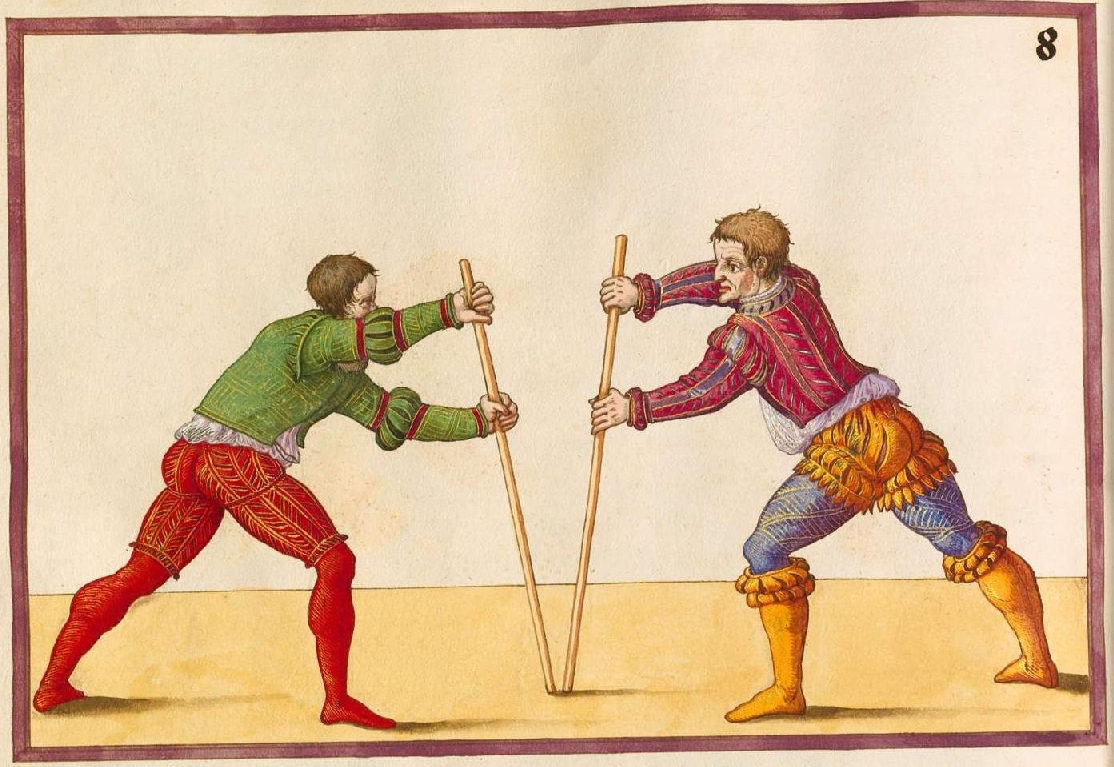
Image Source
A staff, being merely a stick, was easily produced and readily available. The forms for other pole weapons such as spears, halberds, and the like could be seen as extensions of the use of the staff. Due to its ubiquitous nature, competence in its use was a societal expectation, particularly among the early English.
This cultural aspect of an assumption of martial prowess with the weapon would later break off from the English in a way during the modern period, to be maintained by us Americans as part of our separation from the British people. And of course, firearms would supplant many older weapons during that transition. Yet, it is important to remember our history to appreciate where we are today and how we got here. I would also be remiss if I did not exhort the English to remember who they are and restore what they have lost.
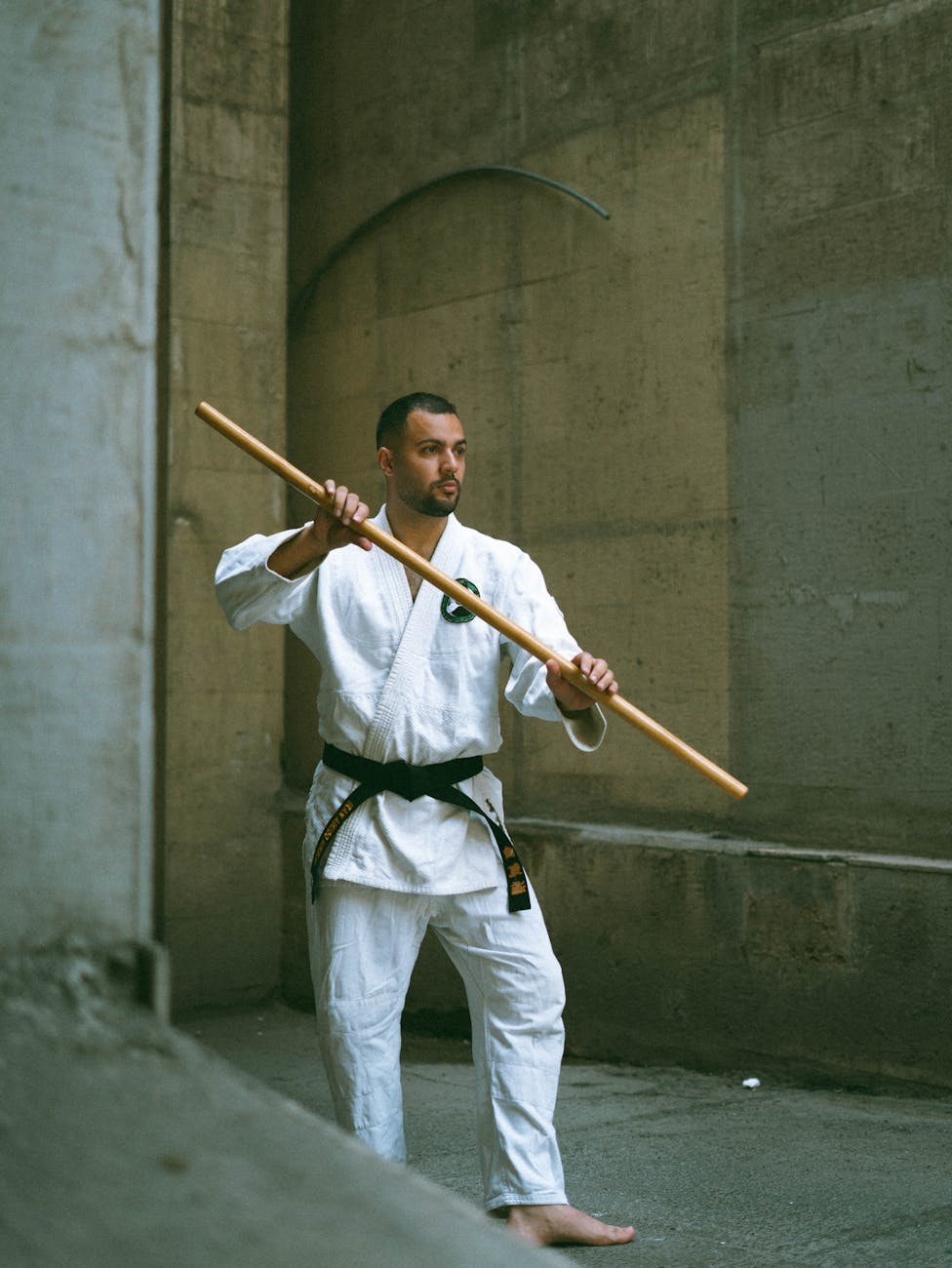
In the Far East, one might know such a weapon as a “bo staff.” Of course, “bo,” can potentially just mean “stick” or “staff” in Japanese. This is similar to how “katana” means “sword.” Other Asian languages would have their own variations of this term, but the Japanese may be the most prominent and influential among martial artists in the West, particularly Americans due to our close relationship with them. Thus, their term for the weapon is the one used here. A bo staff in Asia might commonly be made of bamboo, also popular for its sturdy and lightweight structure.
In the Far East, perhaps more so than other parts of the world, oppression and Lawlessness – in the Christian understanding – have prevailed, by and large, from antiquity to the modern era. As such, tyrannical restrictions on the keeping and bearing of arms are often noted as a reason for the prominence and usage of the staff in Asian cultures.
For example, if samurai or other agents of tyranny came to confiscate whatever they deemed a weapon, a staff could serve a dual purpose for fishing, carrying water, cooking, etc. This made it less likely to be taken away by any jackboot thugs in the East.
Notable Uses of the Staff
Perhaps the greatest advantage of the staff is its reach. It allows a warrior to strike a target from a greater distance than he could with just his hands. Of course, with its durability and leverage, a staff also allows for greater strikes than the body alone can perform.
The reach advantage is notably apparent when one modifies his staff with a blade attached to the end, turning it into a “spear.” Spears filled much the same role as the modern rifle across the ancient world, being cheap, effective, and too good to pass up.
A man named Richard Pike once claimed in a pamphlet he wrote in 1625 that he defeated three swordsman in a duel while armed with a staff. Such a feat seems incredible if true, no matter what reach advantage may be afforded by the staff. Perhaps his opponents were overcome with rage and unskilled. Nevertheless, such claims do make for inspiring boasts with the humble spear.
Historical martial artists and reenactors have long known of the advantages of spears over other weapons, particularly swords. This becomes especially apparent during group fights with multiple opponents on both sides. Long polearms such as a spear or staff afford teammates the ability to help one another by obstructing incoming attacks to their neighbors and reaching across to attack enemies over a wider area in ways that swords and other, shorter weapons simply cannot do.
An Enduring Legacy
As time progressed, humans used their ingenuity to enhance and refine the staff. This led to smaller versions of it, integrated with metal or other hard pieces. The truncheon could be considered such a development. Even in a world where guns were becoming prominent and pushing combat to further distances, much of the action still took place up close.
This was true a century ago, as it is today. No matter how far away guns allow combatants to engage, there is still a great deal of conflict that occurs right in our faces, close enough to grab the enemy with our bare hands. At those distances, projectile weapons may become a liability, lending to the continued relevance of the staff in one form of another.
Nowadays, it is much more common and practical for one who prefers a fighting stick to use a so-called “baton,” especially in light of telescoping versions which can be collapsed into a smaller size when not in use. In fact, “baton” literally means “staff used as a weapon.” Though in modern vernacular, one probably thinks of a baton as a short stick and a staff as a long stick, similar to the hard distinction between a “sword” and a “knife.”
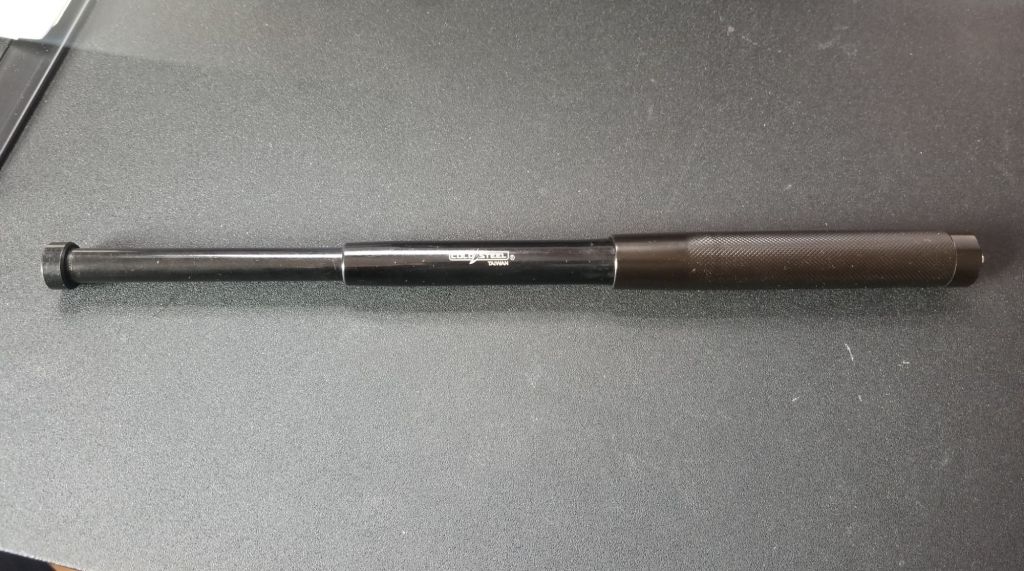
Hardened steel combined with telescoping capability makes the expandable baton a martial artist’s dream. It is portable and unobtrusive as a sidearm in its collapsed state, which is always nice and comfortable. It leans into our human desire for convenience and portability.
Also, when moving around unsavory types, such as those who would cause trouble when they become aware of the presence of weapons, the telescoping baton is more easily concealed to hide it from disruptive and prejudicial eyes. Yet, it still retains all of the effectiveness of older, static designs, if not more so with conventional construction materials.
Related Weapons
As touched upon with the sometimes dubious distinction between a “knife” versus a “sword,” the line between one thing and another can be difficult to draw. So it is when trying to delineate between different weapons related to, or evolutions of, the staff. Some have been mentioned here, others have not.
Is the mace an alteration of the staff? Arguably. Should the Irish tradition of the shillelagh be mentioned in an article discussing the staff? Probably. What is the fundamental difference between the staff and spear? Not much.
Such it is with iconic weapons. Yet, I felt inspired to write about the staff and extol its virtues. It is an elegant, simple, and profound weapon. I appreciate it very much. God be praised.
All Pensive Warrior blog posts are licensed under a Creative Commons Attribution-NonCommercial-NoDerivatives 4.0 International License.
 The Pensive Warrior