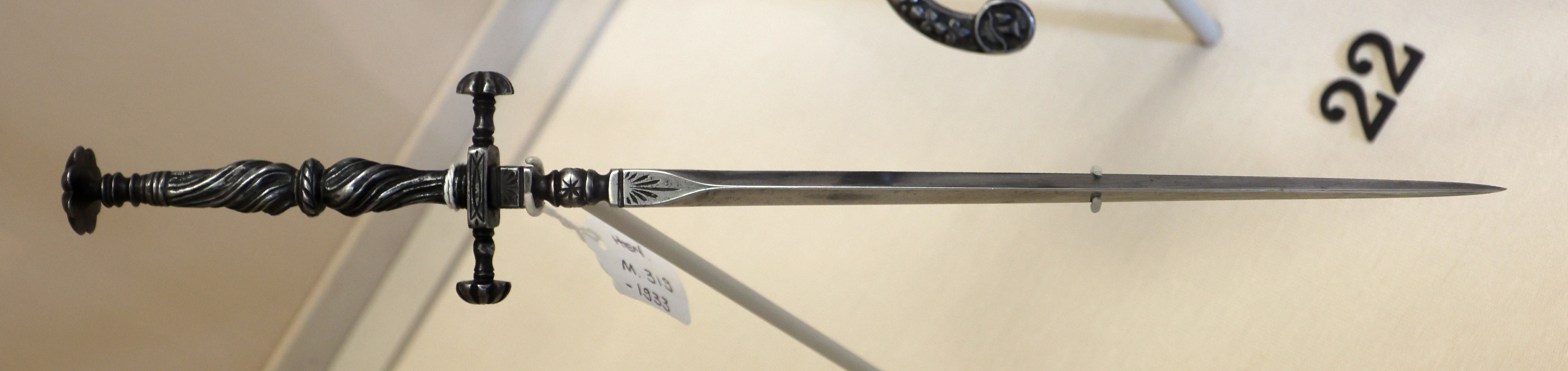
The stiletto is a classic weapon that may have evolved from the rondel dagger, or “dagger of mercy,” used by knights in the Middle Ages to penetrate armor and finish downed opponents. Thus, it seems to be somewhat of a scaled down version of a rondel dagger, often featuring an unsharpened blade that could be round or angular with multiple bevels. A cross-guard and hilt, along with the typically unsharpened blade, gave it incredible indexing on a draw and allowed for it to be held in a greater variety of grips than a sharpened blade. These weapons could be very ornate and decorative, as they could be used as a fashion piece as much as a weapon.
Of course, as with lots of pieces of historical weapons, we in the modern era have a tendency to impose terms and theories of development on these things which we often do not know the full story of. The stiletto may be one such weapon. Where did it really come from? Did it develop from the rondel dagger? Maybe. Maybe not. Also, how was it used? Again, there are things we can surmise from its design and what we can deduce, but that is also something which likely varied from user to user. One thing that is certain is the legacy which this iconic weapon has left in its wake.
Terminology & History
As for the term “stiletto,” it has seen widespread use. It is an Italian word which may be translated as “sharp rod” into English. In medieval fighting manuals, one can find reference to stilettos with images depicting a double-edged weapon looking similar to a Fairburn-Sykes dagger from the 20th Century. For example, Achille Marozzo does this in his treatise, Opera Nova in the section “Dueling, Unarmed vs. Dagger.” Therefore, the term “stiletto” should not be taken so strictly to refer only to the sleek, trimmed down version of a rondel dagger that is marketed as such by modern blade sellers. At least not if one cares about the etymology of the term.
However, most of us probably aren’t such sticklers for that sort of thing. Which is good, because you will see lots of products marketed with the term “stiletto” nowadays which have nothing to do with the classic weapon. From women’s shoes to switchblades, it is a catchy term which has become broadly applied.
Application/Usage
As anyone with a martial arts background would see from a quick glance at the weapon, the stiletto was a specialized thrusting blade. Like any dagger, it could be held in a forward or reverse grip. However, the design of the stiletto appears to allow it to excel with a modified forward grip where the guard is “fingered.” This means to put the index finger over the guard, onto the blade portion of the weapon rather than keeping all the fingers on the hilt. Such a grip would give great stability and discretion to the blade, as well as minimizing the torque on the wrist from thrusting. Many daggers prevent this due to the double-edged blade, but stilettos are iconic for lacking a sharpened edge. Instead, they opt for a multi-angular design such as a triangular or cube-shaped blade. One may describe it more like a tent peg than a traditional blade.
This multi-angular design would allow for great penetration with minimal resistance. Of course, the unsharpened edge would mean it lacked cutting capacity, although this is certainly not as much of a downside as one might think. After all, thrusts are what end fights with blades, with a rather large and powerful weapon being needed to incapacitate with a cut. Even if a stiletto did have a sharpened edge, it is unlikely it would be very combat-effective at cutting. That is not to say it wouldn’t be able to cut, just that cuts it could make would likely be too shallow to make a significant difference in a fight. Thus, specializing the weapon for maximum thrusting capability makes sense.
The main function of the stiletto would be to thrust through clothing and body tissue to reach vital organs inside the chest cavity such as the heart and lungs. With its design, it would excel at this purpose phenomenally. This kind of penetration would allow for quick incapacitation with minimal force needed. Given its petite design, it would also be comfortable to carry everyday without it getting in the way of performing other tasks. When traveling around untrustworthy types, it could also be easily concealed under one’s garments. As such, the stiletto would be a perfect sidearm before the age of automatic firearms, performing much the same function up close as a modern, semi-automatic pistol does from a distance.
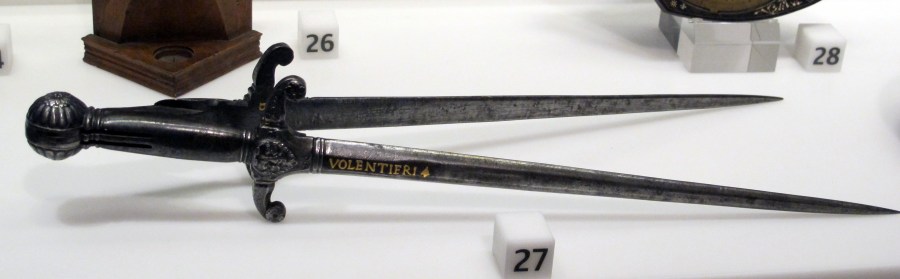
Also, just as people still love to modify and customize their sidearms today, so too was it with the classic stiletto. Many of these items seen in museums, reproduction markets, and historical artwork are ornate and fashionable. For many of us, the weapon one carries is as much a part of our outfit as any garment. That is true for me today, and held true for people of the past. Such was the case with stilettos.
The Weapon’s Legacy
This iconic weapon continues to inspire not only knives, but other implements to the present day. As mentioned, the term “stiletto” has never been exclusive to the iconic weapon we now know it as. The equally-classic, Fairburn-Sykes dagger from the Second World War was sometimes referred to as a stiletto. Going back, many stilettos were used by some soldiers in the First World War, and the FS dagger may have been an outgrowth from that. It should also be mentioned that old, triangle bayonets from the early modern period look remarkably like stilettos, only longer and made to be fixed to the barrel of a gun.

Of course, Italian knife makers still use the term stiletto in their marketing. Switchblades and other folding knives from Italy may be commonly termed as such, even though one might argue such blades bear little resemblance to the iconic weapon they take their namesake from. Many women are probably more familiar with the fashionable lady’s shoe bearing the name “stiletto” that sports a long, thin heel. Such items are a stark reminder of the word’s etymology and broad application. Almost any long, thin spike of varying application can be a “stiletto” in the literal sense.
As for me, I think I would be very comfortable carrying a stiletto as my bladed sidearm if I needed a replacement for my single-edged knife. It would require me to change up my knife fighting style to a purely thrust-centric approach. However, if needed, I could certainly do that and it would absolutely work. As mentioned, thrusts are what end fights, and cuts with a small-to-average-size knife are usually just for opening the enemy up to a thrust. A stiletto just gets straight to the point then, so to speak. You can’t go wrong with a pointy spike up close.
All Pensive Warrior blog posts are licensed under a Creative Commons Attribution-NonCommercial-NoDerivatives 4.0 International License.
 The Pensive Warrior