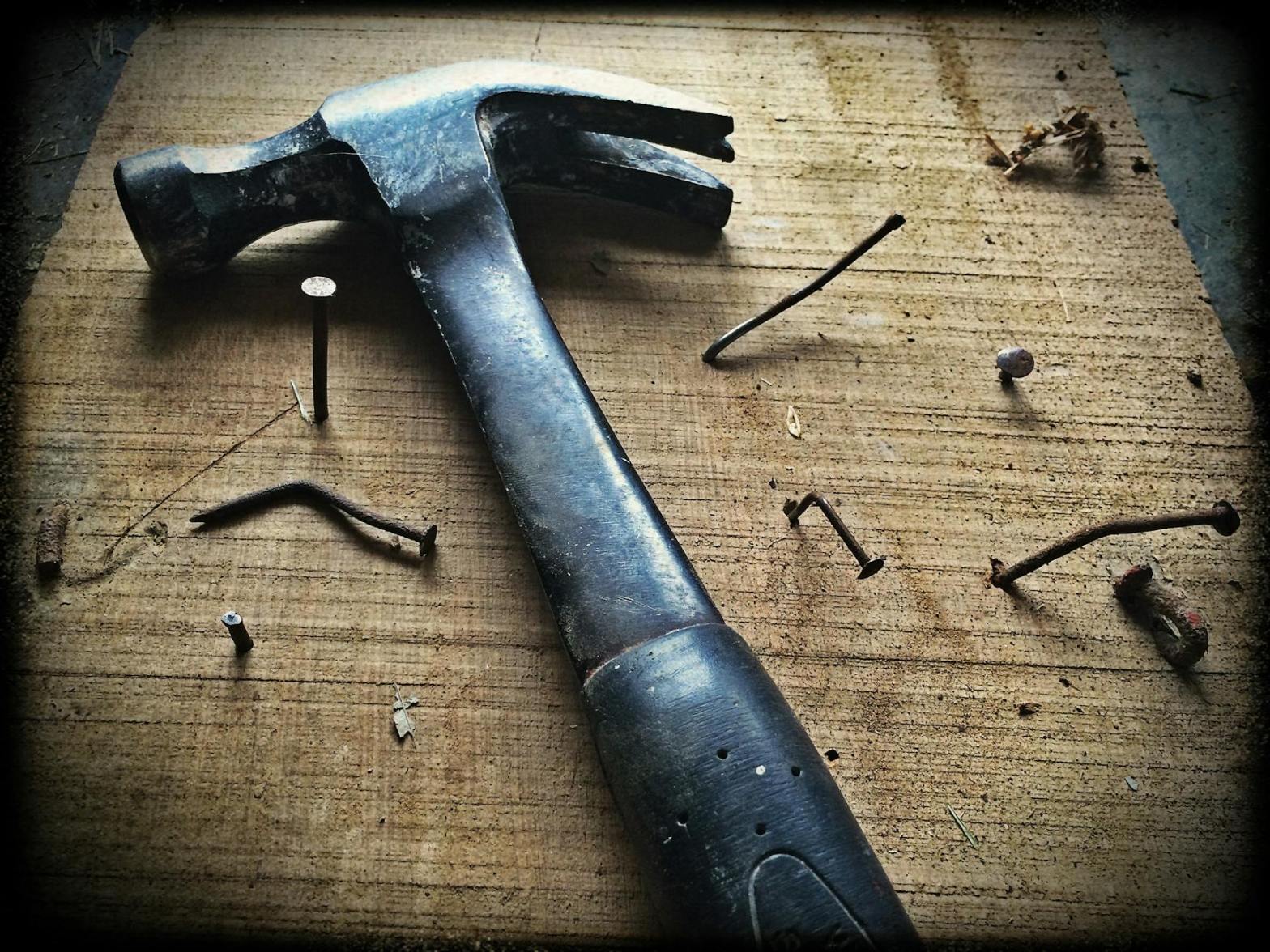
We’ve all heard the notion, “to a hammer, everything looks like a nail.” This is true when we have some charity and don’t scrutinize the statement. For those who don’t understand what this means, it is an idiom espousing the idea that if you are only familiar with one tool, then you will find excuses to use that tool all the time. This includes scenarios in which it would be inappropriate to use said tool. In so doing, some kind of damage is caused, as happens when one uses a hammer on things that are not nails. A hammer applied in any way other than driving a nail is destructive, and when pursuing any intended outcome other than a destructive one, using a hammer as such is counterproductive.
This is of course notwithstanding situations where one is using a hammer as a weapon and the intended outcome is the destruction of the opponent. In such a case, obviously that destructive end is productive. However, the original idiom assumes for the sake of argument that we are talking about an ordinary construction hammer used for driving and pulling nails. With this assumption accepted, the notion espoused by the original idiom withstands scrutiny and can be said to be true. No analogy, metaphor, or other figure of speech is perfect. Analogies and the like can be tortured beyond their original context to defeat the meaning, but we must have charity and not do so when assessing such things.
With that said, let us modify the original statement to make it more defensible and true. “When all you have; know how to use; or are willing to use is a hammer, everything will tend to appear as a nail.” Obviously, this doesn’t roll off the tongue quite as smooth as the original phrase, but it does remove the holes in it that a critic could poke. Now, we can move onto the inverse notion derived from the acceptance of this original idea.
If A=B, then B=A
Of course, if something is true, then the inverse of it should also be true. That brings up the notion of “when you don’t have a hammer, nothing looks like a nail.” This is a quote I recently read from the Facebook page The New Christian Intellectual. I do not know, nor am I associated with the administrator of this page; but he seems an intelligent Christian fellow, and I would recommend his content. As for his statement, it is true that when you don’t have or know how to use a metaphorical hammer, then nothing would appear to you as a metaphorical nail. What is meant by this?
It means the same thing as the old adage. That is, it is a commentary on the importance of having and knowing how to use the right tool for the job. However, the inverse of the old adage may be more useful nowadays, especially in the realm of polemics, as the saying that “to a hammer, everything looks like a nail” can be commonly misused. In the modern vernacular, I have certainly noticed in media and common speech the use of this old adage to disparage those using a stern or forceful approach to something, or to insinuate the person adopts such an approach too much.
While this may be true of some individuals somewhere at some times, it can take the old adage into a slightly different context which can have dramatic effects on our modern lexicon and the ideas people presuppose. After all, the notion that “to a hammer, everything looks like a nail” can be refuted by noting that no it does not necessarily. To a metaphorical hammer that knows itself and what it is not, and as one who knows a metaphorical screwdriver and what it used for, this anthropomorphic being might very well recognize the difference between nails and other things; and when dealing with other things, go about enlisting other anthropomorphic tools to help deal with them.
If the aforementioned refutation holds true, then not only does it shatter the literal notion of the old adage – which admittedly was not meant to be taken literally, but may be by those extending it beyond its original intent – but it also refutes those who would take the notion out of context to use it as a disparaging saying. Why would one want to refute such instances? Because clear meanings in the use of our language are important. It helps prevent semantic confusion, revisionism, and other problematic things that can inhibit social stability.
The phrase “to a hammer, everything looks like a nail” can be used maliciously to disparage someone who is using a stern or forceful approach where one is necessary, especially in the minds of people who are not privy to all the history or context of a situation. Also, it is just plain courteous to use language clearly and appropriately, and this is especially so when using phrases that hinge on metaphors like anthropomorphic hammers.
Being Prepared Goes A Long Way
All this discussion does remind me a bit of the story of David and Goliath in 1 Samuel 17. In this retelling of events, we notice a few things. David is a shepherd in the traditional sense. Shepherds were often well trained as warriors since they would be the first line of defense on the outskirts of society, protecting people and livestock from both hostile wildlife and foreign incursions. David was no exception in this regard, as he notes to King Saul that he has wrestled against large animals such as lions and prevailed. Few humans throughout history can claim such a feat, so David is already established here as one of the most skilled warriors in the history of the entire world.
While that would be impressive enough, we see that David is also capable of wielding a sling. This is an ancient projectile weapon that would launch stones with about the equivalent force of modern pistol calibers. A sling also took an incredible amount of skill to use, further demonstrating David’s high level of training.
There are two important points to notice from this story. Firstly, we are made aware that David could probably beat Goliath in a melee (as indicated by his comments about lions), yet he opts to slay the giant with a projectile weapon. This shows that David fights smarter, rather than harder. He chooses the best tool for the job and uses it well.
The second point to note is that no one else thought to do something similar. Certainly David was not the only warrior in Israel capable of shooting Goliath with a sling. However, it seems he is the only one to whom it occurs to do this. Why is that? I can only speculate, of course. However, I would posit that maybe since Goliath was challenging everyone with spears and javelins, people just assumed they would need to respond with similar weapons. Again, that is speculation, but it does account for the astonishingly simplistic solution David applies and why no one else did so earlier.
The obvious spiritual answer to the aforementioned question may be that, as the text states in verse 11 of chapter 17, the Israelites were dismayed and terrified. Perhaps this was a supernatural effect of sorts that David was immune to from his anointing earlier in 1 Samuel 16. Again, this is speculation. I cannot be certain of the answers to questions regarding “why” such things happened the way they did. We only have the account of the events themselves and must draw conclusions from them as diligently as we are able in light of the whole of Scripture.
Conclusion
The point in everything discussed herein, succinctly stated, is this: “not only is it important to have the right tool for the job, but also to be familiar with a variety of conventional tools and have them available for when said tools need to be applied.” Doing so not only allows us to be prepared to accomplish things we otherwise would not have, but also enables us to work, fight, and love smarter rather than harder. After all, a hammer may be the best tool for driving nails, but other things can do it too.
The most important thing is to have the tools necessary and to both know how to use them when the time arises, as well as the willingness to do so. You do not want to be the person stuck with a nail and no way to drive it into wood when the time comes. Likewise, when the giant shows up, you want to be the one willing and able to shoot him in the face rather than the horde of cowards who did nothing for one reason or another as civilization remained in peril.
The Pensive Warrior posts are licensed under a Creative Commons Attribution-NonCommercial-NoDerivatives 4.0 International License.
 The Pensive Warrior